
头颈部鳞状细胞癌中的免疫检查点抑制剂:3期临床试验的系统评价
Immune checkpoint inhibitors in head and neck squamous cell carcinoma: A systematic review of phase-3 clinical trials.
作者信息
Poulose Jissy Vijo, Kainickal Cessal Thommachan
机构信息
National Fellowship in Palliative Medicine (Training Program), Institute of Palliative Medicine, Calicut 673008, Kerala, India.
Department of Radiation Oncology, Regional Cancer Centre, Thiruvananthapuram 695011, Kerala, India.
出版信息
World J Clin Oncol. 2022 May 24;13(5):388-411. doi: 10.5306/wjco.v13.i5.388.
BACKGROUND
The outcomes of patients diagnosed with head and neck squamous cell carcinoma (HNSCC) who are not candidates for local salvage therapy and of those diagnosed with recurrent or metastatic disease are dismal. A relatively new systemic therapy option that emerged in recent years in the treatment of advanced HNSCC is immunotherapy using immune checkpoint inhibitors (ICIs). The safety profile and anti-tumor activity of these agents demonstrated in early phase clinical trials paved the way to the initiation of several promising phase-3 trials in the field.
AIM
To evaluate the evidence on the effectiveness of ICIs in HNSCC, based on published phase-3 clinical trials.
METHODS
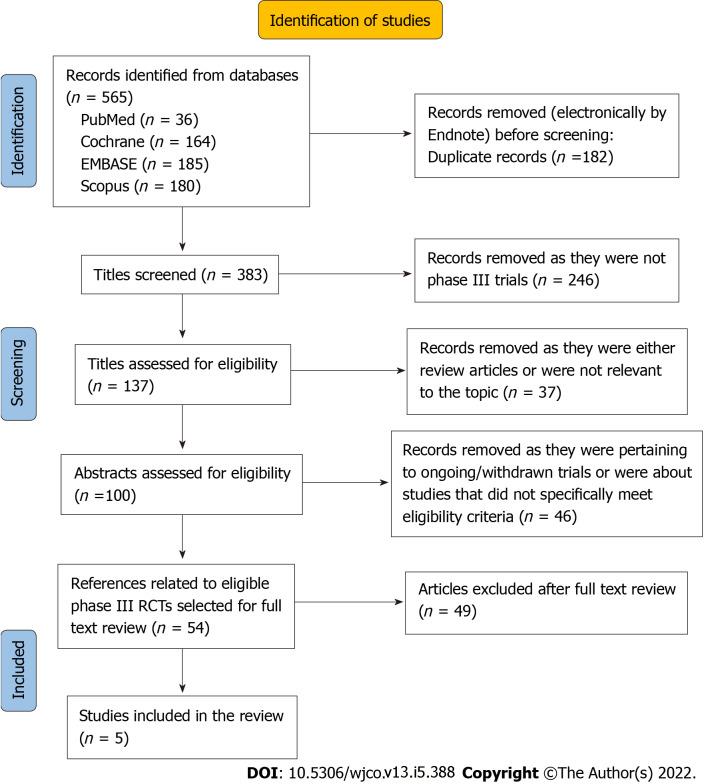
We searched PubMed, Cochrane Library, Embase, and Scopus to identify published literature evaluating immunotherapy using ICIs in recurrent or metastatic HNSCC (R/M HNSCC) and locally advanced head and neck squamous cell carcinoma (LAHNSCC). We used a combination of standardized search terms and keywords including head and neck squamous cell carcinoma, recurrent, metastatic, locally advanced, immunotherapy, immune checkpoint inhibitors, monoclonal antibodies, programmed cell death protein-1 (PD-1), programmed death-ligand 1 (PD-L1), cytotoxic T- lymphocyte associated protein-4 (CTLA-4), and phase-3 clinical trial. A sensitive search filter was used to limit our results to randomized controlled trials.
RESULTS
Five phase-3 clinical trials have reported the data on the effectiveness of immunotherapy in HNSCC so far: Four in R/M HNSCC and one in LAHNSCC. In patients with R/M HNSCC, anti-PD-1 agents nivolumab and pembrolizumab demonstrated improved survival benefits in the second-line treatment setting compared to the standard of care (standard single-agent systemic therapy). While the net gain in overall survival (OS) with nivolumab was 2.4 mo [hazard ratio (HR) = 0.69, = 0.01], that with pembrolizumab was 1.5 mo (HR = 0.80 nominal = 0.0161). The anti-PD-L1 agent durvalumab with or without the anti-cytotoxic T- lymphocyte associated protein-4 agent tremelimumab did not result in any beneficial outcomes. In the first-line setting, in R/M HNSCC, pembrolizumab plus platinum-based chemotherapy resulted in significant improvement in survival with a net gain in OS of 2.3 mo (HR = 0.77, = 0.0034) in the overall population and a net gain in OS of 4.2 mo in the PD-L1 positive (combined positive score > 20) population compared to standard of care (EXTREME regime). In patients with PD-L1 positive R/M HNSCC, monotherapy with pembrolizumab also demonstrated statistically significant improvement in survival compared to EXTREME. In LAHNSCC, immunotherapy using avelumab (an anti-PD-L1 agent) along with standard chemoradiation therapy did not result in improved outcomes compared to placebo plus chemoradiation therapy.
CONCLUSION
Anti-PD-1 agents provide survival benefits in R/M HNSCC in the first and second-line settings, with acceptable toxicity profiles compared to standard therapy. There is no proven efficacy in the curative setting to date.
背景
对于那些不适合接受局部挽救性治疗的头颈部鳞状细胞癌(HNSCC)患者以及那些被诊断为复发或转移性疾病的患者,其治疗结果令人沮丧。近年来,在晚期HNSCC治疗中出现的一种相对较新的全身治疗选择是使用免疫检查点抑制剂(ICI)进行免疫治疗。这些药物在早期临床试验中所展示的安全性和抗肿瘤活性为该领域启动多项有前景的3期试验铺平了道路。
目的
基于已发表的3期临床试验,评估ICI在HNSCC中的有效性证据。
方法
我们检索了PubMed、Cochrane图书馆、Embase和Scopus,以识别评估在复发或转移性HNSCC(R/M HNSCC)和局部晚期头颈部鳞状细胞癌(LAHNSCC)中使用ICI进行免疫治疗的已发表文献。我们使用了包括头颈部鳞状细胞癌、复发、转移、局部晚期、免疫治疗、免疫检查点抑制剂、单克隆抗体、程序性细胞死亡蛋白1(PD-1)、程序性死亡配体1(PD-L1)、细胞毒性T淋巴细胞相关蛋白4(CTLA-4)和3期临床试验在内的标准化检索词和关键词的组合。使用了一个敏感的检索过滤器将我们的结果限制为随机对照试验。
结果
到目前为止,五项3期临床试验报告了免疫治疗在HNSCC中的有效性数据:四项针对R/M HNSCC,一项针对LAHNSCC。在R/M HNSCC患者中,抗PD-1药物纳武单抗和帕博利珠单抗在二线治疗中与标准治疗(标准单药全身治疗)相比,显示出改善的生存获益。纳武单抗的总生存期(OS)净增益为2.4个月[风险比(HR)=0.69,P=0.01],帕博利珠单抗的为1.5个月(HR=0.80,名义P=0.0161)。抗PD-L1药物度伐鲁单抗联合或不联合抗细胞毒性T淋巴细胞相关蛋白4药物曲美木单抗均未产生任何有益结果。在一线治疗中,在R/M HNSCC中,帕博利珠单抗联合铂类化疗导致生存显著改善,总体人群的OS净增益为2.3个月(HR=0.77,P=0.0034),与标准治疗(EXTREME方案)相比,PD-L1阳性(联合阳性评分>20)人群的OS净增益为4.2个月。在PD-L1阳性的R/M HNSCC患者中,与EXTREME相比,帕博利珠单抗单药治疗也显示出生存的统计学显著改善。在LAHNSCC中,与安慰剂加放化疗相比,使用阿维鲁单抗(一种抗PD-L1药物)联合标准放化疗的免疫治疗未产生改善的结果。
结论
抗PD-1药物在R/M HNSCC的一线和二线治疗中提供生存获益,与标准治疗相比,毒性特征可接受。迄今为止,在根治性治疗中尚未证实其疗效。
 Zotero 插件