
自动化全切片图像评估切除的非小细胞肺癌中的免疫浸润:实现更好的风险分层。
Automated whole-slide images assessment of immune infiltration in resected non-small-cell lung cancer: towards better risk-stratification.
机构信息
School of Medicine, South China University of Technology, Guangzhou, 510006, China.
Department of Radiology, Guangdong Provincial People's Hospital, Guangdong Academy of Medical Sciences, Guangzhou, 510080, China.
出版信息
J Transl Med. 2022 Jun 7;20(1):261. doi: 10.1186/s12967-022-03458-9.
BACKGROUND
High immune infiltration is associated with favourable prognosis in patients with non-small-cell lung cancer (NSCLC), but an automated workflow for characterizing immune infiltration, with high validity and reliability, remains to be developed.
METHODS
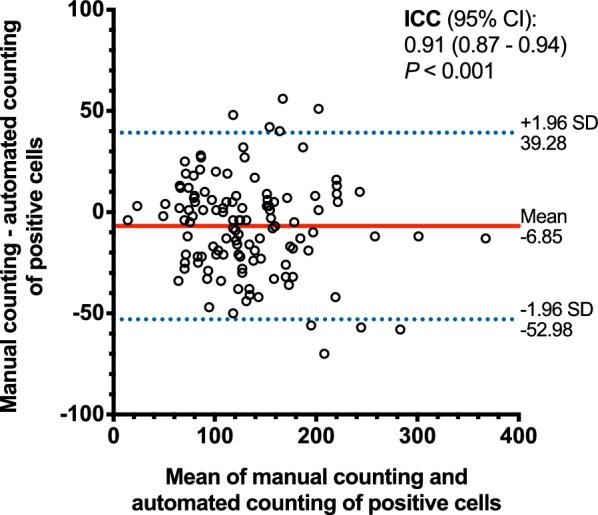
We performed a multicentre retrospective study of patients with completely resected NSCLC. We developed an image analysis workflow for automatically evaluating the density of CD3 and CD8 T-cells in the tumour regions on immunohistochemistry (IHC)-stained whole-slide images (WSIs), and proposed an immune scoring system "I-score" based on the automated assessed cell density.
RESULTS
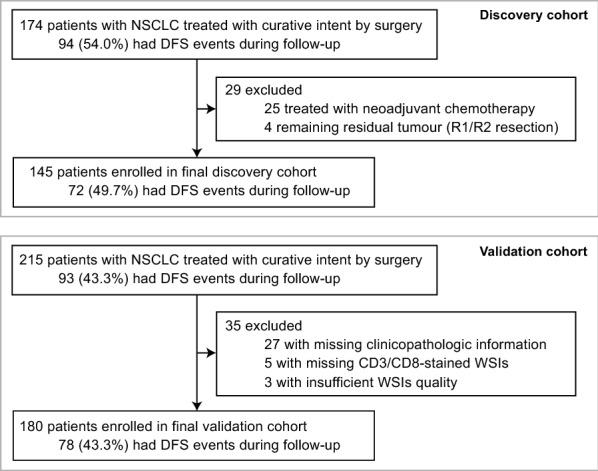
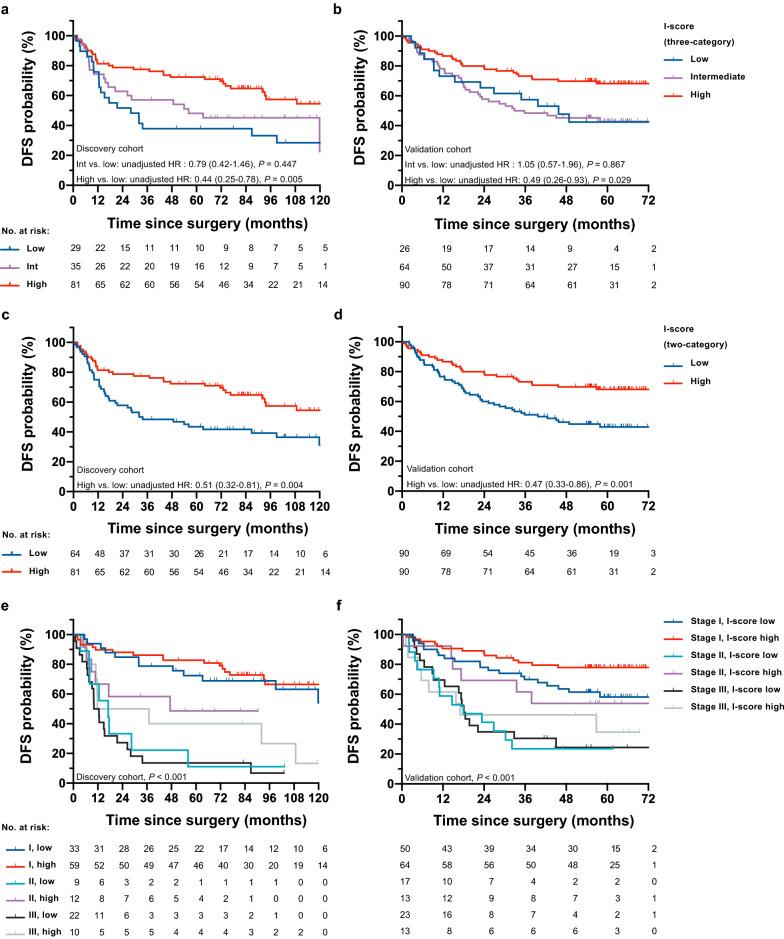
A discovery cohort (n = 145) and a validation cohort (n = 180) were used to assess the prognostic value of the I-score for disease-free survival (DFS). The I-score (two-category) was an independent prognostic factor after adjusting for other clinicopathologic factors. Compared with a low I-score (two-category), a high I-score was associated with significantly superior DFS in the discovery cohort (adjusted hazard ratio [HR], 0.54; 95% confidence interval [CI] 0.33-0.86; P = 0.010) and validation cohort (adjusted HR, 0.57; 95% CI 0.36-0.92; P = 0.022). The I-score improved the prognostic stratification when integrating it into the Cox proportional hazard regression models with other risk factors (discovery cohort, C-index 0.742 vs. 0.728; validation cohort, C-index 0.695 vs. 0.685).
CONCLUSION
This automated workflow and immune scoring system would advance the clinical application of immune microenvironment evaluation and support the clinical decision making for patients with resected NSCLC.
背景
高免疫浸润与非小细胞肺癌(NSCLC)患者的预后良好相关,但仍需要开发一种具有高有效性和可靠性的自动化工作流程来对免疫浸润进行特征描述。
方法
我们对完全切除的 NSCLC 患者进行了一项多中心回顾性研究。我们开发了一种图像分析工作流程,用于自动评估免疫组织化学(IHC)染色的全切片图像(WSI)中肿瘤区域内 CD3 和 CD8 T 细胞的密度,并提出了一种基于自动评估细胞密度的免疫评分系统“IScore”。
结果
我们使用发现队列(n=145)和验证队列(n=180)评估了 I-score 对无病生存期(DFS)的预后价值。在调整其他临床病理因素后,I-score(两分类)是一个独立的预后因素。与低 I-score(两分类)相比,高 I-score 与发现队列(调整后的危险比 [HR],0.54;95%置信区间 [CI] 0.33-0.86;P=0.010)和验证队列(调整后的 HR,0.57;95%CI 0.36-0.92;P=0.022)显著的DFS 相关。当将其与其他危险因素纳入 Cox 比例风险回归模型时,I-score 改善了预后分层(发现队列,C 指数 0.742 与 0.728;验证队列,C 指数 0.695 与 0.685)。
结论
该自动化工作流程和免疫评分系统将推进免疫微环境评估的临床应用,并支持对接受 NSCLC 切除术的患者的临床决策。


 Zotero 插件