
肠道和免疫系统中三种增殖途径(Wnt、Notch和Hippo)概述及其在炎症性肠病(IBD)中的作用
Overview of Three Proliferation Pathways (Wnt, Notch, and Hippo) in Intestine and Immune System and Their Role in Inflammatory Bowel Diseases (IBDs).
作者信息
Khoramjoo Seyed Mobin, Kazemifard Nesa, Baradaran Ghavami Shaghayegh, Farmani Maryam, Shahrokh Shabnam, Asadzadeh Aghdaei Hamid, Sherkat Ghazal, Zali Mohammad Reza
机构信息
Basic and Molecular Epidemiology of Gastrointestinal Disorders Research Center, Research Institute for Gastroenterology and Liver Diseases, Shahid Beheshti University of Medical Sciences, Tehran, Iran.
Gastroenterology and Liver Diseases Research Center, Research Institute for Gastroenterology and Liver Diseases, Shahid Beheshti University of Medical Sciences, Tehran, Iran.
出版信息
Front Med (Lausanne). 2022 May 23;9:865131. doi: 10.3389/fmed.2022.865131. eCollection 2022.
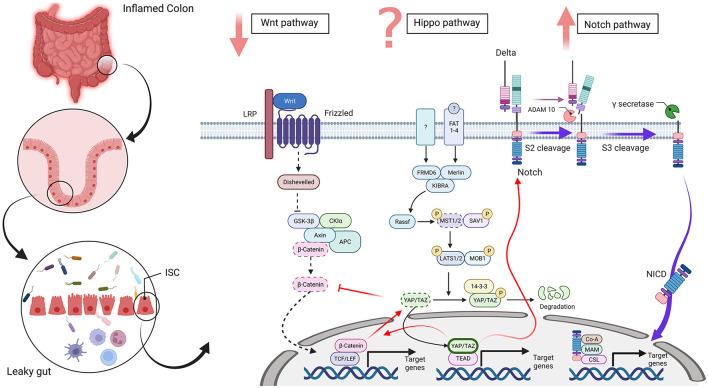
Inflammatory bowel disease (IBD) is a disorder, which involves the gastrointestinal (GI) tract consisting Crohn's disease (CD) and ulcerative colitis (UC). The etiology of this disease is not yet clear and, hence, there are numerous medications and treatments for patients with IBD, although a definite and permanent treatment is still missing. Therefore, finding novel therapeutic approaches are vital for curing patients with IBD. In the GI tract, there are various lineages of cells with different roles that their existence is necessary for the barrier function of intestinal epithelial cells (IECs). Therefore, signaling pathways, which manage the hemostasis of cell lineages in intestine, such as Wnt, Notch, and Hippo, could have crucial roles in regulation of barrier function in the intestine. Additionally, these signaling pathways function as a governor of cell growth, tissue homeostasis, and organ size. In patients with IBD, recent studies have revealed that these signaling pathways are dysregulated that it could result in depletion or excess of a cell lineage in the intestine. Moreover, dysregulation of these signaling pathways in different cell lineages of the immune system could lead to dysregulation of the immune system's responses in IBD. In this article, we summarized the components and signaling of Wnt, Notch, and Hippo pathways and their role in the intestine and immune system. Furthermore, we reviewed latest scientific literature on the crosstalk among these three signaling pathways in IBD. An overview of these three signaling pathways and their interactions in IBD could provide a novel insight for prospective study directions into finding efficient medications or treatments.
炎症性肠病(IBD)是一种涉及胃肠道(GI)的疾病,包括克罗恩病(CD)和溃疡性结肠炎(UC)。这种疾病的病因尚不清楚,因此,尽管仍缺乏明确且持久的治疗方法,但针对IBD患者有多种药物和治疗手段。所以,寻找新的治疗方法对于治愈IBD患者至关重要。在胃肠道中,存在各种具有不同作用的细胞谱系,它们的存在对于肠道上皮细胞(IECs)的屏障功能是必需的。因此,调控肠道细胞谱系稳态的信号通路,如Wnt、Notch和Hippo,可能在调节肠道屏障功能中起关键作用。此外,这些信号通路还起着细胞生长、组织稳态和器官大小调节者的作用。在IBD患者中,最近的研究表明这些信号通路失调,这可能导致肠道中某种细胞谱系的减少或过多。而且,这些信号通路在免疫系统不同细胞谱系中的失调可能导致IBD中免疫系统反应的失调。在本文中,我们总结了Wnt、Notch和Hippo通路的组成和信号传导及其在肠道和免疫系统中的作用。此外,我们回顾了关于IBD中这三种信号通路相互作用的最新科学文献。对这三种信号通路及其在IBD中的相互作用进行概述,可为寻找有效药物或治疗方法的前瞻性研究方向提供新的见解。
 Zotero 插件