
在患有骨肉瘤或黑色素瘤自然发生肺转移的狗中吸入重组人白细胞介素 15:临床活性和反应相关性的 1 期研究。
Inhaled recombinant human IL-15 in dogs with naturally occurring pulmonary metastases from osteosarcoma or melanoma: a phase 1 study of clinical activity and correlates of response.
机构信息
Department of Surgical and Radiological Sciences, University of California, Davis, California, USA
Department of Surgical and Radiological Sciences, University of California, Davis, California, USA.
出版信息
J Immunother Cancer. 2022 Jun;10(6). doi: 10.1136/jitc-2022-004493.
PURPOSE
Although recombinant human interleukin-15 (rhIL-15) has generated much excitement as an immunotherapeutic agent for cancer, activity in human clinical trials has been modest to date, in part due to the risks of toxicity with significant dose escalation. Since pulmonary metastases are a major site of distant failure in human and dog cancers, we sought to investigate inhaled rhIL-15 in dogs with naturally occurring lung metastases from osteosarcoma (OSA) or melanoma. We hypothesized a favorable benefit/risk profile given the concentrated delivery to the lungs with decreased systemic exposure.
EXPERIMENTAL DESIGN
We performed a phase I trial of inhaled rhIL-15 in dogs with gross pulmonary metastases using a traditional 3+3 cohort design. A starting dose of 10 µg twice daily × 14 days was used based on human, non-human primate, and murine studies. Safety, dose-limiting toxicities (DLT), and maximum tolerated dose (MTD) were the primary objectives, while response rates, progression-free and overall survival (OS), and pharmacokinetic and immune correlative analyses were secondary.
RESULTS
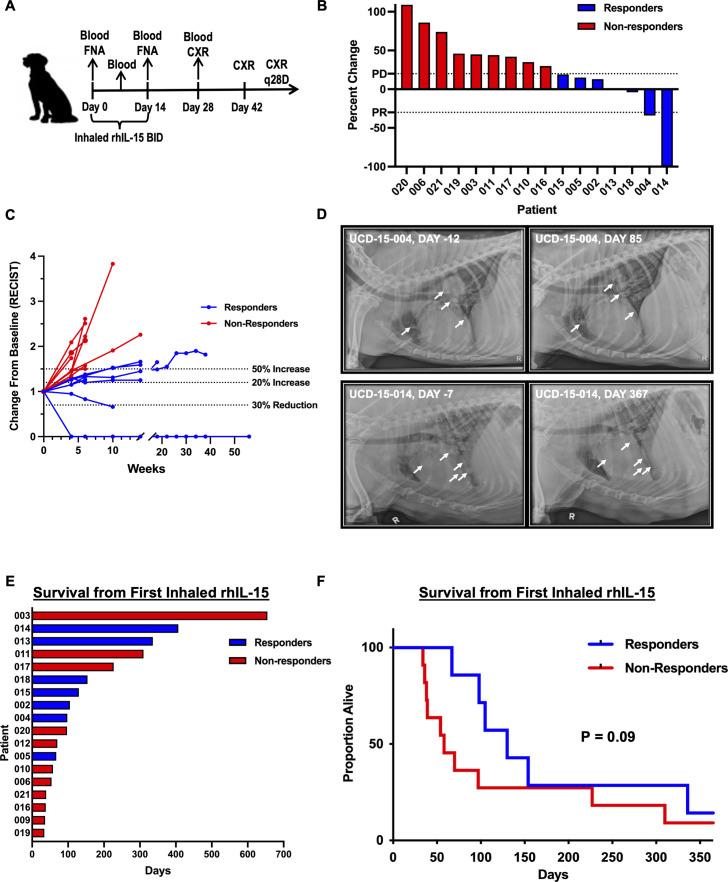
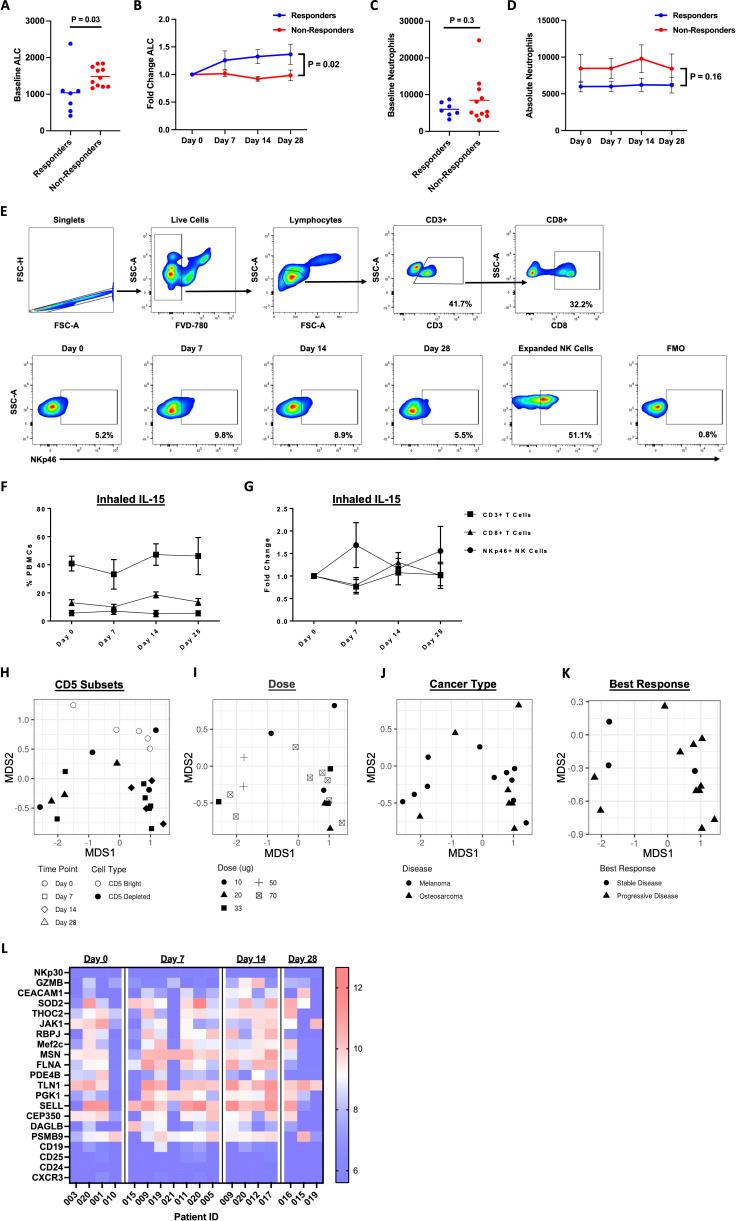
From October 2018 to December 2020, we enrolled 21 dogs with 18 dogs reaching the 28-day response assessment to be evaluable. At dose level 5 (70 μg), we observed two DLTs, thereby establishing 50 µg twice daily × 14 days as the MTD and recommended phase 2 dose. Among 18 evaluable dogs, we observed one complete response >1 year, one partial response with resolution of multiple target lesions, and five stable disease for an overall clinical benefit rate of 39%. Plasma rhIL-15 quantitation revealed detectable and sustained rhIL-15 concentrations between 1-hour and 6 hour postnebulization. Decreased pretreatment lymphocyte counts were significantly associated with clinical benefit. Cytotoxicity assays of banked peripheral blood mononuclear cells revealed significant increases in peak cytotoxicity against canine melanoma and OSA targets that correlated with OS.
CONCLUSIONS
In this first-in-dog clinical trial of inhaled rhIL-15 in dogs with advanced metastatic disease, we observed promising clinical activity when administered as a monotherapy for only 14 days. These data have significant clinical and biological implications for both dogs and humans with refractory lung metastases and support exploration of combinatorial therapies using inhaled rhIL-15.
目的
尽管重组人白细胞介素-15(rhIL-15)作为癌症的免疫治疗药物引起了广泛关注,但迄今为止,其在人体临床试验中的活性一直较为温和,部分原因是随着剂量的显著增加而存在毒性风险。由于肺转移是人类和犬类癌症远处失败的主要部位,我们试图研究吸入 rhIL-15 对患有骨肉瘤(OSA)或黑色素瘤肺转移的犬的作用。我们假设,由于肺部集中给药,全身暴露减少,因此具有良好的获益/风险比。
实验设计
我们采用传统的 3+3 队列设计,对患有肺部转移的犬进行了吸入 rhIL-15 的 I 期临床试验。根据人体、非人类灵长类动物和鼠类研究,我们使用每日两次 10μg 持续 14 天的起始剂量。安全性、剂量限制性毒性(DLT)和最大耐受剂量(MTD)是主要目标,而反应率、无进展生存期(PFS)和总生存期(OS)、药代动力学和免疫相关性分析是次要目标。
结果
从 2018 年 10 月到 2020 年 12 月,我们共招募了 21 只患有肺部转移的犬,其中 18 只在 28 天的反应评估时达到可评估状态。在剂量水平 5(70μg)时,我们观察到 2 例 DLT,从而确定 50μg 每日两次×14 天为 MTD 和推荐的 II 期剂量。在 18 只可评估的犬中,我们观察到 1 只完全缓解(>1 年),1 只部分缓解(多个靶病变消退),5 只稳定疾病,总临床获益率为 39%。血浆 rhIL-15 定量显示,在雾化后 1 小时至 6 小时之间可检测到并持续存在 rhIL-15 浓度。治疗前淋巴细胞计数降低与临床获益显著相关。对储存的外周血单核细胞进行细胞毒性测定显示,针对犬黑色素瘤和 OSA 靶标,细胞毒性峰值显著增加,与 OS 相关。
结论
在这项针对晚期转移性疾病犬的吸入 rhIL-15 的首个 I 期临床试验中,当作为仅 14 天的单一疗法使用时,我们观察到了有希望的临床活性。这些数据对患有难治性肺转移的犬和人类具有重要的临床和生物学意义,并支持探索使用吸入 rhIL-15 的联合治疗。


 Zotero 插件