
迈向心肾综合征的人体模型
Toward Human Models of Cardiorenal Syndrome .
作者信息
Gabbin Beatrice, Meraviglia Viviana, Mummery Christine L, Rabelink Ton J, van Meer Berend J, van den Berg Cathelijne W, Bellin Milena
机构信息
Department of Anatomy and Embryology, Leiden University Medical Center, Leiden, Netherlands.
Department of Applied Stem Cell Technologies, University of Twente, Enschede, Netherlands.
出版信息
Front Cardiovasc Med. 2022 May 26;9:889553. doi: 10.3389/fcvm.2022.889553. eCollection 2022.
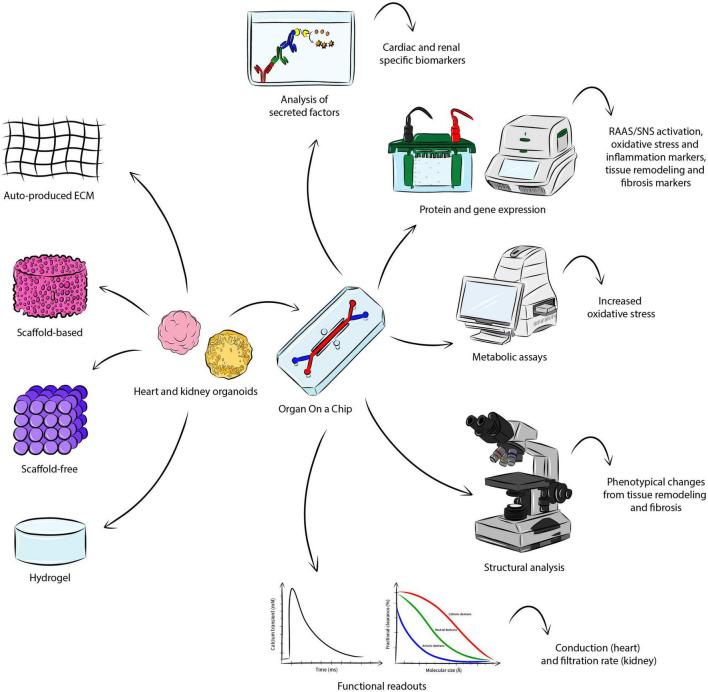
Heart and kidney diseases cause high morbidity and mortality. Heart and kidneys have vital functions in the human body and, interestingly, reciprocally influence each other's behavior: pathological changes in one organ can damage the other. Cardiorenal syndrome (CRS) is a group of disorders in which there is combined dysfunction of both heart and kidney, but its underlying biological mechanisms are not fully understood. This is because complex, multifactorial, and dynamic mechanisms are likely involved. Effective treatments are currently unavailable, but this may be resolved if more was known about how the disease develops and progresses. To date, CRS has actually only been modeled in mice and rats . Even though these models can capture cardiorenal interaction, they are difficult to manipulate and control. Moreover, interspecies differences may limit extrapolation to patients. The questions we address here are what would it take to model CRS and how far are we? There are already multiple independent (human) models of heart and kidney, but none have so far captured their dynamic organ-organ crosstalk. Advanced human models can provide an insight in disease mechanisms and offer a platform for therapy development. CRS represents an exemplary disease illustrating the need to develop more complex models to study organ-organ interaction in-a-dish. Human induced pluripotent stem cells in combination with microfluidic chips are one powerful tool with potential to recapitulate the characteristics of CRS . In this review, we provide an overview of the existing and models to study CRS, their limitations and new perspectives on how heart-kidney physiological and pathological interaction could be investigated for future applications.
心脏和肾脏疾病导致高发病率和死亡率。心脏和肾脏在人体中具有重要功能,有趣的是,它们相互影响彼此的功能:一个器官的病理变化会损害另一个器官。心肾综合征(CRS)是一组心脏和肾脏联合功能障碍的疾病,但其潜在的生物学机制尚未完全了解。这是因为可能涉及复杂、多因素和动态的机制。目前尚无有效的治疗方法,但如果对该疾病的发展和进展有更多了解,这一问题可能会得到解决。迄今为止,CRS实际上仅在小鼠和大鼠中建立了模型。尽管这些模型可以捕捉心肾相互作用,但它们难以操纵和控制。此外,种间差异可能会限制对患者的推断。我们在此探讨的问题是建立CRS模型需要什么以及我们目前进展如何?已经有多个独立的(人类)心脏和肾脏模型,但到目前为止,还没有一个模型能够捕捉到它们动态的器官间相互作用。先进的人类模型可以深入了解疾病机制,并为治疗开发提供一个平台。CRS是一个典型的疾病,说明了需要开发更复杂的模型来研究培养皿中的器官间相互作用。人类诱导多能干细胞与微流控芯片相结合是一种有潜力重现CRS特征的强大工具。在这篇综述中,我们概述了现有的研究CRS的模型及其局限性,以及关于如何研究心脏-肾脏生理和病理相互作用以用于未来应用的新观点。

 Zotero 插件