
卵巢激素调节雌性大鼠的尼古丁摄入和伏隔核谷氨酸能可塑性。
Ovarian Hormones Regulate Nicotine Consumption and Accumbens Glutamatergic Plasticity in Female Rats.
机构信息
Department of Pharmacology and Nutritional Sciences, University of Kentucky, Lexington, KY, 40536.
Department of Psychology, Arizona State University, Tempe, AZ, 85287.
出版信息
eNeuro. 2022 Jun 27;9(3). doi: 10.1523/ENEURO.0286-21.2022. Print 2022 May-Jun.
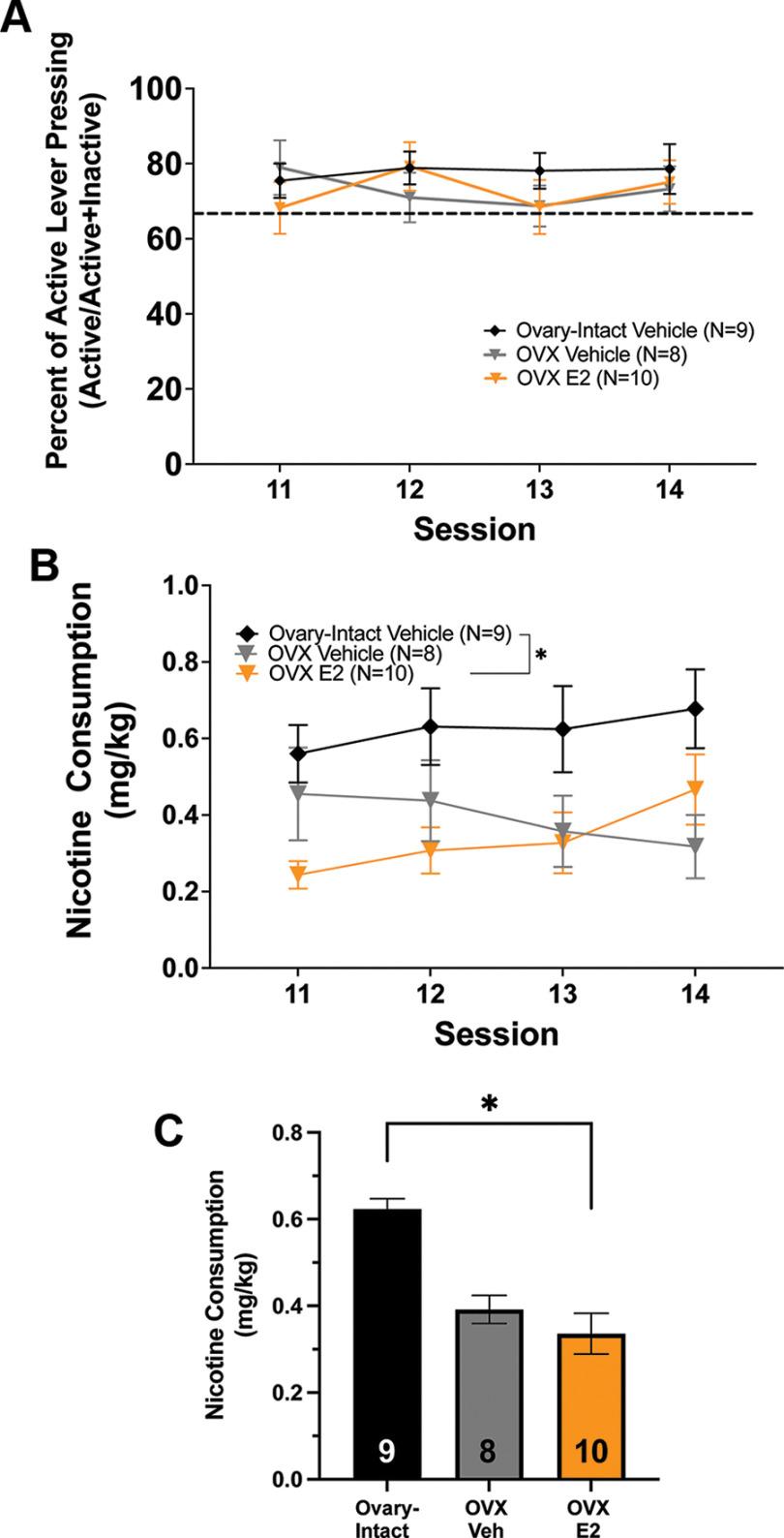
Women report greater cigarette cravings during the menstrual cycle phase with higher circulating levels of 17β-estradiol (E2), which is metabolized to estrone (E1). Both E2 and E1 bind to estrogen receptors (ERs), which have been highly studied in the breast, uterus, and ovary. Recent studies have found that ERs are also located on GABAergic medium spiny neurons (MSNs) within the nucleus accumbens core (NAcore). Glutamatergic plasticity in NAcore MSNs is altered following nicotine use; however, it is unknown whether estrogens impact this neurobiological consequence. To test the effect of estrogen on nicotine use, we ovariectomized (OVX) female rats that then underwent nicotine self-administration acquisition and compared them to ovary-intact (sham) rats. The OVX animals then received either sesame oil (vehicle), E2, or E1+E2 supplementation for 4 or 20 d before nicotine sessions. While both ovary-intact and OVX females readily discriminated levers, OVX females consumed less nicotine than sham females. Further, neither E2 nor E1+E2 increased nicotine consumption back to sham levels following OVX, regardless of the duration of the treatment. OVX also rendered NAcore MSNs in a potentiated state following nicotine self-administration, which was reversed by 4 d of systemic E2 treatment. Finally, we found that E2 and E1+E2 increased ERα mRNA in the NAcore, but nicotine suppressed this regardless of hormone treatment. Together, these results show that estrogens regulate nicotine neurobiology, but additional factors may be required to restore nicotine consumption to ovary-intact levels.
女性在循环中 17β-雌二醇(E2)水平较高的月经周期阶段报告更强烈的香烟渴望,E2 代谢为雌酮(E1)。E2 和 E1 都与雌激素受体(ER)结合,这些受体在乳房、子宫和卵巢中得到了广泛研究。最近的研究发现,ER 也位于伏隔核核心(NAcore)中的 GABA 能中间棘神经元(MSNs)上。NAcore MSNs 中的谷氨酸能可塑性在尼古丁使用后发生改变;然而,雌激素是否会影响这种神经生物学后果尚不清楚。为了测试雌激素对尼古丁使用的影响,我们对接受过尼古丁自我给药的去卵巢(OVX)雌性大鼠进行了卵巢切除术(OVX),并将其与卵巢完整(假手术)大鼠进行了比较。OVX 动物随后接受芝麻油(载体)、E2 或 E1+E2 补充 4 或 20 天,然后进行尼古丁治疗。虽然卵巢完整和 OVX 雌性大鼠都能轻松区分杠杆,但 OVX 雌性大鼠的尼古丁消耗量低于假手术雌性大鼠。此外,无论治疗持续时间如何,E2 或 E1+E2 都不能将 OVX 后增加的尼古丁消耗量恢复到假手术水平。OVX 还使 NAcore MSNs 在尼古丁自我给药后处于增强状态,这种状态可通过 4 天的全身 E2 治疗逆转。最后,我们发现 E2 和 E1+E2 增加了 NAcore 中的 ERα mRNA,但无论激素治疗如何,尼古丁都会抑制这种情况。总之,这些结果表明雌激素调节尼古丁的神经生物学,但可能需要其他因素来将尼古丁的消耗量恢复到卵巢完整的水平。




 Zotero 插件