
TAFA4及其受体FPR1在脊髓中的分子结构、表达及作用
Molecular Structure, Expression and Role of TAFA4 and its Receptor FPR1 in the Spinal Cord.
作者信息
Zhu Sipin, Hu Xiaoyong, Bennett Samuel, Mai Yuliang, Xu Jiake
机构信息
Department of Orthopaedics, The Second Affiliated Hospital and Yuying Children's Hospital of Wenzhou Medical University, Wenzhou, China.
Molecular Lab, School of Biomedical Sciences, University of Western Australia, Perth, WA, Australia.
出版信息
Front Cell Dev Biol. 2022 May 31;10:911414. doi: 10.3389/fcell.2022.911414. eCollection 2022.
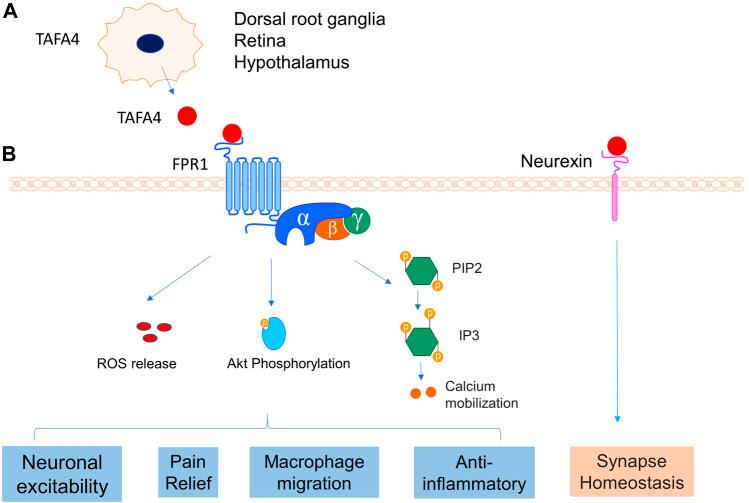
TAFA chemokine like family member 4 (TAFA4, also named FAM19A4) is a member of the TAFA chemokine like ligand or FAM19A family, which includes TAFA1, TAFA2, TAFA3, TAFA4, and TAFA5 (or FAM19A1, FAM19A2, FAM19A3, FAM19A4, and FAM19A5). They are also referred to as neurokines and are involved in the regulation of a diverse range of cellular processes, including chemotaxis of macrophages, phagocytosis, and release of reactive oxygen species (ROS). TAFA4 is a marker of C-low-threshold mechanoreceptors and is expressed predominantly in nociceptors, such as dorsal root ganglia (DRG). TAFA4 has been implicated in the sensory perception of pain in the spinal cord. Mice with deficiency of TAFA4 demonstrate altered excitability in lamina IIi neurons in DRG in addition to increased mechanical and chemical nociception following inflammation or injury. As a secreted protein, TAFA4 binds to cell surface receptor formyl peptide receptor 1 (FPR1), a G protein-coupled receptor to mediate the chemoattraction of macrophages, phagocytosis, and the inflammatory profile of macrophages. It also interacts with cell surface neurexin to mediate signalling across the synapse. Further understanding the mechanisms by which this conserved protein family regulates diverse biological processes such as in neuronal functions, inflammation, and tissue fibrosis will help to design therapeutic targets for the treatment of TAFA related diseases such as spinal cord injury and neuro-inflammatory disorders.
TAFA趋化因子样家族成员4(TAFA4,也称为FAM19A4)是TAFA趋化因子样配体或FAM19A家族的成员,该家族包括TAFA1、TAFA2、TAFA3、TAFA4和TAFA5(或FAM19A1、FAM19A2、FAM19A3、FAM19A4和FAM19A5)。它们也被称为神经激肽,参与多种细胞过程的调节,包括巨噬细胞的趋化作用、吞噬作用和活性氧(ROS)的释放。TAFA4是C型低阈值机械感受器的标志物,主要在伤害感受器中表达,如背根神经节(DRG)。TAFA4与脊髓疼痛的感觉感知有关。缺乏TAFA4的小鼠除了在炎症或损伤后机械性和化学性伤害感受增加外,DRG中IIi层神经元的兴奋性也发生改变。作为一种分泌蛋白,TAFA4与细胞表面受体甲酰肽受体1(FPR1)结合,FPR1是一种G蛋白偶联受体,可介导巨噬细胞的化学吸引、吞噬作用以及巨噬细胞的炎症特征。它还与细胞表面神经连接蛋白相互作用,介导突触间的信号传导。进一步了解这个保守蛋白家族调节多种生物学过程(如神经元功能、炎症和组织纤维化)的机制,将有助于设计治疗与TAFA相关疾病(如脊髓损伤和神经炎症性疾病)的治疗靶点。




 Zotero 插件