
在对照性人体疟疾感染试验中,加蓬 GMZ2 疫苗接种志愿者的细胞和抗体反应。
Cellular and antibody response in GMZ2-vaccinated Gabonese volunteers in a controlled human malaria infection trial.
机构信息
Centre de Recherches Médicales de Lambaréné, BP : 242, Lambaréné, Gabon.
Institute of Tropical Medicine, University Tübingen, Wilhelmstr. 27, 72074, Tübingen, Germany.
出版信息
Malar J. 2022 Jun 17;21(1):191. doi: 10.1186/s12936-022-04169-8.
BACKGROUND
Antibody and cellular memory responses following vaccination are important measures of immunogenicity. These immune markers were quantified in the framework of a vaccine trial investigating the malaria vaccine candidate GMZ2.
METHODS
Fifty Gabonese adults were vaccinated with two formulations (aluminum Alhydrogel and CAF01) of GMZ2 or a control vaccine (Verorab). Vaccine efficacy was assessed using controlled human malaria infection (CHMI) by direct venous inoculation of 3200 live Plasmodium falciparum sporozoites (PfSPZ Challenge). GMZ2-stimulated T and specific B-cell responses were estimated by flow cytometry before and after vaccination. Additionally, the antibody response against 212 P. falciparum antigens was estimated before CHMI by protein microarray.
RESULTS
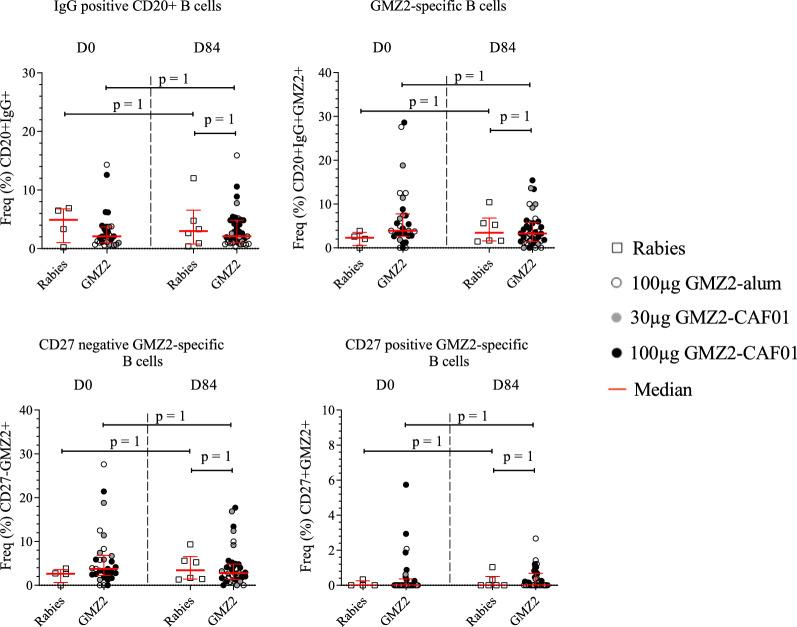
Frequencies of pro- and anti-inflammatory CD4 T cells stimulated with the vaccine antigen GMZ2 as well as B cell profiles did not change after vaccination. IL-10-producing CD4 T cells and CD20 IgG B cells were increased post-vaccination regardless of the intervention, thus could not be specifically attributed to any malaria vaccine regimen. In contrast, GMZ2-specific antibody response increased after the vaccination, but was not correlated to protection. Antibody responses to several P. falciparum blood and liver stage antigens (MSP1, MSP4, MSP8, PfEMP1, STARP) as well as the breadth of the malaria-specific antibody response were significantly higher in protected study participants.
CONCLUSIONS
In lifelong malaria exposed adults, the main marker of protection against CHMI is a broad antibody pattern recognizing multiple stages of the plasmodial life cycle. Despite vaccination with GMZ2 using a novel formulation, expansion of the GMZ2-stimulated T cells or the GMZ2-specific B cell response was limited, and the vaccine response could not be identified as a marker of protection against malaria. Trial registration PACTR; PACTR201503001038304; Registered 17 February 2015; https://pactr.samrc.ac.za/TrialDisplay.aspx?TrialID=1038.
背景
接种疫苗后的抗体和细胞记忆反应是免疫原性的重要衡量标准。在一项针对疟疾疫苗候选 GMZ2 的疫苗试验中,对这些免疫标志物进行了量化。
方法
50 名加蓬成年人分别接种了两种 GMZ2 制剂(铝佐剂 Alhydrogel 和 CAF01)或对照疫苗(Verorab)。通过直接静脉接种 3200 个活的恶性疟原虫孢子(PfSPZ 挑战)来评估疫苗的功效。在接种前后,通过流式细胞术估计 GMZ2 刺激的 T 细胞和特异性 B 细胞反应。此外,在 CHMI 之前通过蛋白质微阵列估计了针对 212 种恶性疟原虫抗原的抗体反应。
结果
用疫苗抗原 GMZ2 刺激的促炎和抗炎 CD4 T 细胞以及 B 细胞谱的频率在接种后没有改变。接种后,IL-10 产生的 CD4 T 细胞和 CD20 IgG B 细胞增加,无论干预措施如何,因此不能专门归因于任何疟疾疫苗方案。相反,GMZ2 特异性抗体反应在接种后增加,但与保护无关。在受保护的研究参与者中,对几种恶性疟原虫血液和肝脏阶段抗原(MSP1、MSP4、MSP8、PfEMP1、STARP)以及广泛的疟疾特异性抗体反应的抗体反应显著更高。
结论
在终身暴露于疟疾的成年人中,对 CHMI 的主要保护标志物是识别疟原虫生命周期多个阶段的广泛抗体模式。尽管使用新型制剂接种 GMZ2,但 GMZ2 刺激的 T 细胞或 GMZ2 特异性 B 细胞反应的扩增有限,并且无法将疫苗反应确定为对疟疾的保护标志物。试验注册 PACTR;PACTR201503001038304;注册于 2015 年 2 月 17 日;https://pactr.samrc.ac.za/TrialDisplay.aspx?TrialID=1038.




 Zotero 插件