
T 形细胞在腹侧耳蜗核内的局部靶点。
Local targets of T-stellate cells in the ventral cochlear nucleus.
机构信息
Department of Neuroscience, University of Wisconsin-Madison School of Medicine and Public Health, Madison, Wisconsin, USA.
出版信息
J Comp Neurol. 2022 Nov;530(16):2820-2834. doi: 10.1002/cne.25378. Epub 2022 Jun 18.
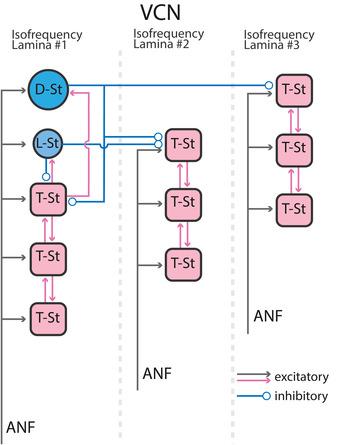
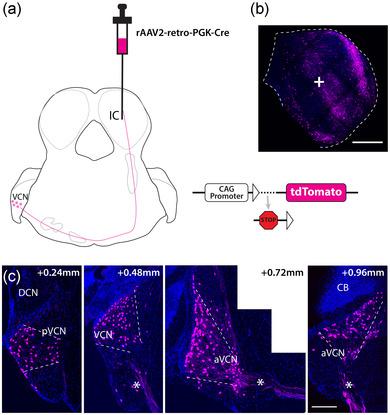
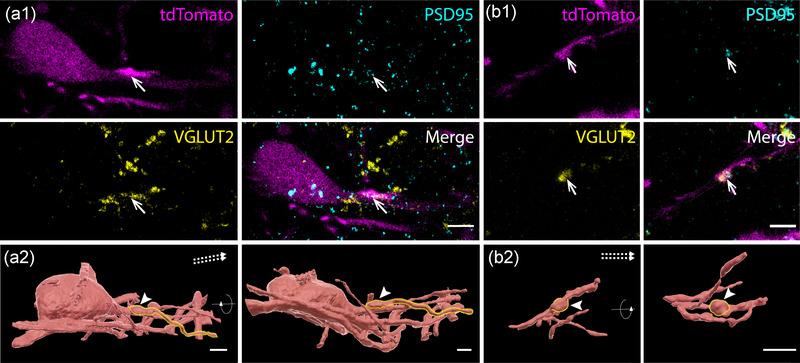
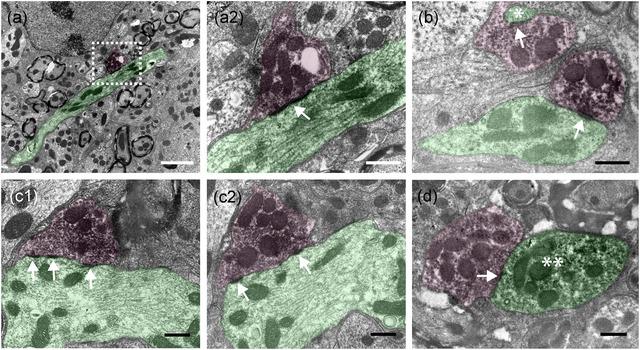
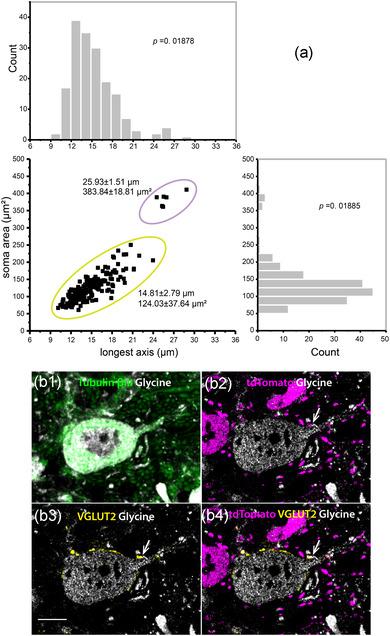
T-stellate cells in the ventral cochlear nucleus (VCN) are known to have local axon collaterals that terminate in the vicinity of their dendrites and cell bodies within the same isofrequency lamina in parallel with the auditory nerve fibers that innervate them. Excitatory synaptic connections between stellate cells within an isofrequency lamina are hypothesized to be involved in the nitric oxide-mediated upregulation of T-stellate responses to their auditory input. This could serve as a mechanism of variable gain control in the enhancement of responses to vowel spectral peaks. Previous studies have provided indirect evidence for these possible synaptic interconnections between T-stellate cells, but unequivocal identification has yet to be established. Here, we used retrograde neuronal tracing with adeno-associated viral vector or biotinylated dextran amine injected into the inferior colliculus (IC) to detect the postsynaptic target of T-stellate cells within the VCN. We show that backfilled T-stellate cell axons make monosynapatic connections on the labeled cell bodies and dendrites of other labeled T-stellate cells within an isofrequency lamina. Electron microscopy revealed that T-stellate terminals can also make synapses on structures not retrogradely labeled from the IC. Glycine antibodies combined with the viral labeling indicated that these nonbackfilled structures that the labeled T-stellate terminals were synapsing on are most likely the cell bodies and dendrites of two size categories of glycinergic VCN cells, whose sizes and relative numbers indicated they are the D- and L-stellate cells. These cells are known to provide inhibitory inputs back onto T-stellate cells. Our data indicate that, in addition to their auditory nerve input, T-stellate cells provide a second modulatable excitatory input to both inhibitory and excitatory cells in a VCN isofrequency lamina and may play a significant role in acoustic information processing.
腹侧耳蜗核 (VCN) 中的 T 形星形细胞已知具有局部轴突侧支,其末端终止于同一等频层内与其树突和细胞体附近,与支配它们的听神经纤维平行。推测同一等频层内星形细胞之间的兴奋性突触连接参与了一氧化氮介导的 T 形星形细胞对其听觉输入反应的上调。这可能是增强对元音谱峰反应的可变增益控制的一种机制。先前的研究为 T 形星形细胞之间这些可能的突触连接提供了间接证据,但尚未明确确定。在这里,我们使用腺相关病毒载体或生物素化葡聚糖胺逆行神经元追踪,将其注入下丘脑中 (IC),以检测 VCN 内 T 形星形细胞的突触后靶标。我们表明,回充的 T 形星形细胞轴突在同一等频层内与其他标记的 T 形星形细胞的标记细胞体和树突形成单突触连接。电子显微镜显示 T 形星形细胞末端也可以与从 IC 未逆行标记的结构形成突触。甘氨酸抗体与病毒标记结合表明,标记的 T 形星形细胞末端突触连接的这些未回充结构很可能是两种大小类别的甘氨酸能 VCN 细胞的细胞体和树突,其大小和相对数量表明它们是 D-和 L-星形细胞。已知这些细胞向 T 形星形细胞提供抑制性输入。我们的数据表明,除了其听神经输入外,T 形星形细胞还向 VCN 等频层内的抑制性和兴奋性细胞提供第二种可调节的兴奋性输入,并可能在声信息处理中发挥重要作用。




 Zotero 插件