
氨酚喹啉-青蒿琥酯治疗无并发症恶性疟原虫疟疾。
Pyronaridine-artesunate for treating uncomplicated Plasmodium falciparum malaria.
机构信息
Department of Clinical Sciences, Liverpool School of Tropical Medicine, Liverpool, UK.
出版信息
Cochrane Database Syst Rev. 2022 Jun 21;6(6):CD006404. doi: 10.1002/14651858.CD006404.pub4.
BACKGROUND
The World Health Organization (WHO) recommends artemisinin-based combination therapies (ACTs) to treat uncomplicated Plasmodium falciparum malaria. Concerns about artemisinin resistance have led to global initiatives to develop new partner drugs to protect artemisinin derivatives in ACT. Pyronaridine-artesunate is a novel ACT.
OBJECTIVES
To evaluate the efficacy of pyronaridine-artesunate compared to alternative ACTs for treating people with uncomplicated P falciparum malaria, and to evaluate the safety of pyronaridine-artesunate and other pyronaridine treatments compared to alternative treatments.
SEARCH METHODS
We searched the Cochrane Infectious Diseases Group Specialized Register; Cochrane Central Register of Controlled Trials (CENTRAL), published in the Cochrane Library; MEDLINE; Embase; and LILACS. We also searched ClinicalTrials.gov, the WHO International Clinical Trials Registry Platform, and the ISRCTN registry for ongoing or recently completed trials. The date of the last search was 27 October 2021.
SELECTION CRITERIA
For the efficacy analysis, we included randomized controlled trials (RCTs) of pyronaridine-artesunate for treating uncomplicated P falciparum malaria. For the safety analysis, we included RCTs that used pyronaridine alone or in combination with any other antimalarials. In addition to these analyses, we conducted a separate systematic review summarizing data on safety from non-randomized studies (NRS) of any patient receiving pyronaridine (NRS safety review). DATA COLLECTION AND ANALYSIS: Two review authors independently extracted all data and assessed the certainty of the evidence. We meta-analysed data to calculate risk ratios (RRs) for treatment failures between comparisons, and for safety outcomes between and across comparisons.
MAIN RESULTS
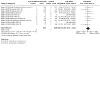
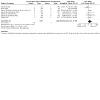
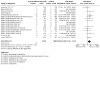
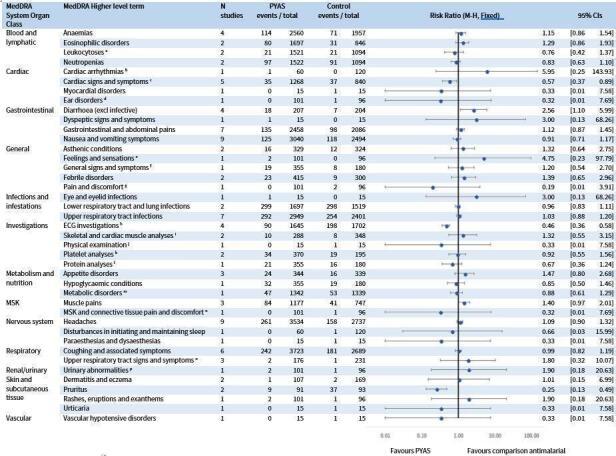
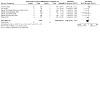
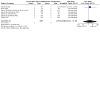
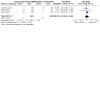
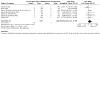
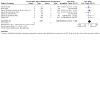
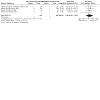
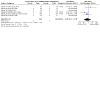
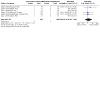
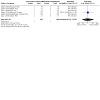
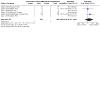
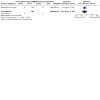
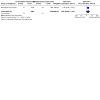
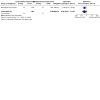
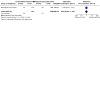
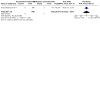
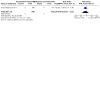
We included 10 relevant RCTs. Seven RCTs were co-funded by Shin Poong Pharmaceuticals, and three were funded by government agencies. Efficacy analysis (RCTs) For the efficacy analysis, we identified five RCTs comprising 5711 participants. This included 4465 participants from 13 sites in Africa, and 1246 participants from five sites in Asia. The analysis included 541 children aged less than five years. Overall, pyronaridine-artesunate had a polymerase chain reaction (PCR)-adjusted treatment failure rate of less than 5%. We evaluated pyronaridine-artesunate versus the following. • Artemether-lumefantrine. Pyronaridine artesunate may perform better for PCR-adjusted failures at day 28 (RR 0.59, 95% confidence interval (CI) 0.26 to 1.31; 4 RCTs, 3068 participants, low-certainty evidence); for unadjusted failures at day 28 (RR 0.27, 95% CI 0.13 to 0.58; 4 RCTs, 3149 participants, low-certainty evidence); and for unadjusted failures at day 42 (RR 0.61, 95% CI 0.46 to 0.82; 4 RCTs, 3080 participants, low-certainty evidence). For PCR-adjusted failures at day 42, there may be little or no difference between groups (RR 0.86, 95% CI 0.49 to 1.51; 4 RCTs, 2575 participants, low-certainty evidence). • Artesunate-amodiaquine. Pyronaridine artesunate may perform better for PCR-adjusted failures at day 28 (RR 0.55, 95% CI 0.11 to 2.77; 1 RCT, 1245 participants, low-certainty evidence); probably performs better for unadjusted failures at day 28 (RR 0.49, 95% CI 0.30 to 0.81; 1 RCT, 1257 participants, moderate-certainty evidence); may make little or no difference for PCR-adjusted failures at day 42 (RR 0.98, 95% CI 0.20 to 4.83; 1 RCT, 1091 participants, low-certainty evidence); and probably makes little or no difference for unadjusted failures at day 42 (RR 0.98, 95% CI 0.78 to 1.23; 1 RCT, 1235 participants, moderate-certainty evidence). • Mefloquine plus artesunate. Pyronaridine artesunate may perform better for PCR-adjusted failures at day 28 (RR 0.37, 95% CI 0.13 to 1.05; 1 RCT, 1117 participants, low-certainty evidence); probably performs better for unadjusted failures at day 28 (RR 0.36, 95% CI 0.17 to 0.78; 1 RCT, 1120 participants, moderate-certainty evidence); may make little or no difference for unadjusted failures at day 42 (RR 0.84, 95% CI 0.54 to 1.31; 1 RCT, 1059 participants, low-certainty evidence); but may lead to higher PCR-adjusted failures at day 42 (RR 1.80, 95% CI 0.90 to 3.57; 1 RCT, 1037 participants, low-certainty evidence). Safety analysis (RCTs) For the RCT safety analysis, we identified eight RCTs, one of which was delineated by study site, comparing pyronaridine-artesunate to other antimalarials. Pyronaridine-artesunate was associated with raised liver enzymes compared to other antimalarials: alanine aminotransferase (ALT) (RR 3.59, 95% CI 1.76 to 7.33; 8 RCTS, 6669 participants, high-certainty evidence) and aspartate transaminase (AST) (RR 2.22, 95% CI 1.12 to 4.41; 8 RCTs, 6669 participants, moderate-certainty evidence). No such effect was demonstrated with bilirubin (RR 1.03, 95% CI 0.49 to 2.18; 7 RCTs, 6384 participants, moderate-certainty evidence). There was one reported case in which raised ALT occurred with raised bilirubin. No study reported severe drug-induced liver injury. Electrocardiograph (ECG) abnormalities were less common with pyronaridine-artesunate compared to other antimalarials. We identified no other safety concerns. NRS safety review A review on safety in NRS allowed us to increase the population within which safety was assessed. We included seven studies with 9546 participants: five single-arm observational studies, one cohort event monitoring study, and one dose-escalation study. All studies provided data on adverse event frequency, with a small number of participants experiencing serious adverse events and adverse effects related to pyronaridine: serious adverse events average 0.37%; drug-related 9.0%. In two studies reporting elevations in liver enzymes, small percentages of participants (2.4% and 14.1% respectively) experienced increases in either ALT, AST, or bilirubin on day 7; however, these were small increases that returned to normal by day 42. AUTHORS' CONCLUSIONS: Pyronaridine-artesunate was efficacious against uncomplicated P falciparum malaria; achieved a PCR-adjusted treatment failure rate of less than 5% at days 28 and 42; and may be at least as good as, or better than, other marketed ACTs. Pyronaridine-artesunate increases the risk of episodes of abnormally raised ALT. The observational data did not signal an excess of clinically important adverse effects.
背景
世界卫生组织(WHO)建议使用青蒿素类复方疗法(ACT)治疗无并发症的恶性疟原虫疟疾。对青蒿素耐药性的担忧导致了在 ACT 中开发新的联合用药来保护青蒿素衍生物的全球计划。派隆那林-青蒿琥酯是一种新型的 ACT。
目的
评估派隆那林-青蒿琥酯治疗无并发症恶性疟原虫疟疾的疗效,与替代 ACT 相比,并评估派隆那林-青蒿琥酯和其他派隆那林治疗与替代治疗相比的安全性。
检索方法
我们检索了 Cochrane 传染病组专业注册库;Cochrane 中央对照试验注册库(CENTRAL),发表在 Cochrane 图书馆中;MEDLINE;Embase;以及 LILACS。我们还检索了 ClinicalTrials.gov、世界卫生组织国际临床试验注册平台和 ISRCTN 注册处,以获取正在进行或最近完成的试验。最后一次检索日期是 2021 年 10 月 27 日。
选择标准
对于疗效分析,我们纳入了使用派隆那林-青蒿琥酯治疗无并发症恶性疟原虫疟疾的随机对照试验(RCT)。对于安全性分析,我们纳入了使用派隆那林单独或与任何其他抗疟药联合使用的 RCT。除了这些分析之外,我们还进行了一项单独的系统综述,总结了来自任何接受派隆那林治疗的患者的非随机研究(NRS)的安全性数据(NRS 安全性综述)。
数据收集和分析
两位综述作者独立提取所有数据,并评估证据的确定性。我们对数据进行荟萃分析,以计算两组间治疗失败的风险比(RR),以及两组间和跨组间安全性结果的 RR。
主要结果
我们纳入了 10 项相关 RCT。其中 7 项 RCT 由 Shin Poong 制药公司共同资助,3 项由政府机构资助。疗效分析(RCT)对于疗效分析,我们确定了 5 项 RCT,共纳入 5711 名参与者。其中包括来自非洲 13 个地点的 4465 名参与者和来自亚洲 5 个地点的 1246 名参与者。分析包括 541 名年龄小于 5 岁的儿童。总体而言,派隆那林-青蒿琥酯的聚合酶链反应(PCR)调整治疗失败率低于 5%。我们评估了派隆那林-青蒿琥酯与以下药物的疗效:
• 青蒿琥酯-甲氟喹。派隆那林-青蒿琥酯可能在 PCR 调整后的第 28 天失败率方面表现更好(RR 0.59,95%置信区间(CI)0.26 至 1.31;4 项 RCT,3068 名参与者,低确定性证据);在未经调整的第 28 天失败率方面(RR 0.27,95%CI 0.13 至 0.58;4 项 RCT,3149 名参与者,低确定性证据);以及在未经调整的第 42 天失败率方面(RR 0.61,95%CI 0.46 至 0.82;4 项 RCT,3080 名参与者,低确定性证据)。对于 PCR 调整后的第 42 天失败率,两组之间可能没有差异或差异很小(RR 0.86,95%CI 0.49 至 1.51;4 项 RCT,2575 名参与者,低确定性证据)。
• 青蒿琥酯-氨苯砜。派隆那林-青蒿琥酯可能在 PCR 调整后的第 28 天失败率方面表现更好(RR 0.55,95%CI 0.11 至 2.77;1 项 RCT,1245 名参与者,低确定性证据);在未经调整的第 28 天失败率方面可能表现更好(RR 0.49,95%CI 0.30 至 0.81;1 项 RCT,1257 名参与者,中确定性证据);在未经调整的第 42 天失败率方面可能没有差异或差异很小(RR 0.98,95%CI 0.20 至 4.83;1 项 RCT,1091 名参与者,低确定性证据);并且在未经调整的第 42 天失败率方面可能没有差异或差异很小(RR 0.98,95%CI 0.78 至 1.23;1 项 RCT,1235 名参与者,中确定性证据)。
• 甲氟喹-青蒿琥酯。派隆那林-青蒿琥酯可能在 PCR 调整后的第 28 天失败率方面表现更好(RR 0.37,95%CI 0.13 至 1.05;1 项 RCT,1117 名参与者,低确定性证据);在未经调整的第 28 天失败率方面可能表现更好(RR 0.36,95%CI 0.17 至 0.78;1 项 RCT,1120 名参与者,中确定性证据);在未经调整的第 42 天失败率方面可能没有差异或差异很小(RR 0.84,95%CI 0.54 至 1.31;1 项 RCT,1059 名参与者,低确定性证据);但可能导致第 42 天 PCR 调整后的失败率更高(RR 1.80,95%CI 0.90 至 3.57;1 项 RCT,1037 名参与者,低确定性证据)。安全性分析(RCT)对于 RCT 安全性分析,我们确定了 8 项 RCT,其中一项按研究地点进行了划分,比较了派隆那林-青蒿琥酯与其他抗疟药的安全性。派隆那林-青蒿琥酯与其他抗疟药相比,可能会导致肝酶升高:丙氨酸氨基转移酶(ALT)(RR 3.59,95%CI 1.76 至 7.33;8 项 RCT,6669 名参与者,高确定性证据)和天冬氨酸氨基转移酶(AST)(RR 2.22,95%CI 1.12 至 4.41;8 项 RCT,6669 名参与者,中确定性证据)。在胆红素方面没有这种影响(RR 1.03,95%CI 0.49 至 2.18;7 项 RCT,6384 名参与者,中确定性证据)。有一例报告称 ALT 升高伴有胆红素升高。没有研究报告严重的药物性肝损伤。派隆那林-青蒿琥酯与其他抗疟药相比,心电图(ECG)异常较少。我们没有发现其他安全问题。NRS 安全性综述在 NRS 上进行的安全性综述使我们能够增加安全性评估的人群。我们纳入了 7 项研究,共有 9546 名参与者:五项单臂观察性研究,一项队列事件监测研究,和一项剂量递增研究。所有研究都报告了不良事件的频率,少数参与者(2.4%和 14.1%)在第 7 天经历了 ALT、AST 或胆红素的升高;然而,这些都是小的增加,在第 42 天恢复正常。
作者结论
派隆那林-青蒿琥酯治疗无并发症恶性疟原虫疟疾有效;PCR 调整后的治疗失败率低于 5%,在第 28 天和第 42 天;并且可能与其他市售的 ACT 一样有效,或者更好。派隆那林-青蒿琥酯增加了异常升高的丙氨酸氨基转移酶的风险。观察性数据没有提示临床上有重要不良影响。




















 Zotero 插件