
中国一家三级教学医院中耐多粘菌素菌的流行情况及分子特征
Prevalence and Molecular Characteristics of Polymyxin-Resistant in a Chinese Tertiary Teaching Hospital.
作者信息
Xiao Chenlu, Zhu Yan, Yang Zhitao, Shi Dake, Ni Yuxing, Hua Li, Li Jian
机构信息
Department of Laboratory Medicine, Ruijin Hospital Affiliated to Shanghai Jiao Tong University School of Medicine, Shanghai 200025, China.
Department of Clinical Microbiology, Ruijin Hospital Affiliated to Shanghai Jiao Tong University School of Medicine, Shanghai 200025, China.
出版信息
Antibiotics (Basel). 2022 Jun 14;11(6):799. doi: 10.3390/antibiotics11060799.
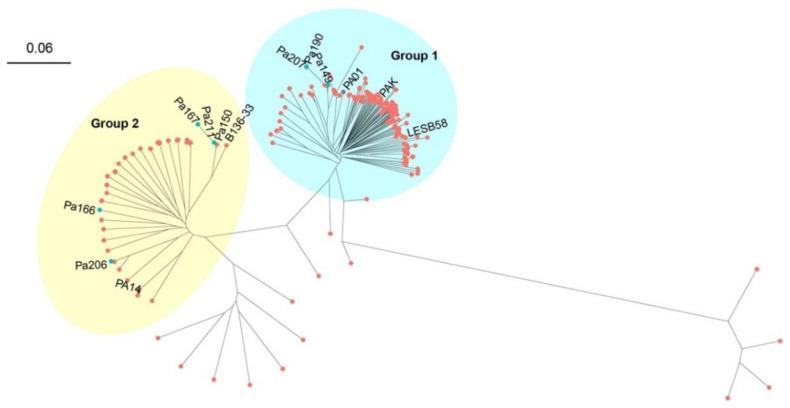
Polymyxin-resistant is a major threat to public health globally. We investigated the prevalence of polymyxin-resistant in a Chinese teaching hospital and determined the genetic and drug-resistant phenotypes of the resistant isolates. isolates identified by MALDI-TOF MS were collected across a 3-month period in Ruijin Hospital. Antimicrobial susceptibility was determined by a Vitek-2 Compact system with broth dilution used to determine polymyxin B (PMB) susceptibility. Polymyxin-resistant isolates were further characterized by molecular typing using PCR, multi-locus sequence typing (MLST) and whole-genome sequencing. Phylogenetic relationships were analyzed using single nucleotide polymorphism (SNP) from the whole-genome sequencing. Of 362 isolates collected, 8 (2.2%) isolates from separate patients across six wards were polymyxin-resistant (MIC range, PMB 4-16 μg/mL and colistin 4-≥16 μg/mL). Four patients received PMB treatments (intravenous, aerosolized and/or topical) and all patients survived to discharge. All polymyxin-resistant isolates were genetically related and were assigned to five different clades (Isolate 150 and Isolate 211 being the same ST823 type). Genetic variations V51I, Y345H, G68S and R155H in and L71R in were identified, which might confer polymyxin resistance in these isolates. Six of the polymyxin-resistant isolates showed reduced susceptibility to imipenem and meropenem (MIC range ≥ 16 μg/mL), while two of the eight isolates were resistant to ceftazidime. We revealed a low prevalence of polymyxin-resistant in a Chinese teaching hospital with most polymyxin-resistant isolates being multidrug-resistant. Therefore, effective infection control measures are urgently needed to prevent further spread of resistance to the last-line polymyxins.
耐多粘菌素对全球公共卫生构成重大威胁。我们调查了一家中国教学医院中耐多粘菌素的流行情况,并确定了耐药菌株的基因和耐药表型。在瑞金医院为期3个月的时间里收集了通过基质辅助激光解吸电离飞行时间质谱(MALDI-TOF MS)鉴定的菌株。采用Vitek-2 Compact系统测定抗菌药物敏感性,采用肉汤稀释法测定多粘菌素B(PMB)敏感性。对耐多粘菌素菌株进一步通过聚合酶链反应(PCR)、多位点序列分型(MLST)和全基因组测序进行分子分型。利用全基因组测序的单核苷酸多态性(SNP)分析系统发育关系。在收集的362株菌株中,来自六个病房不同患者的8株(2.2%)菌株对多粘菌素耐药(MIC范围:PMB为4 - 16μg/mL,黏菌素为4 - ≥16μg/mL)。4例患者接受了PMB治疗(静脉注射、雾化吸入和/或局部用药),所有患者均存活至出院。所有耐多粘菌素菌株均具有基因相关性,被分为五个不同的进化枝(菌株150和菌株211为同一ST823型)。在pmrCAB和mgrB中分别鉴定出可能导致这些菌株耐多粘菌素的基因变异V51I、Y345H、G68S和R155H以及L71R。其中6株耐多粘菌素菌株对亚胺培南和美罗培南的敏感性降低(MIC范围≥16μg/mL),8株中有2株对头孢他啶耐药。我们发现一家中国教学医院中耐多粘菌素的流行率较低,大多数耐多粘菌素菌株为多重耐药。因此,迫切需要有效的感染控制措施以防止对最后一线多粘菌素的耐药性进一步传播。

 Zotero 插件