
前列腺癌中癌症相关成纤维细胞的分子特征
Molecular Characterization of Cancer Associated Fibroblasts in Prostate Cancer.
作者信息
Vitale Giovanni, Caraglia Michele, Jung Volker, Kamradt Jörn, Gentilini Davide, Di Martino Maria Teresa, Dicitore Alessandra, Abate Marianna, Tagliaferri Pierosandro, Itro Annalisa, Ferro Matteo, Balsamo Raffaele, De Sio Marco, Facchini Gaetano, Persani Luca, Schmitt Kai, Saar Matthias, Stöckle Michael, Unteregger Gerhard, Zappavigna Silvia
机构信息
Department of Medical Biotechnology and Translational Medicine (BIOMETRA), University of Milan, 20133 Milan, Italy.
Laboratory of Geriatric and Oncologic Neuroendocrinology Research, Istituto Auxologico Italiano (IRCCS), Cusano Milanino, 20095 Milan, Italy.
出版信息
Cancers (Basel). 2022 Jun 14;14(12):2943. doi: 10.3390/cancers14122943.
BACKGROUND
Stromal components surrounding epithelial cancer cells seem to play a pivotal role during epithelial-to-mesenchymal transition (EMT), tumor invasion, and metastases. To identify the molecular mechanisms underlying tumor-stroma interactions may yield novel therapeutic targets for prostate cancer.
METHODS
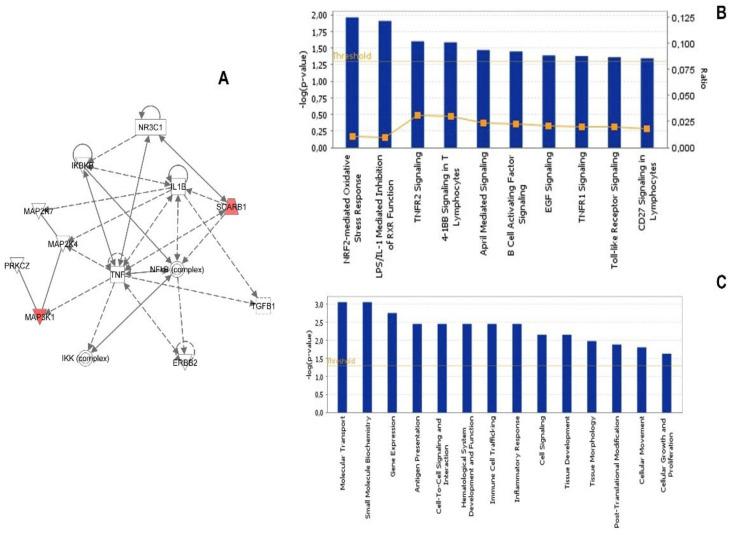
Gene expression profile of prostate-cancer associated fibroblast (PCAF) and prostate non-cancer associated fibroblast (PNAF) cells isolated from radical prostatectomy was performed by Illumina, analyzed, and further processed by Ingenuity: IPA software. qRT-PCR was performed on an independent set of 17 PCAF, 12 PNAF, and 12 fibroblast cell lines derived from patients with benign prostatic hyperplasia (BPHF).
RESULTS
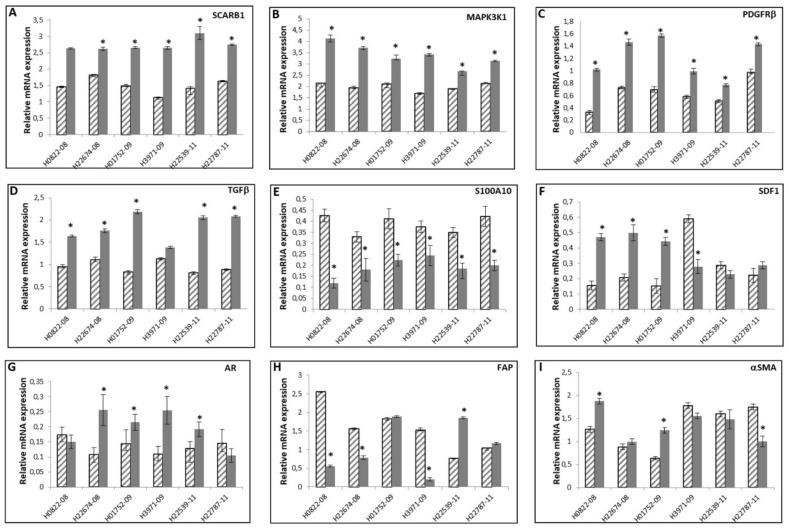
Using microarray analysis, we found six upregulated genes and two downregulated genes in PCAFs compared to PNAFs. To validate microarray results, we performed qRT-PCR for the most significantly regulated genes involved in the modulation of proliferation and androgen resistance on an independent set of PNAF, PCAF, and BHPF samples. We confirmed the increased expression of SCARB1, MAPK3K1, and TGF-β as well as the decreased expression of S100A10 in PCAFs compared to PNAFs and BPHFs.
CONCLUSIONS
These results provide strong evidence that the observed changes in the gene expression profile of PCAFs can contribute to functional alteration of adjacent prostate cancer cells.
背景
上皮癌细胞周围的基质成分在上皮-间质转化(EMT)、肿瘤侵袭和转移过程中似乎起着关键作用。确定肿瘤-基质相互作用的分子机制可能为前列腺癌带来新的治疗靶点。
方法
通过Illumina对从根治性前列腺切除术中分离出的前列腺癌相关成纤维细胞(PCAF)和前列腺非癌相关成纤维细胞(PNAF)进行基因表达谱分析,并用Ingenuity:IPA软件进行分析和进一步处理。对来自良性前列腺增生患者(BPHF)的17个PCAF、12个PNAF和12个成纤维细胞系的独立样本进行qRT-PCR。
结果
通过微阵列分析,我们发现与PNAF相比,PCAF中有6个基因上调,2个基因下调。为了验证微阵列结果,我们对一组独立的PNAF、PCAF和BHPF样本中参与增殖调节和雄激素抵抗的最显著调控基因进行了qRT-PCR。我们证实,与PNAF和BPHF相比,PCAF中SCARB1、MAPK3K1和TGF-β的表达增加,而S100A10的表达降低。
结论
这些结果提供了强有力的证据,表明PCAF基因表达谱中观察到的变化可能有助于相邻前列腺癌细胞的功能改变。



 Zotero 插件