
mTOR 通路中的翻译调控
The Translational Regulation in mTOR Pathway.
机构信息
Key Laboratory of Molecular Medicine and Biotherapy, School of Life Sciences, Beijing Institute of Technology, No. 5 South Zhongguancun Street, Beijing 100081, China.
出版信息
Biomolecules. 2022 Jun 8;12(6):802. doi: 10.3390/biom12060802.
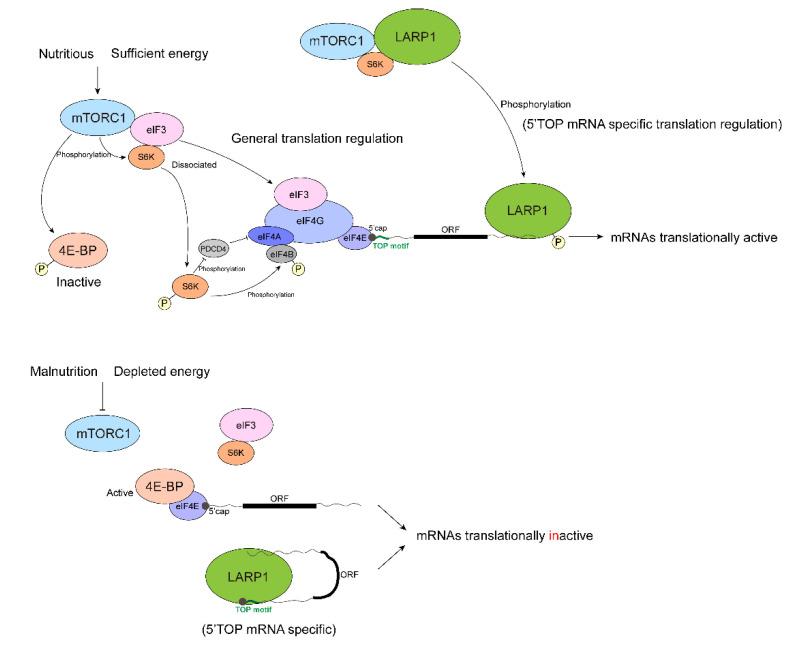
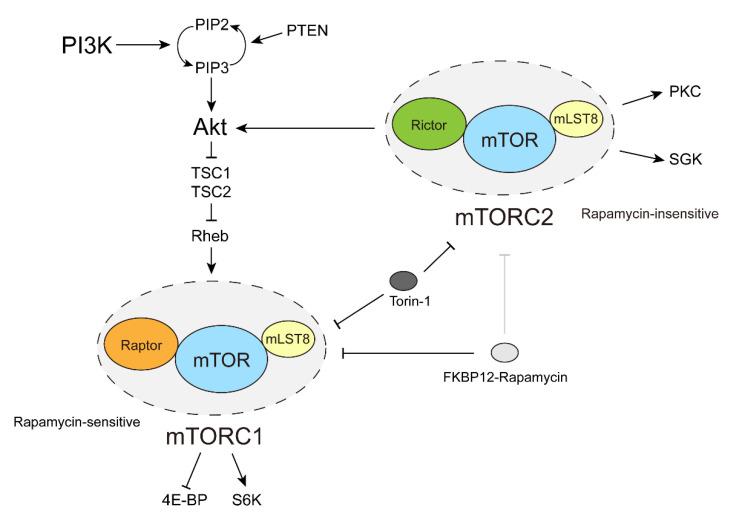
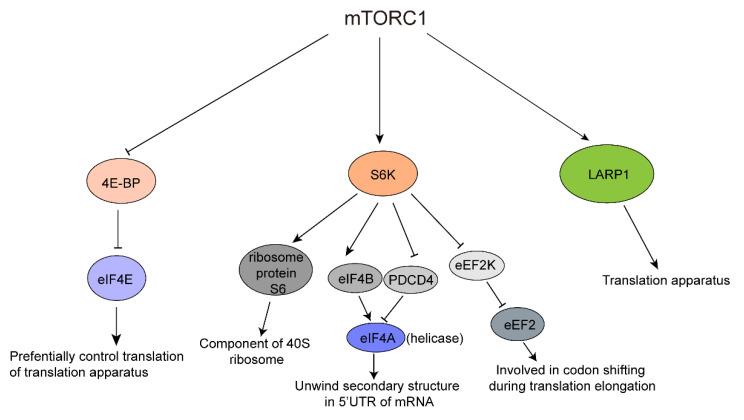
The mechanistic/mammalian target of rapamycin (mTOR) plays a master role in cell proliferation and growth in response to insulin, amino acids, energy levels, and oxygen. mTOR can coordinate upstream signals with downstream effectors, including transcriptional and translational apparatuses to regulate fundamental cellular processes such as energy utilization, protein synthesis, autophagy, cell growth, and proliferation. Of the above, protein synthesis is highly energy-consuming; thus, mRNA translation is under the tight and immediate control of mTOR signaling. The translational regulation driven by mTOR signaling mainly relies on eukaryotic translation initiation factor 4E (eIF4E)-binding protein (4E-BP), ribosomal protein S6 kinase (S6K), and its downstream players, which are significant in rapid cellular response to environmental change. mTOR signaling not only controls the general mRNA translation, but preferential mRNA translation as well. This means that mTOR signaling shows the stronger selectivity to particular target mRNAs. Some evidence has supported the contribution of 4E-BP and La-related proteins 1 (LARP1) to such translational regulation. In this review, we summarize the mTOR pathway and mainly focus on mTOR-mediated mRNA translational regulation. We introduce the major components of mTOR signaling and their functions in translational control in a general or particular manner, and describe how the specificity of regulation is coordinated. Furthermore, we summarize recent research progress and propose additional ideas for reference. Because the mTOR pathway is on the center of cell growth and metabolism, comprehensively understanding this pathway will contribute to the therapy of related diseases, including cancers, type 2 diabetes, obesity, and neurodegeneration.
哺乳动物雷帕霉素靶蛋白(mTOR)在细胞增殖和生长中发挥着重要作用,它能对胰岛素、氨基酸、能量水平和氧气等信号做出反应。mTOR 可以协调上游信号与下游效应器,包括转录和翻译装置,从而调节细胞的基本过程,如能量利用、蛋白质合成、自噬、细胞生长和增殖。在这些过程中,蛋白质合成是高度耗能的;因此,mRNA 翻译受到 mTOR 信号的严格和直接控制。mTOR 信号驱动的翻译调节主要依赖于真核翻译起始因子 4E(eIF4E)结合蛋白(4E-BP)、核糖体蛋白 S6 激酶(S6K)及其下游因子,这些因子在细胞对环境变化的快速反应中起着重要作用。mTOR 信号不仅控制一般的 mRNA 翻译,还控制优先的 mRNA 翻译。这意味着 mTOR 信号对特定的靶 mRNA 表现出更强的选择性。有证据表明,4E-BP 和 La 相关蛋白 1(LARP1)有助于这种翻译调节。在这篇综述中,我们总结了 mTOR 通路,并主要集中在 mTOR 介导的 mRNA 翻译调节上。我们介绍了 mTOR 信号的主要组成部分及其在翻译控制中的一般或特定功能,并描述了调节的特异性是如何协调的。此外,我们总结了最近的研究进展,并提出了一些额外的想法供参考。由于 mTOR 通路处于细胞生长和代谢的中心,全面了解该通路将有助于相关疾病的治疗,包括癌症、2 型糖尿病、肥胖症和神经退行性疾病。
 Zotero 插件