
根据职业特征分析代谢性疾病药物治疗依从性的现状及不依从风险
Status and Risk of Noncompliance of Adherence to Medications for Metabolic Diseases According to Occupational Characteristics.
作者信息
Kim Heeyun, Lee Wanhyung, Koo Jung-Wan
机构信息
Department of Occupational and Environmental Medicine, Central Hospital, Siheung 15079, Korea.
Department of Occupational and Environmental Medicine, Gil Medical Center, Gachon University College of Medicine, Incheon 21565, Korea.
出版信息
J Clin Med. 2022 Jun 17;11(12):3484. doi: 10.3390/jcm11123484.
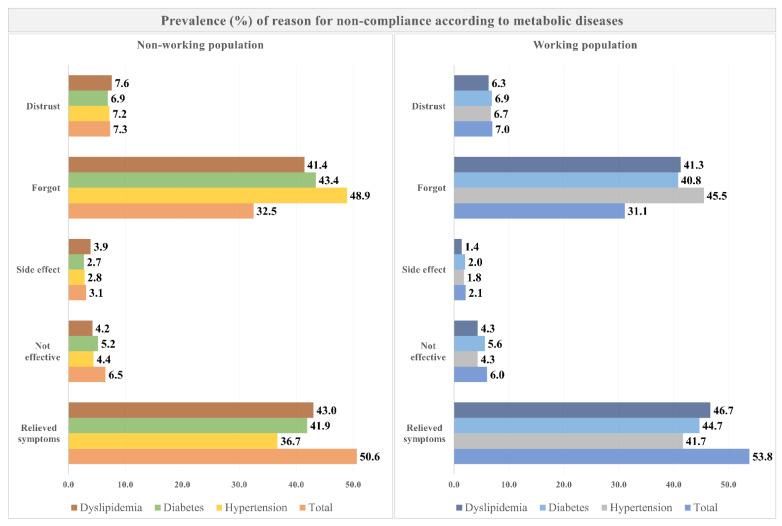
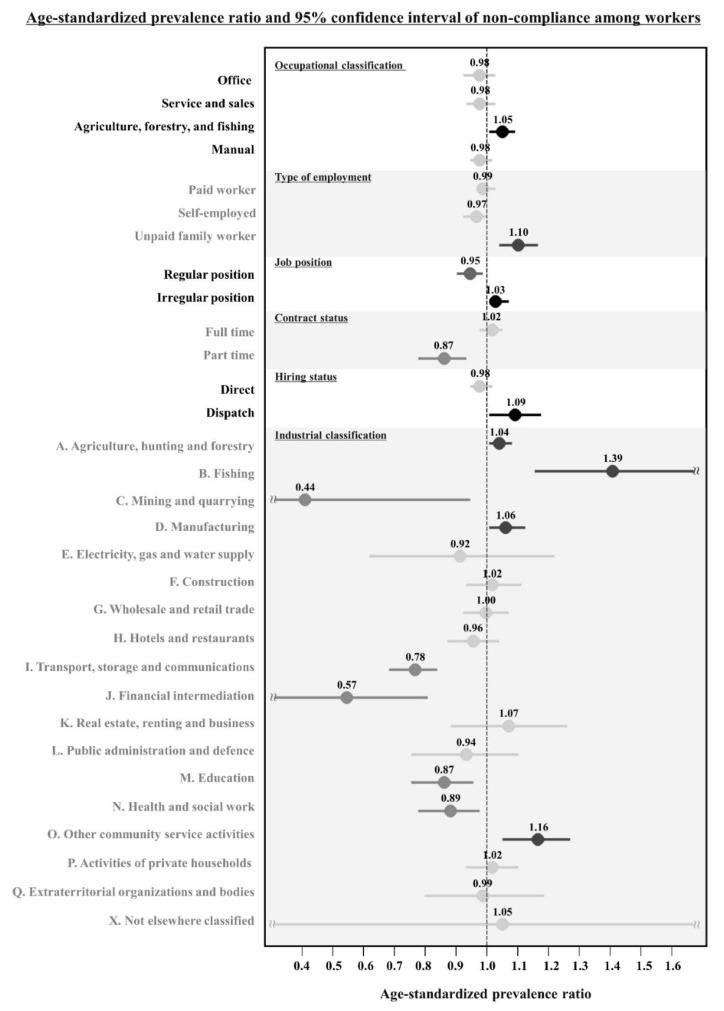
Thus far, little attention has been paid to adherence to medications focusing on the workers and occupational characteristics. This study aimed to assess the status and risk of noncompliance among workers compared to nonworkers, and the association between nonadherence to medication of metabolic diseases and occupational characteristics. Self-reported adherence to medications for hypertension, diabetes, or dyslipidemia and occupational characteristics were evaluated using the Korea Health Panel Study (2008-2018). The status of adherence to medications was evaluated based on working status, with detailed reasons provided for noncompliance. The risk of noncompliance was estimated using the generalized estimating equation, and a subgroup analysis with age-standardized prevalence ratio according to occupational characteristics was also conducted. During the follow-up period, 19,660 (13.9%) person years were noncompliant with medication adherence for 141,807 person years. Workers had a higher prevalence (15.0%) of noncompliance than nonworkers (13.0%). Workers (OR:1.10, 95% CI:1.04-1.14) showed an increased risk of noncompliance compared to nonworkers. Workers who were manual, unpaid family workers, irregular, or dispatched workers showed an increased prevalence of noncompliance. This study found that workers were susceptible to nonadherence to metabolic disease medication. Future research on the role of working conditions in medication adherence would benefit metabolic disease prevention.
到目前为止,很少有人关注针对工人和职业特征的药物依从性。本研究旨在评估与非工人相比,工人中不依从药物治疗的现状和风险,以及代谢疾病药物不依从与职业特征之间的关联。使用韩国健康面板研究(2008 - 2018年)评估自我报告的高血压、糖尿病或血脂异常药物依从性以及职业特征。根据工作状态评估药物依从性状况,并为不依从提供详细原因。使用广义估计方程估计不依从的风险,并根据职业特征进行年龄标准化患病率比的亚组分析。在随访期间,141,807人年中有19,660人年(13.9%)存在药物治疗不依从情况。工人的不依从患病率(15.0%)高于非工人(13.0%)。与非工人相比,工人(比值比:1.10,95%置信区间:1.04 - 1.14)出现不依从的风险增加。体力劳动者、无薪家庭工人、非正规或派遣工人的不依从患病率有所增加。本研究发现,工人易出现代谢疾病药物治疗不依从情况。未来关于工作条件在药物依从性中作用的研究将有助于代谢疾病的预防。

 Zotero 插件