
BNT162b2 mRNA新冠疫苗在泰国患有慢性病的青少年中的免疫原性和反应原性
Immunogenicity and Reactogenicity of mRNA BNT162b2 COVID-19 Vaccine among Thai Adolescents with Chronic Diseases.
作者信息
Chantasrisawad Napaporn, Puthanakit Thanyawee, Tangsathapornpong Auchara, Techasaensiri Chonnamet, Phongsamart Wanatpreeya, Suwanpakdee Detchvijitr, Jaruampornpan Peera, Sophonphan Jiratchaya, Suntarattiwong Piyarat, Chotpitayasunondh Tawee
机构信息
Department of Pediatrics, Faculty of Medicine, Chulalongkorn University, Bangkok 10330, Thailand.
Center of Excellence for Pediatric Infectious Diseases and Vaccines, Faculty of Medicine, Chulalongkorn University, Bangkok 10330, Thailand.
出版信息
Vaccines (Basel). 2022 May 29;10(6):871. doi: 10.3390/vaccines10060871.
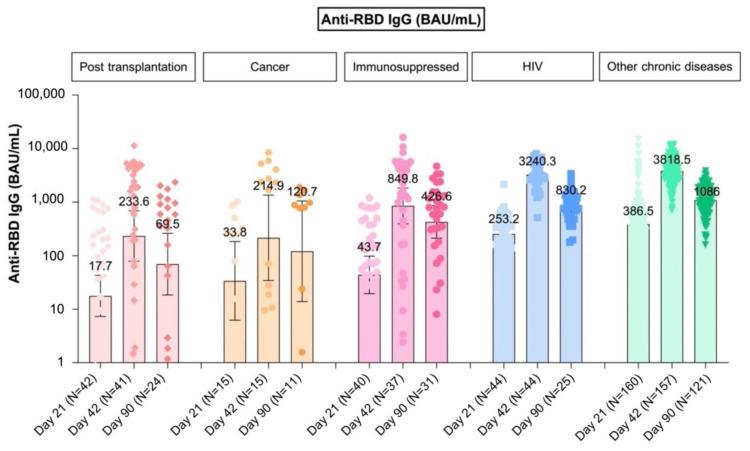
Adolescents with underlying diseases are at risk of severe COVID-19. The immune response of BNT162b2 may be poor among immunocompromised adolescents. We aim to describe immunogenicity of mRNA BNT162b2 among adolescents who are immunocompromised or have chronic diseases. We recruited adolescents 12-18 years of age; group A impaired-immunity (post-transplantation, cancer, on immunosuppressive drugs) and group B chronic diseases. A two-dose regimen of BNT162b2 was given. Immunogenicity was determined by surrogate virus neutralization test (sVNT) and IgG against receptor-binding domain (RBD). From August to October 2021, 312 adolescents, with a median age (IQR) of 15 years (13.7-16.5), were enrolled (group A 100, group B 212). The geometric means (GMs) of sVNT (% inhibition) against Delta strain and anti-RBD IgG (BAU/mL) after the 2nd dose among group A were: post-transplantation recipients 52.9 (95% CI 37.7-74.2) and 233.6 (95% CI 79-690.6); adolescents with cancer 62.3 (95% CI 29.2-133.1) and 214.9(95% CI 34.2-1348.6); and adolescents with other immunosuppressive conditions 66.7 (95% CI 52.4-84.8) and 849.8 (95% CI 393.4-1835.8). In group B were: adolescents living with HIV 98 (95% CI 97.3-98.8) and 3240.3 (95% CI 2699-3890.2), and adolescents with other chronic disease 98.6 (95% CI 98.3-98.9) and 3818.5 (95% CI 3490.4-4177.4). At day 90, immunity declined; among impaired-immunity participants were 43.9 (95% CI 30.8-62.4) and 178.7 (95% CI 91.2-350.1) and adolescents with chronic diseases were 90.6 (95% CI 88.4-92.8) and 1037.1 (95% CI 933.3-1152.5). In conclusion, adolescents with impaired immunity had a poor response to 2-doses of BNT162b2, additional dose should be considered. Adolescents with chronic diseases had excellent response but immunity waned after 3 m, booster dose may be required.
患有基础疾病的青少年有患重症 COVID-19 的风险。在免疫功能低下的青少年中,BNT162b2 的免疫反应可能较差。我们旨在描述 mRNA BNT162b2 在免疫功能低下或患有慢性疾病的青少年中的免疫原性。我们招募了 12 至 18 岁的青少年;A 组为免疫功能受损(移植后、癌症、使用免疫抑制药物),B 组为慢性疾病。给予两剂 BNT162b2 方案。通过替代病毒中和试验(sVNT)和针对受体结合域(RBD)的 IgG 来确定免疫原性。2021 年 8 月至 10 月,共纳入 312 名青少年,中位年龄(IQR)为 15 岁(13.7 - 16.5),其中 A 组 100 名,B 组 212 名。A 组第二次接种后针对德尔塔毒株的 sVNT(%抑制率)几何均值和抗 RBD IgG(BAU/mL)分别为:移植后受者 52.9(95%CI 37.7 - 74.2)和 233.6(95%CI 79 - 690.6);癌症青少年 62.3(95%CI 29.2 - 133.1)和 214.9(95%CI 34.2 - 1348.6);以及患有其他免疫抑制疾病的青少年 66.7(95%CI 52.4 - 84.8)和 849.8(95%CI 393.4 - 1835.8)。B 组分别为:感染艾滋病毒的青少年 98(95%CI 97.3 - 98.8)和 3240.3(95%CI 2699 - 3890.2),以及患有其他慢性疾病的青少年 98.6(95%CI 98.3 - 98.9)和 3818.5(95%CI 3490.4 - 4177.4)。在第 90 天,免疫力下降;免疫功能受损参与者中为 43.9(95%CI 30.8 - 62.4)和 178.7(95%CI 91.2 - 350.1),患有慢性疾病的青少年中为 90.6(95%CI 88.4 - 92.8)和 1037.1(95%CI 933.3 - 1152.5)。总之,免疫功能受损的青少年对两剂 BNT162b2 反应较差,应考虑增加剂量。患有慢性疾病的青少年反应良好,但 3 个月后免疫力减弱,可能需要加强剂量。

 Zotero 插件