
利用发病数据和流动数据从确定性和半确定性房室模型中推断有效繁殖数。
Inferring the effective reproductive number from deterministic and semi-deterministic compartmental models using incidence and mobility data.
机构信息
Data Science Institute and School of Computer Science, National University of Ireland Galway, Ireland.
School of Computer Science, Ryan Institute and Data Science Institute, National University of Ireland Galway, Ireland.
出版信息
PLoS Comput Biol. 2022 Jun 27;18(6):e1010206. doi: 10.1371/journal.pcbi.1010206. eCollection 2022 Jun.
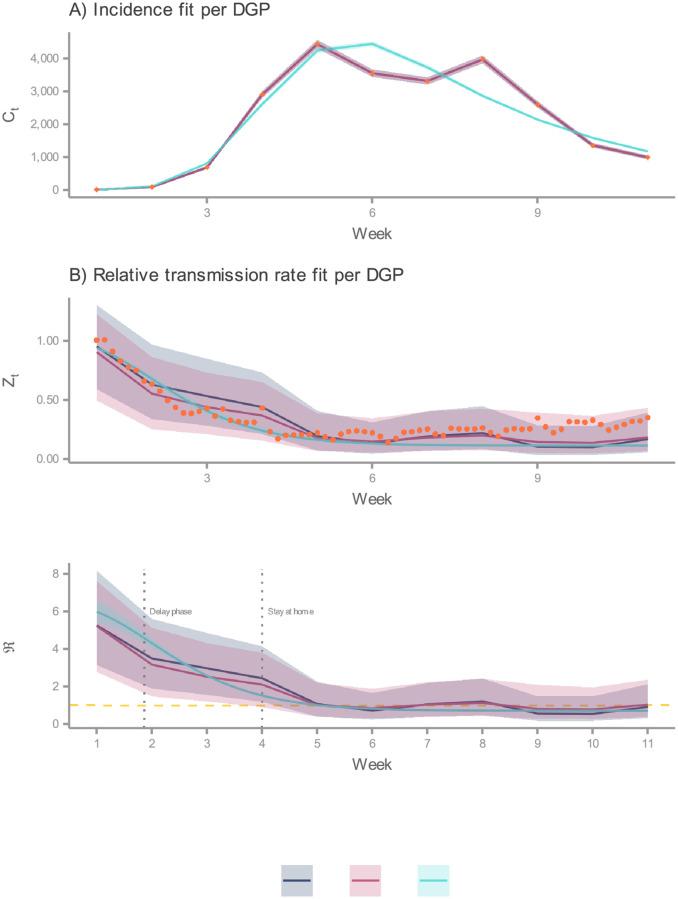
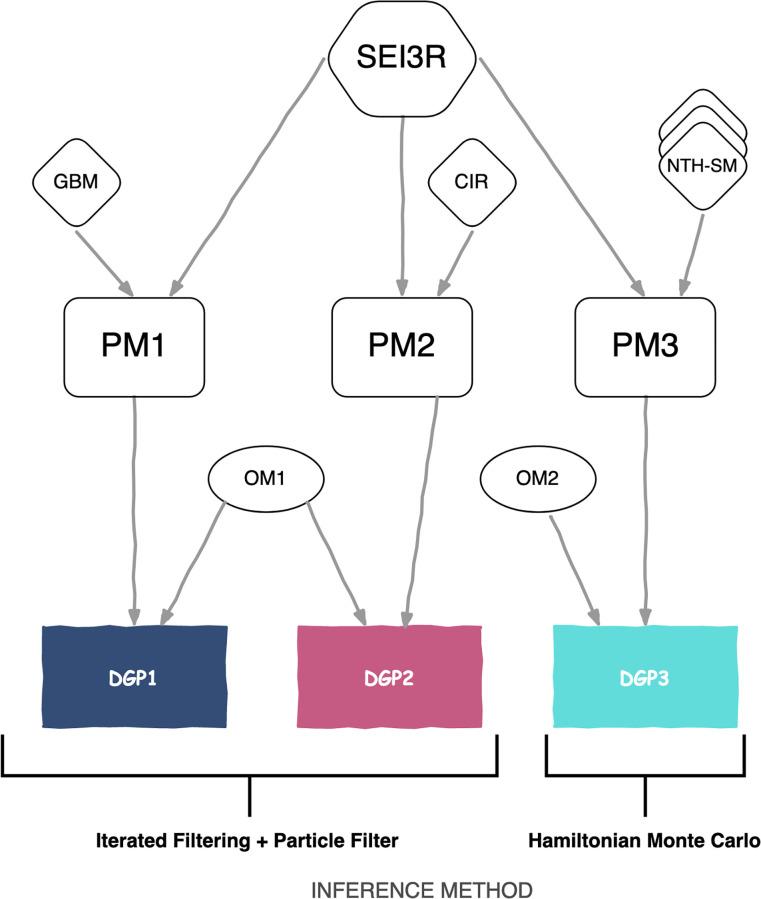
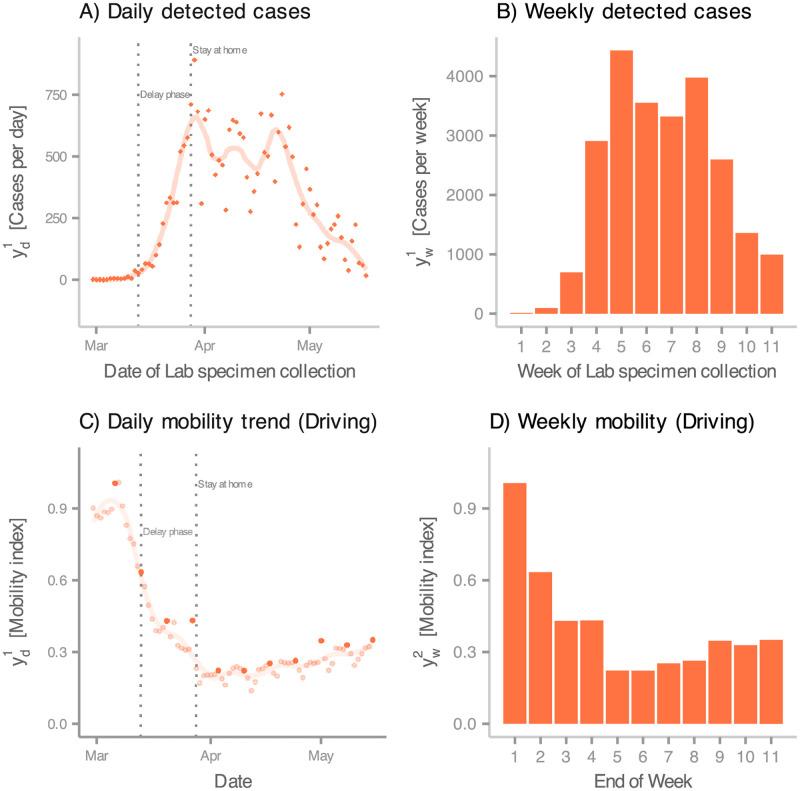
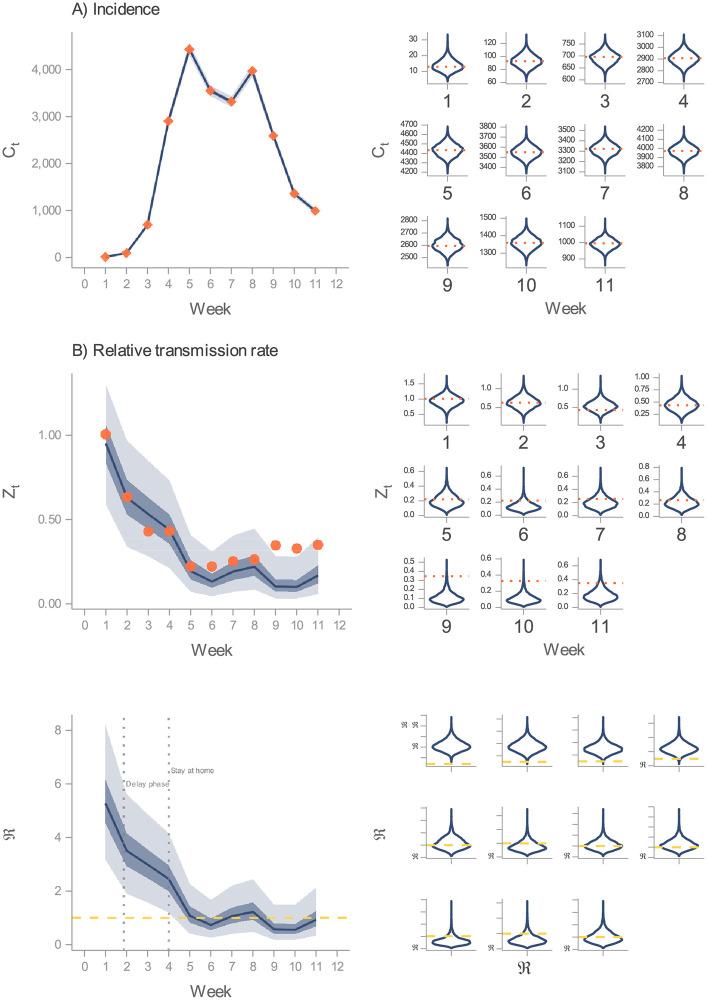
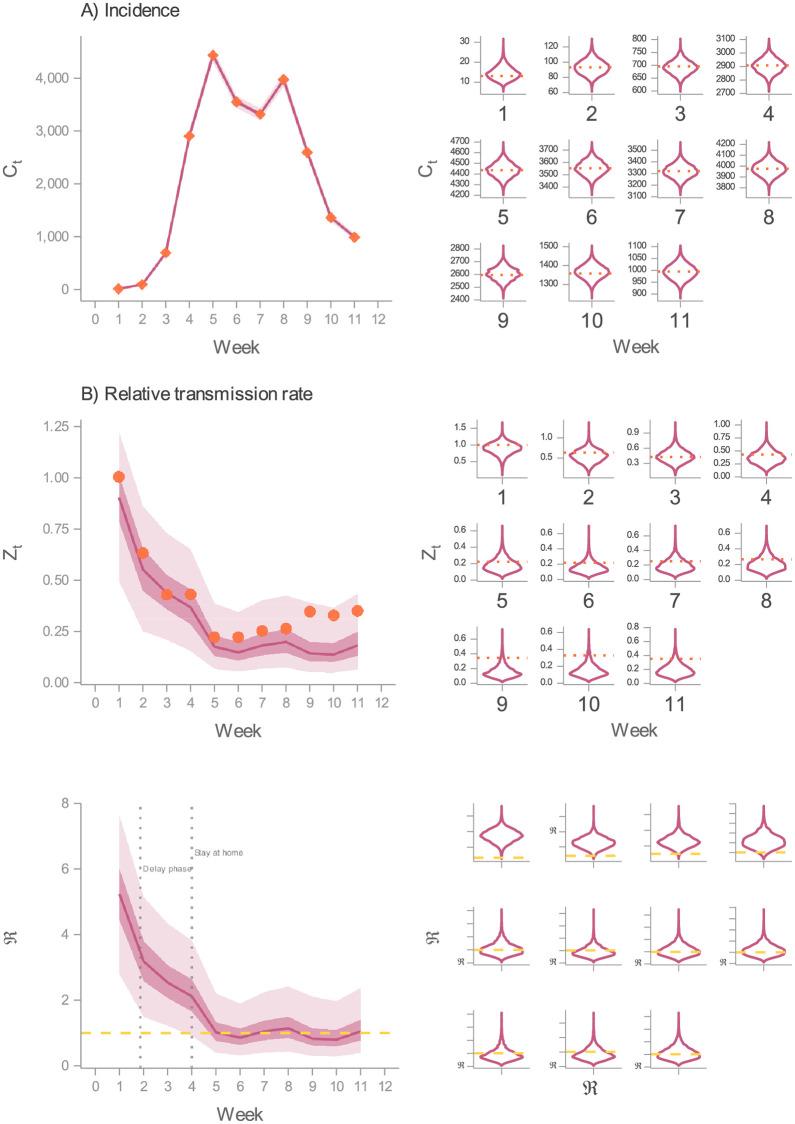
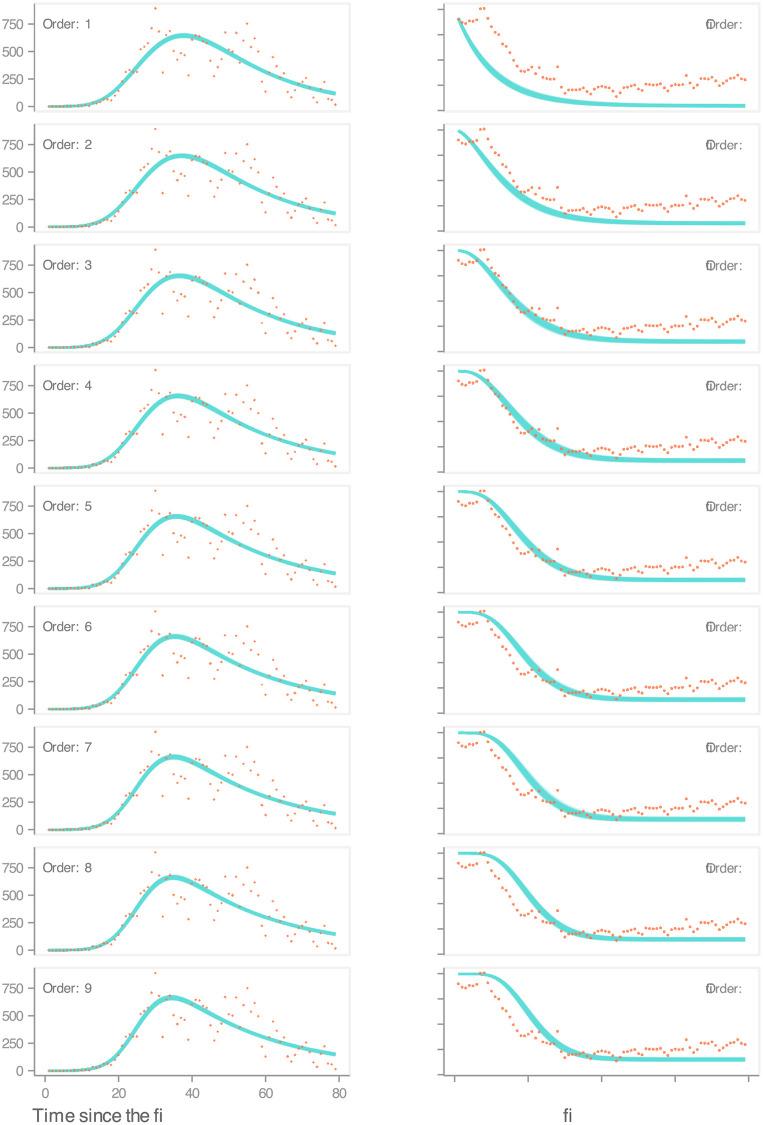
The effective reproduction number (ℜt) is a theoretical indicator of the course of an infectious disease that allows policymakers to evaluate whether current or previous control efforts have been successful or whether additional interventions are necessary. This metric, however, cannot be directly observed and must be inferred from available data. One approach to obtaining such estimates is fitting compartmental models to incidence data. We can envision these dynamic models as the ensemble of structures that describe the disease's natural history and individuals' behavioural patterns. In the context of the response to the COVID-19 pandemic, the assumption of a constant transmission rate is rendered unrealistic, and it is critical to identify a mathematical formulation that accounts for changes in contact patterns. In this work, we leverage existing approaches to propose three complementary formulations that yield similar estimates for ℜt based on data from Ireland's first COVID-19 wave. We describe these Data Generating Processes (DGP) in terms of State-Space models. Two (DGP1 and DGP2) correspond to stochastic process models whose transmission rate is modelled as Brownian motion processes (Geometric and Cox-Ingersoll-Ross). These DGPs share a measurement model that accounts for incidence and transmission rates, where mobility data is assumed as a proxy of the transmission rate. We perform inference on these structures using Iterated Filtering and the Particle Filter. The final DGP (DGP3) is built from a pool of deterministic models that describe the transmission rate as information delays. We calibrate this pool of models to incidence reports using Hamiltonian Monte Carlo. By following this complementary approach, we assess the tradeoffs associated with each formulation and reflect on the benefits/risks of incorporating proxy data into the inference process. We anticipate this work will help evaluate the implications of choosing a particular formulation for the dynamics and observation of the time-varying transmission rate.
有效繁殖数(ℜt)是衡量传染病病程的理论指标,可使决策者评估当前或以往的控制措施是否成功,或者是否需要采取额外的干预措施。然而,该指标无法直接观察,必须根据可用数据进行推断。一种获得此类估计值的方法是将房室模型拟合到发病率数据上。我们可以将这些动态模型想象为描述疾病自然史和个体行为模式的结构集合。在应对 COVID-19 大流行的背景下,假设传播率保持不变是不现实的,关键是要确定一种数学公式来考虑接触模式的变化。在这项工作中,我们利用现有的方法提出了三种互补的公式,这些公式基于爱尔兰第一波 COVID-19 数据得出了相似的 ℜt 估计值。我们使用状态空间模型来描述这些数据生成过程(DGP)。其中两个(DGP1 和 DGP2)对应于随机过程模型,其传播率被建模为布朗运动过程(几何布朗运动和 Cox-Ingersoll-Ross 布朗运动)。这些 DGP 具有相同的测量模型,该模型考虑了发病率和传播率,其中移动性数据被视为传播率的代理。我们使用迭代滤波和粒子滤波对这些结构进行推断。最后一个 DGP(DGP3)是由一组确定性模型构建的,这些模型将传播率描述为信息延迟。我们使用汉密尔顿蒙特卡罗法将该模型池拟合到发病率报告中。通过这种互补的方法,我们评估了每种公式的权衡,并思考了将代理数据纳入推断过程的利弊。我们预计这项工作将有助于评估选择特定公式对时变传播率的动态和观察的影响。

 Zotero 插件