
聚合物纳米颗粒中的光诱导电荷产生可恢复晚期视网膜色素变性大鼠的视力。
Light-induced charge generation in polymeric nanoparticles restores vision in advanced-stage retinitis pigmentosa rats.
机构信息
Center for Synaptic Neuroscience and Technology, Istituto Italiano di Tecnologia, Genova, Italy.
IRCCS Ospedale Policlinico San Martino, Genova, Italy.
出版信息
Nat Commun. 2022 Jun 27;13(1):3677. doi: 10.1038/s41467-022-31368-3.
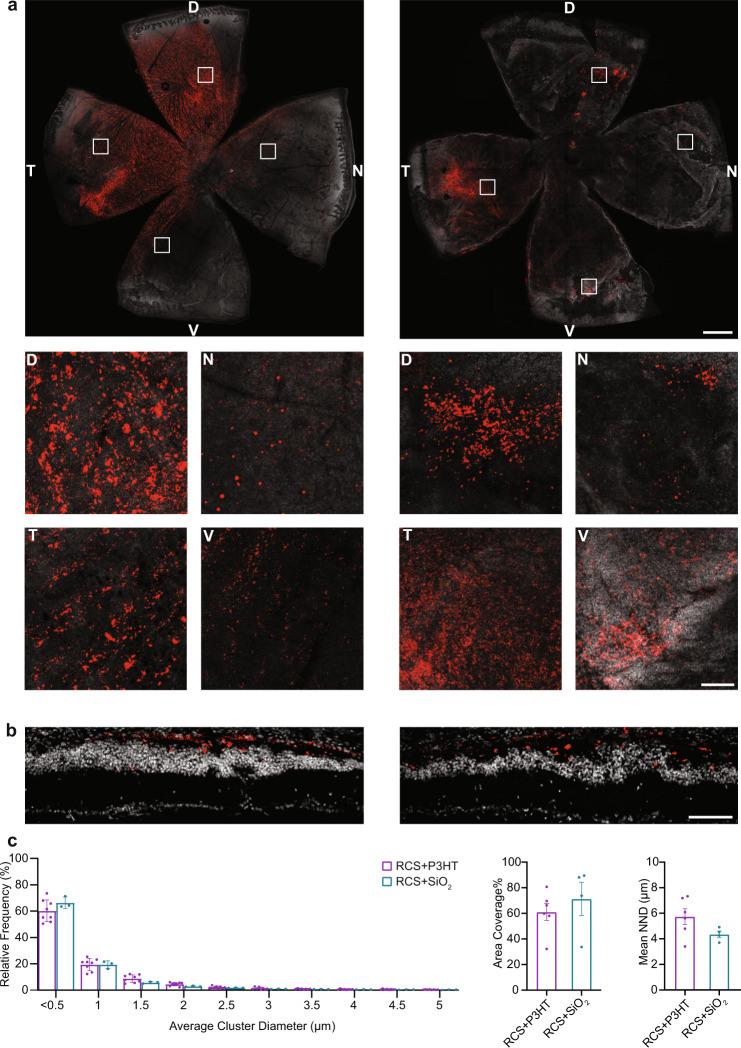
Retinal dystrophies such as Retinitis pigmentosa are among the most prevalent causes of inherited legal blindness, for which treatments are in demand. Retinal prostheses have been developed to stimulate the inner retinal network that, initially spared by degeneration, deteriorates in the late stages of the disease. We recently reported that conjugated polymer nanoparticles persistently rescue visual activities after a single subretinal injection in the Royal College of Surgeons rat model of Retinitis pigmentosa. Here we demonstrate that conjugated polymer nanoparticles can reinstate physiological signals at the cortical level and visually driven activities when microinjected in 10-months-old Royal College of Surgeons rats bearing fully light-insensitive retinas. The extent of visual restoration positively correlates with the nanoparticle density and hybrid contacts with second-order retinal neurons. The results establish the functional role of organic photovoltaic nanoparticles in restoring visual activities in fully degenerate retinas with intense inner retina rewiring, a stage of the disease in which patients are subjected to prosthetic interventions.
视网膜营养不良,如色素性视网膜炎,是遗传性失明的最常见原因之一,对此存在治疗需求。为此,人们开发了视网膜假体以刺激内层视网膜网络,该网络最初免受变性影响,但在疾病晚期会恶化。我们最近报道,共轭聚合物纳米粒子在皇家外科学院色素性视网膜炎大鼠模型单次视网膜下注射后,可持续挽救视觉活动。在这里,我们证明当将共轭聚合物纳米粒子微注射到具有完全光敏感的视网膜的 10 月龄皇家外科学院大鼠中时,它们可以在皮质水平和视觉驱动的活动中恢复生理信号。视觉恢复的程度与纳米颗粒密度和与二级视网膜神经元的混合接触呈正相关。这些结果确立了有机光伏纳米粒子在恢复具有强烈内部视网膜重连的完全退化的视网膜中的视觉活动的功能作用,这是患者接受假体干预的疾病阶段。




 Zotero 插件