
趋化因子和替代分子梯度的不同命运:对 CCR7 指导的树突状细胞迁移的影响。
Distinct Fates of Chemokine and Surrogate Molecule Gradients: Consequences for CCR7-Guided Dendritic Cell Migration.
机构信息
Biotechnology Institute Thurgau (BITg) at the University of Konstanz, Kreuzlingen, Switzerland.
Graduate School for Cellular and Biomedical Sciences, University of Bern, Bern, Switzerland.
出版信息
Front Immunol. 2022 Jun 13;13:913366. doi: 10.3389/fimmu.2022.913366. eCollection 2022.
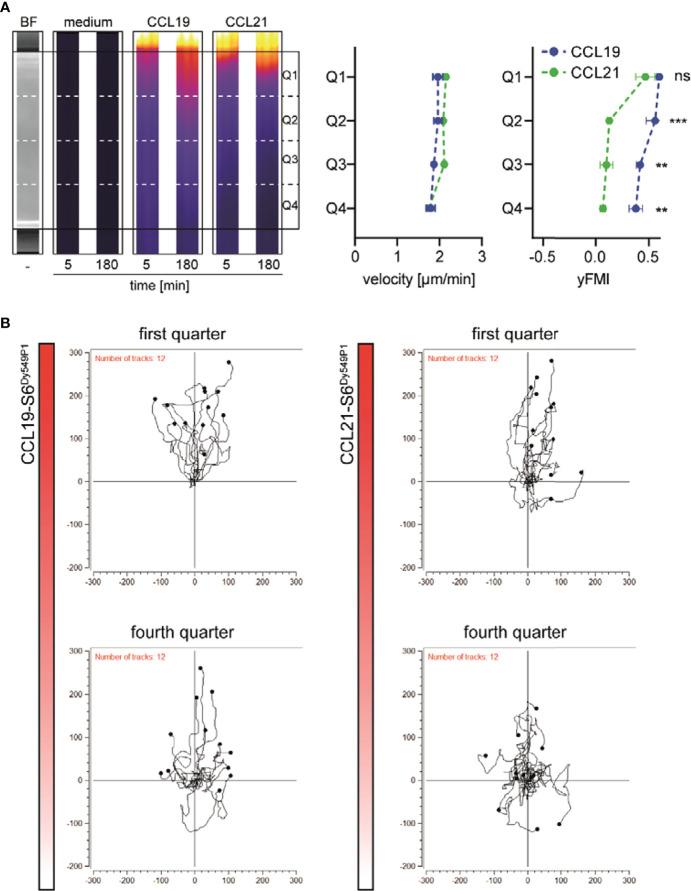
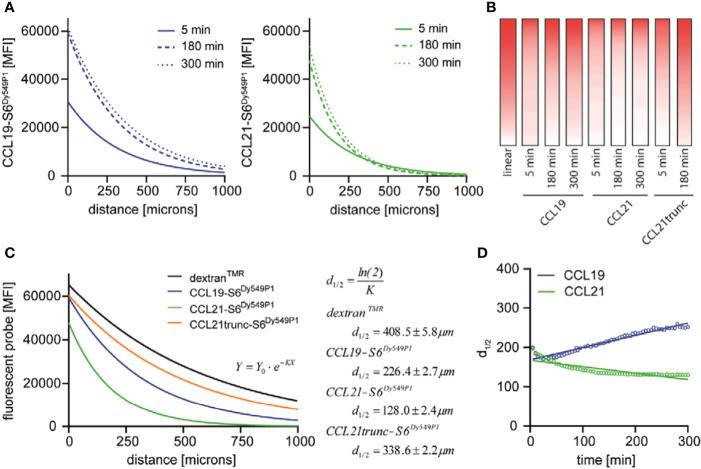
Chemokine-guided leukocyte migration is a hallmark of the immune system to cope with invading pathogens. Intruder confronted dendritic cells (DCs) induce the expression of the chemokine receptor CCR7, which enables them to sense and migrate along chemokine gradients to home to draining lymph nodes, where they launch an adaptive immune response. Chemokine-mediated DC migration is recapitulated and intensively studied in 3D matrix migration chambers. A major caveat in the field is that chemokine gradient formation and maintenance in such 3D environments is generally not assessed. Instead, fluorescent probes, mostly labelled dextran, are used as surrogate molecules, thereby neglecting important electrochemical properties of the chemokines. Here, we used site-specifically, fluorescently labelled CCL19 and CCL21 to study the establishment and shape of the chemokine gradients over time in the 3D collagen matrix. We demonstrate that CCL19 and particularly CCL21 establish stable, but short-distance spanning gradients with an exponential decay-like shape. By contrast, dextran with its neutral surface charge forms a nearly linear gradient across the entire matrix. We show that the charged C-terminal tail of CCL21, known to interact with extracellular matrix proteins, is determinant for shaping the chemokine gradient. Importantly, DCs sense differences in the shape of CCL19 and CCL21 gradients, resulting in distinct spatial migratory responses.
趋化因子引导的白细胞迁移是免疫系统应对入侵病原体的标志。入侵的树突状细胞 (DC) 诱导趋化因子受体 CCR7 的表达,使其能够感知并沿着趋化因子梯度迁移到引流淋巴结,在那里它们发起适应性免疫反应。趋化因子介导的 DC 迁移在 3D 基质迁移室中得到了再现和深入研究。该领域的一个主要问题是,一般不评估此类 3D 环境中趋化因子梯度的形成和维持。相反,荧光探针,主要是标记的葡聚糖,被用作替代分子,从而忽略了趋化因子的重要电化学特性。在这里,我们使用特异性荧光标记的 CCL19 和 CCL21 来研究趋化因子梯度在 3D 胶原基质中随时间的建立和形状。我们证明 CCL19 特别是 CCL21 形成稳定的,但短程跨度的梯度,具有指数衰减样的形状。相比之下,带有中性表面电荷的葡聚糖在整个基质中形成几乎线性的梯度。我们表明,CCL21 的带电荷的 C 末端尾巴已知与细胞外基质蛋白相互作用,是塑造趋化因子梯度的决定因素。重要的是,DC 能够感知 CCL19 和 CCL21 梯度形状的差异,从而导致不同的空间迁移反应。

 Zotero 插件