
脐带血清元素组学分析 52 种微量元素与儿童早期神经发育:来自孟加拉国农村前瞻性出生队列的证据。
Umbilical cord serum elementomics of 52 trace elements and early childhood neurodevelopment: Evidence from a prospective birth cohort in rural Bangladesh.
机构信息
Department of Biostatistics, School of Public Health, Nanjing Medical University, Nanjing 211166, China.
Department of Environmental Health, Harvard T.H. Chan School of Public Health, Boston, MA 02115, USA.
出版信息
Environ Int. 2022 Aug;166:107370. doi: 10.1016/j.envint.2022.107370. Epub 2022 Jun 24.
BACKGROUND
Prenatal exposures to neurotoxic metals and trace elements are associated with early childhood neurodevelopmental outcomes. However, consequences of simultaneous exposure to mixtures of elements remain unclear.
OBJECTIVE
To examine individual and joint effects of prenatal trace element exposure on early childhood neurodevelopment.
METHODS
Using a well-established Bangladesh prospective birth cohort (2008-2011), we measured concentrations of 52 trace elements in umbilical cord serum of 569 mother-infant pairs using inductively coupled plasma mass spectrometry. Neurodevelopment was evaluated at 20-40 months of age using Bayley Scales of Infant and Toddler Development, Third Edition. Stability elastic net (ENET) was used to screen elements individually associated with the outcome; candidate exposures were combined by weighted linear combination to form a risk score representing their mixture effect on early childhood neurodevelopment.
RESULTS
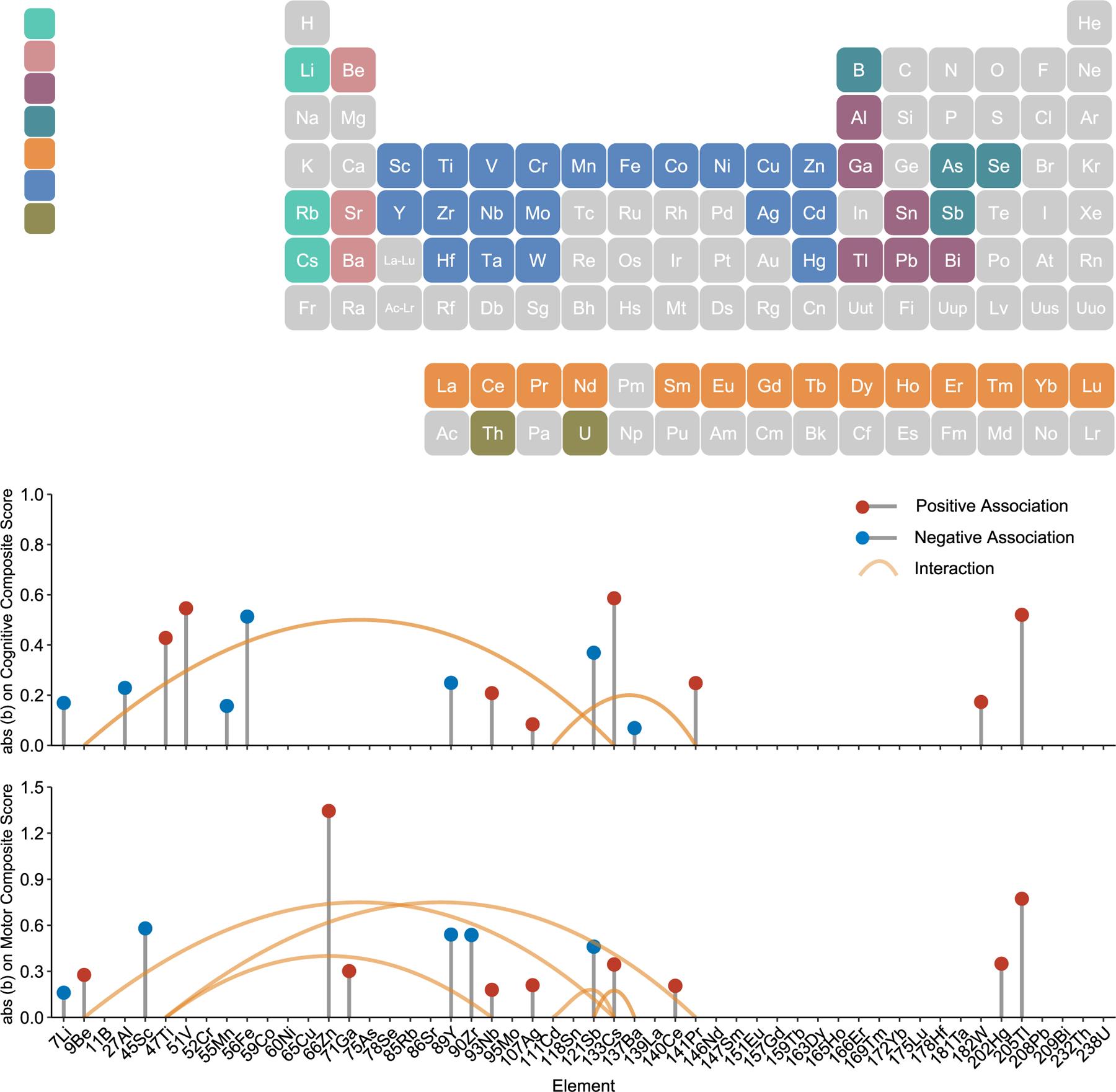
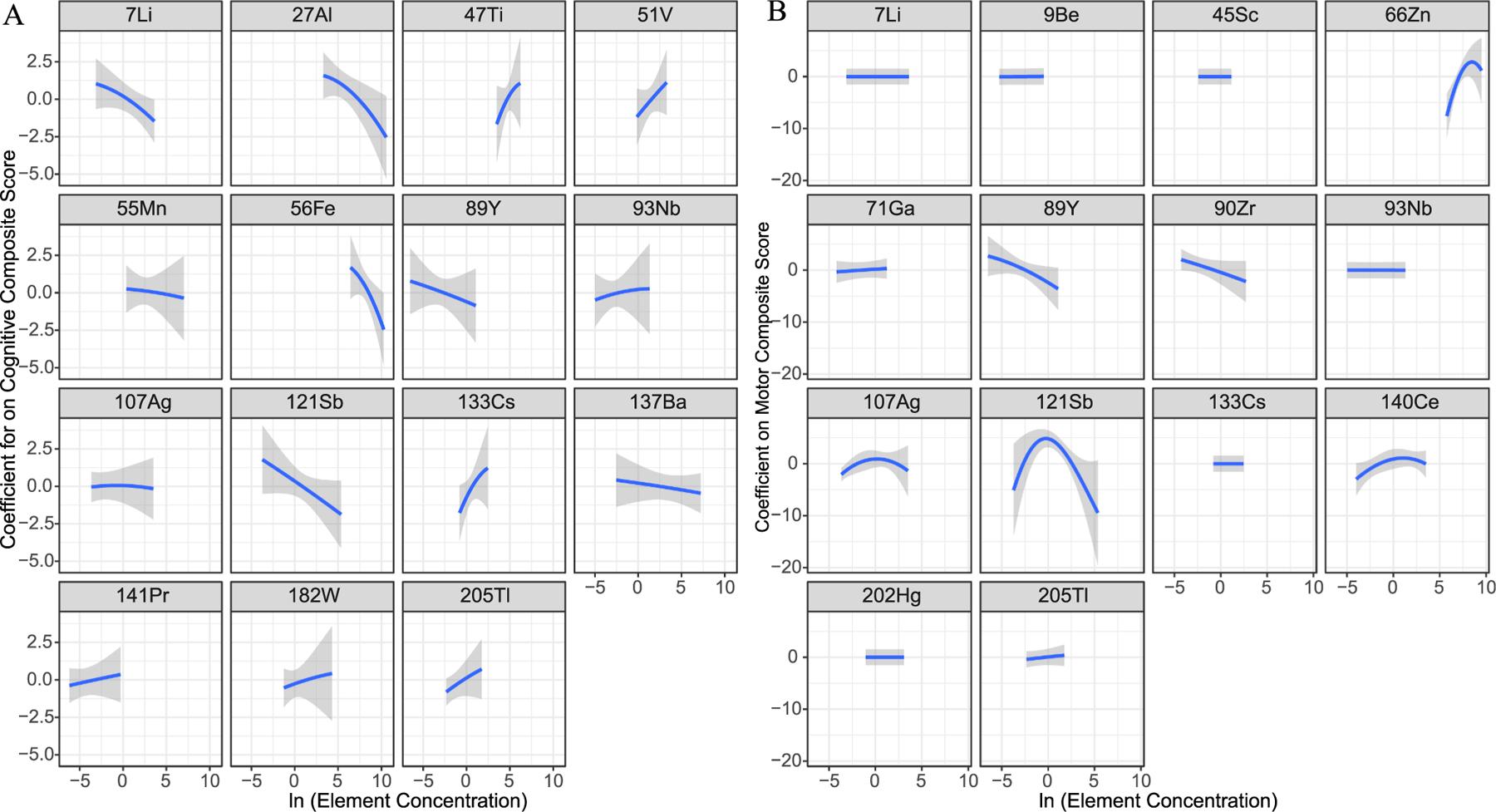
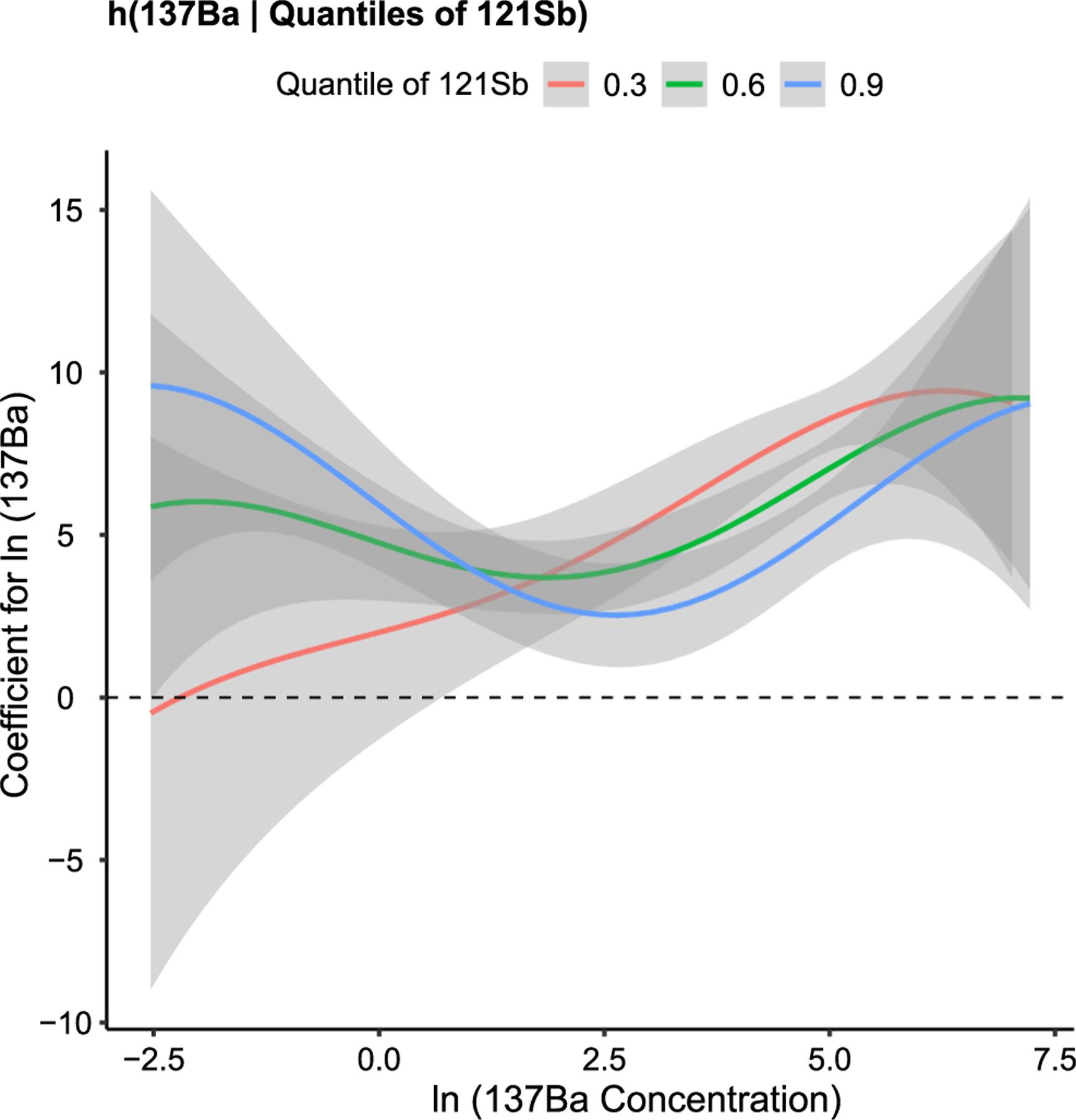
Stability ENET identified 15 trace elements associated with cognitive composite score and 14 associated with motor composite score, which were linearly combined to form the element risk score (ERS). Children with higher ERS had lower probability of cognitive developmental delay (OR: 0.21; 95 %CI: 0.10, 0.40; P < 0.001; P < 0.001). Children with ERS in the top quintile had a significantly lower risk of motor developmental delay (OR: 0.16; 95 %CI: 0.09, 0.31; P < 0.001; P < 0.001) versus the lowest quintile. In Bayesian kernel machine regression analyses, lithium [conditional posterior inclusion probability (cPIP) = 0.68], aluminum (cPIP = 0.83) and iron (cPIP = 1.00) contributed most to the lower cognitive composite score; zinc (cPIP = 1.00), silver (cPIP = 0.81), and antimony (cPIP = 0.65) mainly contributed to the change of motor composite score.
CONCLUSION
Co-exposure to lithium/aluminum/iron or zinc/silver/antimony appears to impact children's neurodevelopment. ERS score reflecting maternal exposure could indicate children's risk of neurodevelopmental delay, warranting further studies to explore the underlying mechanism.
背景
产前暴露于神经毒性金属和微量元素与儿童早期神经发育结局有关。然而,同时暴露于元素混合物的后果尚不清楚。
目的
研究产前微量元素暴露对儿童早期神经发育的个体和联合作用。
方法
利用一个成熟的孟加拉国前瞻性出生队列(2008-2011 年),我们使用电感耦合等离子体质谱法测量了 569 对母婴脐带血清中 52 种微量元素的浓度。使用贝利婴幼儿发育量表第三版在 20-40 个月龄时评估神经发育。稳定性弹性网络(ENET)用于筛选与结果单独相关的元素;候选暴露物通过加权线性组合组合在一起,形成代表其对儿童早期神经发育混合效应的风险评分。
结果
稳定性 ENET 确定了 15 种与认知综合评分相关的微量元素和 14 种与运动综合评分相关的微量元素,它们被线性组合形成元素风险评分(ERS)。ERS 较高的儿童认知发育迟缓的可能性较低(OR:0.21;95%CI:0.10,0.40;P<0.001;P<0.001)。ERS 处于最高五分位的儿童运动发育迟缓的风险显著降低(OR:0.16;95%CI:0.09,0.31;P<0.001;P<0.001),而最低五分位的儿童则无此情况。在贝叶斯核机器回归分析中,锂[条件后验纳入概率(cPIP)=0.68]、铝(cPIP=0.83)和铁(cPIP=1.00)对认知综合评分的降低贡献最大;锌(cPIP=1.00)、银(cPIP=0.81)和锑(cPIP=0.65)主要影响运动综合评分的变化。
结论
锂/铝/铁或锌/银/锑的共同暴露似乎会影响儿童的神经发育。反映母体暴露的 ERS 评分可以表明儿童神经发育迟缓的风险,需要进一步研究以探索潜在机制。

 Zotero 插件