
快速 SOFA 评分和炎症生物标志物对社区获得性菌血症预测的诊断准确性。
Diagnostic accuracy of quick SOFA score and inflammatory biomarkers for predicting community-onset bacteremia.
机构信息
Department of Infectious Diseases, Aso Iizuka Hospital, 3-83 Yoshio, Iizuka, Fukuoka, 820-8505, Japan.
Department of Clinical Laboratory, Aso Iizuka Hospital, Iizuka, Fukuoka, Japan.
出版信息
Sci Rep. 2022 Jul 1;12(1):11121. doi: 10.1038/s41598-022-15408-y.
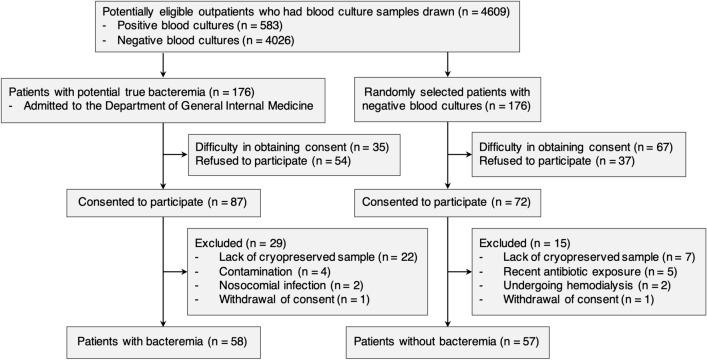
The potential use of quick SOFA (qSOFA) score and inflammatory biomarkers as bacteremia predictors is unelucidated. Herein the aim of this study was to evaluate the diagnostic accuracy of the qSOFA score and biomarkers for predicting community-onset bacteremia. We enrolled adult outpatients with blood culture samples drawn between 2018 and 2020. Contamination, intensive care unit admission, and hemodialysis were excluded. We performed a case-control study, and analyzed 115 patients (58 with bacteremia and 57 without bacteremia). The positive likelihood ratio (LR) for bacteremia was 2.46 (95% confidence interval [CI] 0.76-9.05) for a qSOFA score ≥ 2, and 4.07 (95% CI 1.92-9.58) for tachypnea (≥ 22/min). The highest performing biomarkers were procalcitonin (area under the curve [AUC] 0.80; 95% CI 0.72-0.88), followed by presepsin (AUC 0.69; 95% CI 0.60-0.79), and C-reactive protein (AUC 0.60; 95% CI 0.49-0.70). The estimated optimal cut-off value of procalcitonin was 0.377 ng/mL, with a sensitivity of 74.1%, a specificity of 73.7%, and a positive LR of 2.82. Presepsin was 407 pg/mL, with a sensitivity of 60.3%, a specificity of 75.4%, and a positive LR of 2.46. Procalcitonin was found to be a modestly useful biomarker for predicting non-severe community-onset bacteremia. Tachypnea (≥ 22/min) itself, rather than the qSOFA score, can be a diagnostic predictor. These predictors may aid decision-making regarding the collection of blood culture samples in the emergency department and outpatient clinics.
快速序贯器官衰竭评估(qSOFA)评分和炎症生物标志物作为菌血症预测因子的潜在用途尚未阐明。本研究旨在评估 qSOFA 评分和生物标志物对预测社区获得性菌血症的诊断准确性。我们纳入了 2018 年至 2020 年间采集血培养样本的成年门诊患者。排除了污染、重症监护病房入院和血液透析的患者。我们进行了一项病例对照研究,分析了 115 名患者(58 名菌血症患者和 57 名非菌血症患者)。qSOFA 评分≥2 的菌血症阳性似然比(LR)为 2.46(95%置信区间[CI] 0.76-9.05),呼吸急促(≥22/min)为 4.07(95%CI 1.92-9.58)。表现最佳的生物标志物是降钙素原(AUC 0.80;95%CI 0.72-0.88),其次是降钙素原前肽(AUC 0.69;95%CI 0.60-0.79)和 C 反应蛋白(AUC 0.60;95%CI 0.49-0.70)。降钙素原的最佳截断值估计为 0.377 ng/mL,其敏感性为 74.1%,特异性为 73.7%,阳性 LR 为 2.82。降钙素原前肽为 407 pg/mL,敏感性为 60.3%,特异性为 75.4%,阳性 LR 为 2.46。降钙素原对预测非严重社区获得性菌血症是一种中等有用的生物标志物。呼吸急促(≥22/min)本身,而不是 qSOFA 评分,可以作为诊断预测指标。这些预测指标可能有助于在急诊科和门诊决策是否采集血培养样本。

 Zotero 插件