
烟酰胺促进人多能干细胞形成视网膜类器官 增强神经细胞命运决定。
Nicotinamide Promotes Formation of Retinal Organoids From Human Pluripotent Stem Cells Enhanced Neural Cell Fate Commitment.
作者信息
Regent Florian, Batz Zachary, Kelley Ryan A, Gieser Linn, Swaroop Anand, Chen Holly Y, Li Tiansen
机构信息
Neurobiology, Neurodegeneration & Repair Laboratory, National Eye Institute, National Institutes of Health, Bethesda, MD, United States.
出版信息
Front Cell Neurosci. 2022 Jun 17;16:878351. doi: 10.3389/fncel.2022.878351. eCollection 2022.
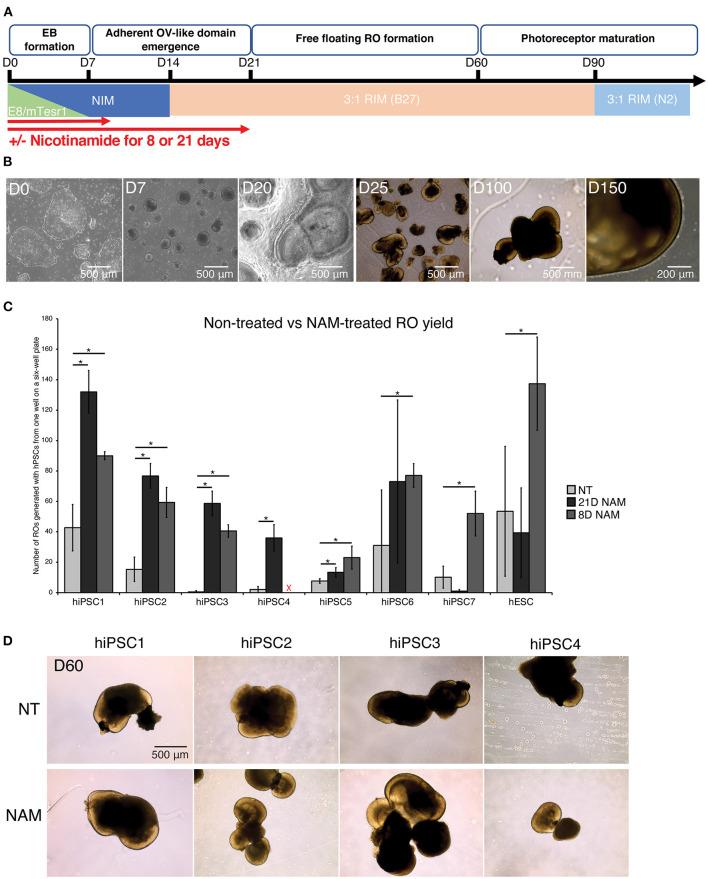
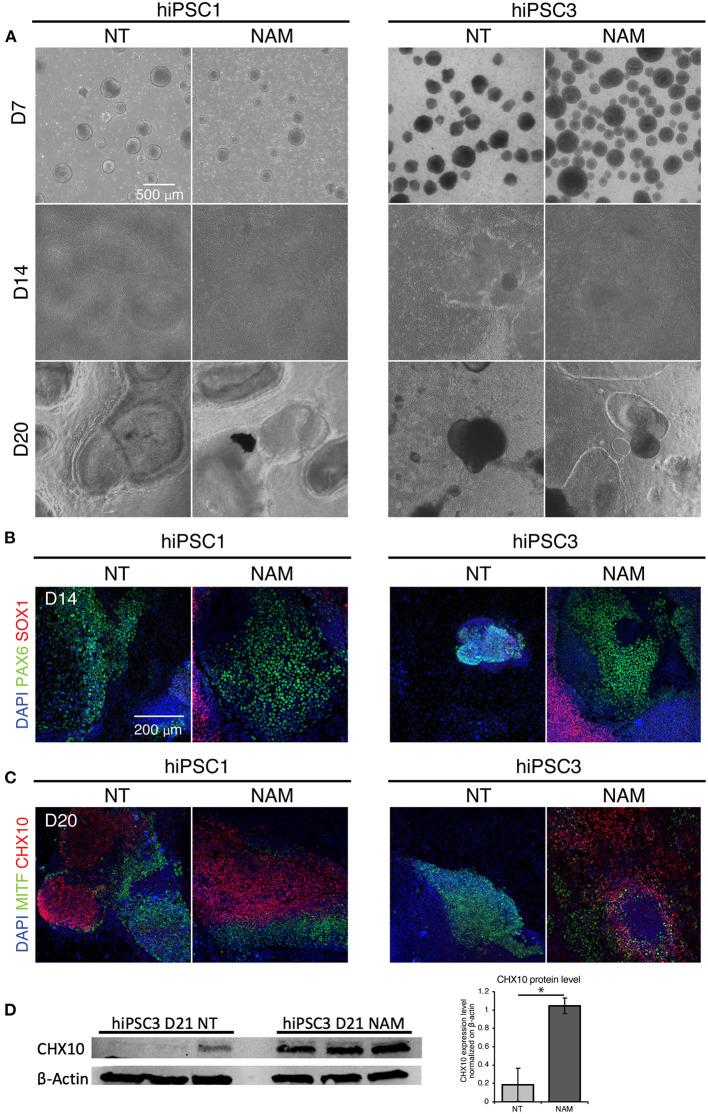
Retinal organoids (ROs) derived from human pluripotent stem cells (hPSCs) recapitulate key features of retinogenesis and provide a promising platform to study retinal development and disease in a human context. Although multiple protocols are currently in use, hPSCs exhibit tremendous variability in differentiation efficiency, with some cell lines consistently yielding few or even no ROs, limiting their utility in research. We report here that early nicotinamide (NAM) treatment significantly improves RO yield across 8 hPSC lines from different donors, including some that would otherwise fail to generate a meaningful number of ROs. NAM treatment promotes neural commitment of hPSCs at the expense of non-neural ectodermal cell fate, which in turn increases eye field progenitor generation. Further analysis suggests that this effect is partially mediated through inhibition of BMP signaling. Our data encourage a broader use of human ROs for disease modeling applications that require the use of multiple patient-specific cell lines.
源自人类多能干细胞(hPSC)的视网膜类器官(RO)概括了视网膜发育的关键特征,并为在人类背景下研究视网膜发育和疾病提供了一个有前景的平台。尽管目前有多种方案在使用,但hPSC在分化效率上表现出极大的变异性,一些细胞系始终只能产生很少甚至没有RO,限制了它们在研究中的效用。我们在此报告,早期烟酰胺(NAM)处理显著提高了来自不同供体的8种hPSC系的RO产量,包括一些否则无法产生有意义数量RO的细胞系。NAM处理以牺牲非神经外胚层细胞命运为代价促进hPSC的神经定向,这反过来又增加了眼场祖细胞的产生。进一步分析表明,这种效应部分是通过抑制BMP信号传导介导的。我们的数据鼓励更广泛地使用人类RO进行需要使用多种患者特异性细胞系的疾病建模应用。


 Zotero 插件