
血清钙化倾向T50与弹性假黄瘤患者的疾病严重程度相关。
Serum Calcification Propensity T50 Associates with Disease Severity in Patients with Pseudoxanthoma Elasticum.
作者信息
Nollet Lukas, Van Gils Matthias, Fischer Suzanne, Campens Laurence, Karthik Swapna, Pasch Andreas, De Zaeytijd Julie, Leroy Bart P, Devos Daniel, De Backer Tine, Coucke Paul J, Vanakker Olivier M
机构信息
Center for Medical Genetics, Ghent University Hospital, 9000 Ghent, Belgium.
Department of Biomolecular Medicine, Ghent University, 9000 Ghent, Belgium.
出版信息
J Clin Med. 2022 Jun 28;11(13):3727. doi: 10.3390/jcm11133727.
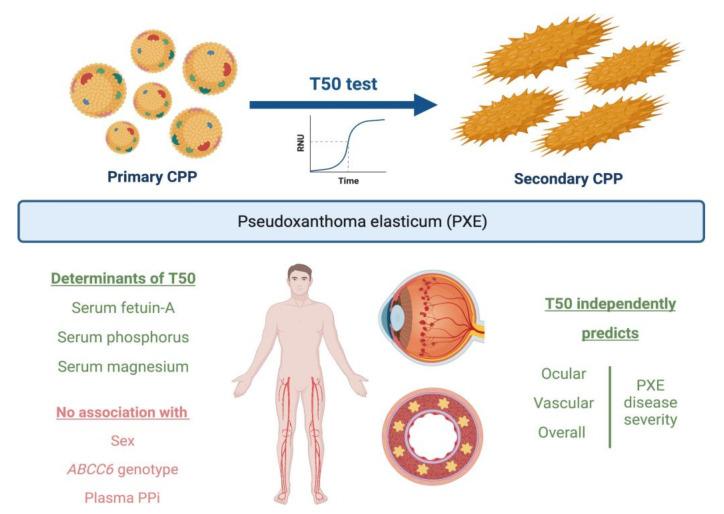
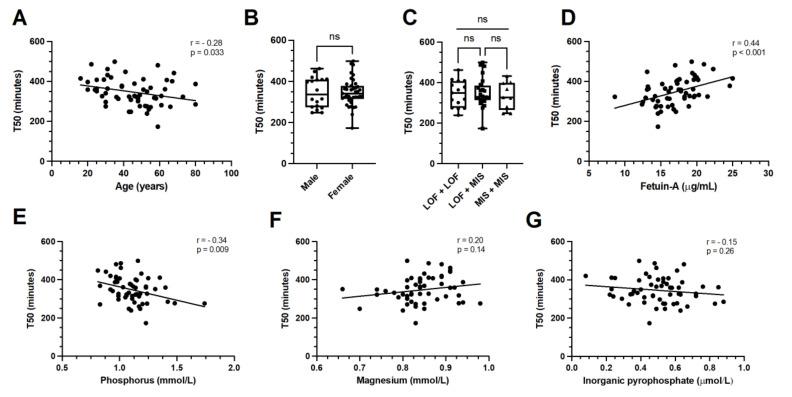
Pseudoxanthoma elasticum (PXE) is a currently intractable genetic disorder characterized by progressive ectopic calcification in the skin, eyes and arteries. Therapeutic trials in PXE are severely hampered by the lack of reliable biomarkers. Serum calcification propensity T50 is a blood test measuring the functional anticalcifying buffer capacity of serum. Here, we evaluated T50 in PXE patients aiming to investigate its determinants and suitability as a potential biomarker for disease severity. Fifty-seven PXE patients were included in this cross-sectional study, and demographic, clinical, imaging and biochemical data were collected from medical health records. PXE severity was assessed using Phenodex scores. T50 was measured using a validated, nephelometry-based assay. Multivariate models were then created to investigate T50 determinants and associations with disease severity. In short, the mean age of patients was 45.2 years, 68.4% was female and mean serum T50 was 347 min. Multivariate regression analysis identified serum fetuin-A (p < 0.001), phosphorus (p = 0.007) and magnesium levels (p = 0.034) as significant determinants of T50, while no correlations were identified with serum calcium, eGFR, plasma PPi levels or the ABCC6 genotype. After correction for covariates, T50 was found to be an independent determinant of ocular (p = 0.013), vascular (p = 0.013) and overall disease severity (p = 0.016) in PXE. To conclude, shorter serum T50—indicative of a higher calcification propensity—was associated with a more severe phenotype in PXE patients. This study indicates, for the first time, that serum T50 might be a clinically relevant biomarker in PXE and may thus be of importance to future therapeutic trials.
弹性假黄瘤(PXE)是一种目前难以治疗的遗传性疾病,其特征为皮肤、眼睛和动脉中进行性异位钙化。由于缺乏可靠的生物标志物,PXE的治疗试验受到严重阻碍。血清钙化倾向T50是一种测量血清功能性抗钙化缓冲能力的血液检测。在此,我们评估了PXE患者的T50,旨在研究其决定因素以及作为疾病严重程度潜在生物标志物的适用性。本横断面研究纳入了57例PXE患者,并从医疗健康记录中收集了人口统计学、临床、影像学和生化数据。使用Phenodex评分评估PXE严重程度。使用经过验证的基于散射比浊法的检测方法测量T50。然后建立多变量模型以研究T50的决定因素及其与疾病严重程度的关联。简而言之,患者的平均年龄为45.2岁,女性占68.4%,血清T50平均为347分钟。多变量回归分析确定血清胎球蛋白-A(p < 0.001)、磷(p = 0.007)和镁水平(p = 0.034)是T50的重要决定因素,而未发现与血清钙、估算肾小球滤过率(eGFR)、血浆焦磷酸水平或ABCC6基因型存在相关性。校正协变量后,发现T50是PXE患者眼部(p = 0.013)、血管(p = 0.013)和总体疾病严重程度(p = 0.016)的独立决定因素。总之,血清T50较短(表明钙化倾向较高)与PXE患者更严重的表型相关。本研究首次表明,血清T50可能是PXE中具有临床相关性的生物标志物,因此可能对未来的治疗试验具有重要意义。

 Zotero 插件