
将原发性进行性皮肤弹力纤维溶解症(PXE)患者的原代表皮成纤维细胞中的ABCC6缺陷与p21介导的细胞早衰及促炎分泌表型的发展联系起来。
Linking ABCC6 Deficiency in Primary Human Dermal Fibroblasts of PXE Patients to p21-Mediated Premature Cellular Senescence and the Development of a Proinflammatory Secretory Phenotype.
作者信息
Tiemann Janina, Wagner Thomas, Lindenkamp Christopher, Plümers Ricarda, Faust Isabel, Knabbe Cornelius, Hendig Doris
机构信息
Institut für Laboratoriums-und Transfusionsmedizin, Herz-und Diabeteszentrum Nordrhein-Westfalen, Universitätsklinik der Ruhr-Universität Bochum, 32545 Bad Oeynhausen, Germany.
出版信息
Int J Mol Sci. 2020 Dec 18;21(24):9665. doi: 10.3390/ijms21249665.
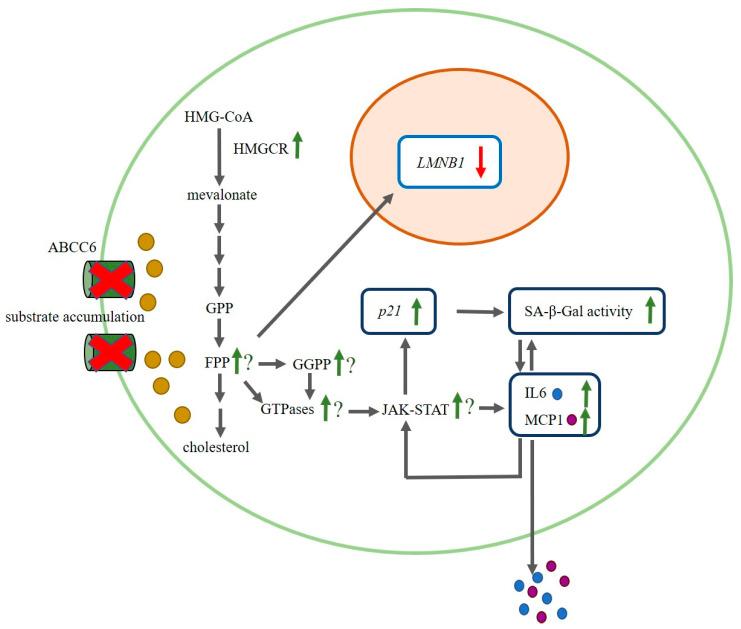
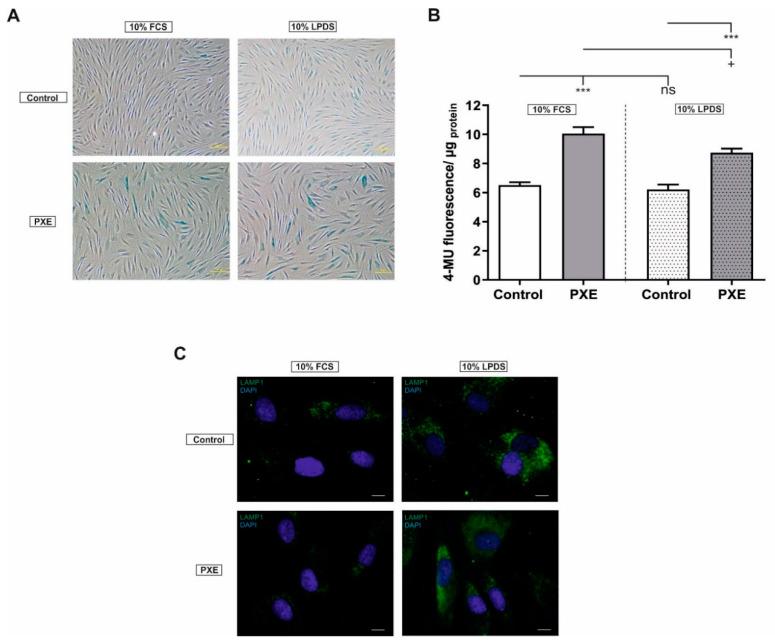
Pseudoxanthoma elasticum (PXE) is a rare autosomal-recessive disorder that is mainly caused by mutations in the () gene. Clinically PXE is characterized by a loss of skin elasticity, arteriosclerosis or visual impairments. It also shares some molecular characteristics with known premature aging syndromes like the Hutchinson-Gilford progeria syndrome (HGPS). However, little is known about accelerated aging processes, especially on a cellular level for PXE now. Therefore, this study was performed to reveal a potential connection between premature cellular aging and PXE pathogenesis by analyzing cellular senescence, a corresponding secretory phenotype and relevant factors of the cell cycle control in primary human dermal fibroblasts of PXE patients. Here, we could show an increased senescence-associated β-galactosidase (SA-β-Gal) activity as well as an increased expression of proinflammatory factors of a senescence-associated secretory phenotype (SASP) like interleukin 6 (IL6) and monocyte chemoattractant protein-1 (MCP1). We further observed an increased gene expression of the cyclin-dependent kinase inhibitor (CDKI) , but no simultaneous induction of gene expression. These data indicate that PXE is associated with premature cellular senescence, which is possibly triggered by a p53-independent p21-mediated mechanism leading to a proinflammatory secretory phenotype.
弹性假黄瘤(PXE)是一种罕见的常染色体隐性疾病,主要由()基因突变引起。临床上,PXE的特征是皮肤弹性丧失、动脉硬化或视力障碍。它还与已知的早衰综合征如哈钦森-吉尔福德早衰综合征(HGPS)具有一些分子特征。然而,目前对于加速衰老过程,尤其是PXE在细胞水平上的情况知之甚少。因此,本研究通过分析PXE患者原代人皮肤成纤维细胞中的细胞衰老、相应的分泌表型和细胞周期调控的相关因子,来揭示细胞早衰与PXE发病机制之间的潜在联系。在此,我们可以看到衰老相关β-半乳糖苷酶(SA-β-Gal)活性增加,以及衰老相关分泌表型(SASP)的促炎因子如白细胞介素6(IL6)和单核细胞趋化蛋白-1(MCP1)的表达增加。我们还进一步观察到细胞周期蛋白依赖性激酶抑制剂(CDKI)的基因表达增加,但未同时诱导()基因表达。这些数据表明,PXE与细胞早衰有关,这可能是由一种不依赖p53的p21介导的机制触发,导致促炎分泌表型。


 Zotero 插件