
伊朗肉用动物中弓形虫的遗传特征。
Genetic characterization of Toxoplasma gondii in meat-producing animals in Iran.
机构信息
Toxoplasmosis Research Center, Communicable Diseases Institute, Mazandaran University of Medical Sciences, Sari, Iran.
Department of Parasitology, School of Medicine, Mazandaran University of Medical Science, Sari, 4847191971, Mazandaran, Iran.
出版信息
Parasit Vectors. 2022 Jul 11;15(1):255. doi: 10.1186/s13071-022-05360-1.
BACKGROUND
The consumption of uncooked or undercooked food from infected intermediate hosts can result in Toxoplasma gondii infection in humans. However, few studies have investigated the genetic diversity of this protozoan parasite in Iran. The aim of the present study was to genetically characterize isolates of T. gondii from intermediate host animals in Mazandaran Province, Iran.
METHODS
Blood and heart tissue samples were collected from 204 ruminants, and brain tissue was collected from 335 birds. The prevalence of T. gondii infection in these samples was determined serologically using the modified agglutination test and by conventional PCR assays. Those PCR samples positive for T. gondii DNA and 13 DNA samples extracted from aborted fetuses in a previous study were genotyped with 12 genetic markers using the multilocus-nested PCR-restriction fragment length polymorphism (Mn-PCR-RFLP) technique.
RESULTS
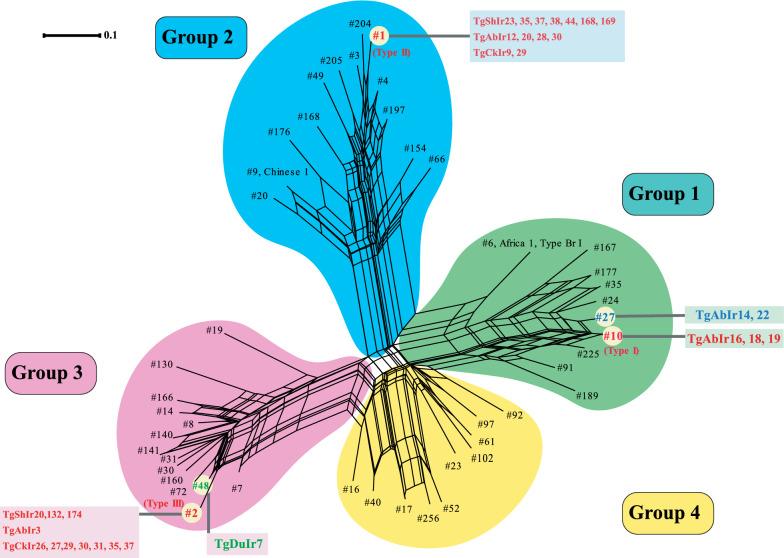
Antibodies for parasites were found in 35.7% of the ruminant (39.1% of sheep and 26.4% of goats) samples and in 51.3% of the bird (100% of geese, 52.3% of free-range chickens and 46% of ducks) samples. Molecular detection by PCR of the repetitive 529-bp DNA fragment revealed contamination of 13.2% of ruminant (14.6% of sheep and 9.4% of goats) samples and of 9.6% of bird (11.1% of chickens, 5.7% of ducks and 0% of geese samples). The results from 30 DNA samples revealed five ToxoDB (genome database for the genus Toxoplasma) PCR-RFLP genotypes, including #1 (Type II), #2 (Type III), #10 (Type I), #27 and #48, with genotype #1 the most predominant.
CONCLUSIONS
As evidenced by the results of this study, ruminants and birds are infected with T. gondii in the region, suggesting that they are likely to be involved in the transmission of T. gondii to humans through meat consumption. The identification of different genotypes may suggest a higher genetic diversity of this parasite in Mazandaran, reflecting local environmental contamination. These results have important public health implications for the prevention and control strategies of infection.
背景
食用受感染中间宿主的未煮熟或未煮熟的食物会导致人类感染刚地弓形虫。然而,很少有研究调查过这种原生动物寄生虫在伊朗的遗传多样性。本研究的目的是从伊朗马赞达兰省的中间宿主动物中分离出刚地弓形虫,并对其进行基因特征分析。
方法
从 204 只反刍动物中采集血液和心脏组织样本,从 335 只鸟类中采集脑组织样本。采用改良凝集试验和常规 PCR 检测方法,对这些样本进行血清学检测,以确定刚地弓形虫感染的流行情况。对那些 PCR 样本中阳性的刚地弓形虫 DNA 以及之前一项研究中从流产胎儿中提取的 13 个 DNA 样本,使用多位点巢式-PCR-限制性片段长度多态性(Mn-PCR-RFLP)技术,用 12 个遗传标记进行基因分型。
结果
在 35.7%的反刍动物(39.1%的绵羊和 26.4%的山羊)样本和 51.3%的鸟类(100%的鹅、52.3%的散养鸡和 46%的鸭)样本中发现了寄生虫抗体。对重复 529bp DNA 片段的 PCR 分子检测显示,13.2%的反刍动物(14.6%的绵羊和 9.4%的山羊)样本和 9.6%的鸟类(11.1%的鸡、5.7%的鸭和 0%的鹅)样本受到了污染。从 30 个 DNA 样本的结果中发现了 5 个 ToxoDB(弓形虫属基因组数据库)PCR-RFLP 基因型,包括#1(Ⅱ型)、#2(Ⅲ型)、#10(Ⅰ型)、#27 和#48,其中#1 型最为常见。
结论
本研究结果表明,该地区的反刍动物和鸟类感染了刚地弓形虫,这表明它们可能通过食用肉类将刚地弓形虫传播给人类。不同基因型的鉴定可能表明该寄生虫在马赞达兰的遗传多样性较高,反映了当地环境的污染。这些结果对感染的预防和控制策略具有重要的公共卫生意义。
 Zotero 插件