
全球寻求问题赌博帮助的患病率:系统评价和荟萃分析。
Global prevalence of help-seeking for problem gambling: A systematic review and meta-analysis.
机构信息
School of Population Health, University of Auckland, Auckland, New Zealand.
School of Psychology, Deakin University, Geelong, Australia.
出版信息
Addiction. 2022 Dec;117(12):2972-2985. doi: 10.1111/add.15952. Epub 2022 Jul 13.
BACKGROUND AND AIMS
Multiple studies have examined barriers and facilitators to help-seeking, but the prevalence of help-seeking for problem gambling (PG) is not well established. We aimed to estimate the international prevalence of help-seeking for PG among the general population and among subgroups of people at risk for PG (i.e. low-risk, moderate-risk and PG).
METHODS
Systematic search of grey literature (through gambling repositories, gambling research institutes and Google) and peer-reviewed literature (through ProQuest, PsycINFO, PubMed and Scopus) for gambling prevalence studies that reported on help-seeking for PG. This review adhered to the Preferred Reporting Items for Systematic Review and Meta-Analyses. Studies used representative sampling methods to determine the prevalence of gambling participation and data collection 2010 onward. Twenty-four studies met the inclusion criteria. The main outcome was population prevalence of help-seeking for PG. Help-seeking was defined as any intentional action to change gambling behaviours, including professional services (inclusive of in-person or distance help), non-professional help (e.g. from family and friends) and self-help. Subgroup analyses were conducted to explain variability in help-seeking prevalence estimates.
RESULTS
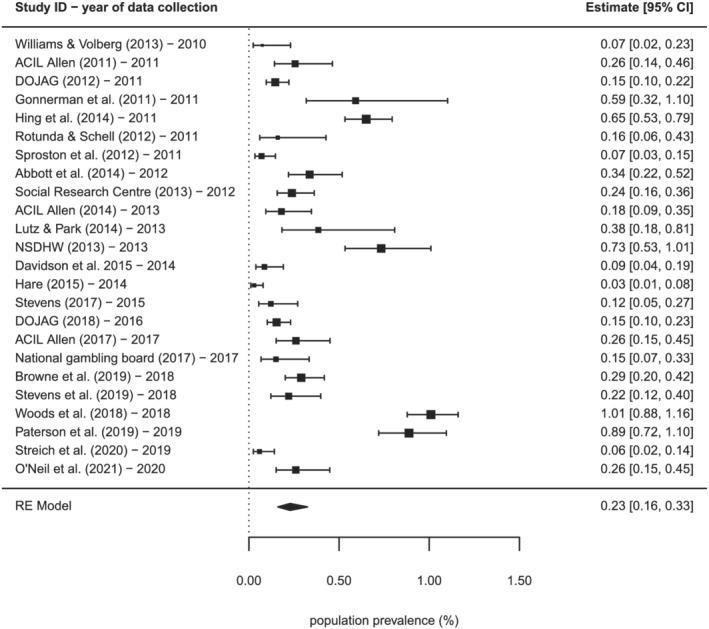
Measurement of help-seeking was inconsistent across included studies and, overall, there was high risk of bias. We estimated a general population help-seeking prevalence for PG of 0.23% (95% CI, 0.16-0.33). Prevalence estimates were significantly higher in studies assessing lifetime (0.50%; 95% CI, 0.35-0.71) compared with current help-seeking (0.14%; 95% CI, 0.10-0.20, P < 0.001), but there was no evidence of difference in prevalence estimates by gambling participation, region, type of help-seeking, or year of data collection. Compared with people with low-risk gambling (0.27%; 95% CI, 0.07%-1.04%), prevalence estimates were significantly higher in those with moderate-risk (3.73%; 95% CI, 2.07%-6.63%) and problem gambling (20.63%; 95% CI, 12.89%-31.35%, P < 0.001).
CONCLUSIONS
One in 25 moderate-risk gamblers and 1 in 5 people with problem gambling have sought help for problems related to their gambling.
背景与目的
多项研究探讨了寻求帮助的障碍和促进因素,但针对赌博问题的寻求帮助的普遍性尚不清楚。我们旨在估计普通人群以及有赌博问题风险的人群(即低风险、中风险和赌博问题)中寻求赌博问题帮助的国际流行率。
方法
通过赌博知识库、赌博研究所和谷歌进行灰色文献系统搜索,以及通过 ProQuest、PsycINFO、PubMed 和 Scopus 进行同行评审文献系统搜索,以确定报告寻求赌博问题帮助的赌博流行率研究。本综述遵循系统评价和荟萃分析的首选报告项目。研究使用代表性抽样方法来确定赌博参与的流行率,并在 2010 年后进行数据收集。有 24 项研究符合纳入标准。主要结果是寻求赌博问题帮助的人群流行率。寻求帮助被定义为任何旨在改变赌博行为的有意行动,包括专业服务(包括面对面或远程帮助)、非专业帮助(例如来自家人和朋友)和自助。进行了亚组分析以解释寻求帮助流行率估计的可变性。
结果
纳入研究中寻求帮助的测量方法不一致,总体而言,存在高度的偏倚风险。我们估计普通人群中寻求赌博问题帮助的流行率为 0.23%(95%置信区间,0.16-0.33)。与当前寻求帮助(0.14%;95%置信区间,0.10-0.20,P<0.001)相比,评估终生(0.50%;95%置信区间,0.35-0.71)的研究中估计的患病率显著更高,但在赌博参与、地区、寻求帮助的类型或数据收集年份方面,没有证据表明患病率估计存在差异。与低风险赌博者(0.27%;95%置信区间,0.07%-1.04%)相比,中风险(3.73%;95%置信区间,2.07%-6.63%)和赌博问题者(20.63%;95%置信区间,12.89%-31.35%,P<0.001)的患病率估计显著更高。
结论
每 25 名中度风险赌徒中就有 1 人,每 5 名有赌博问题的人中就有 1 人寻求过与赌博问题相关的帮助。

 Zotero 插件