
在空腹血糖异常的亚洲裔印度女性中,白细胞端粒长度缩短与高体重指数和皮下肥胖(主要是躯干)独立相关。
Shortening of leucocyte telomere length is independently correlated with high body mass index and subcutaneous obesity (predominantly truncal), in Asian Indian women with abnormal fasting glycemia.
机构信息
Pulmonary Medicine and Sleep Disorders, All India Institute of Medical Sciences, New Delhi, Delhi, India.
Metabolic Research Unit, Diabetes Foundation (India), Safdarjung Development Area (SDA), New Delhi, Delhi, India.
出版信息
BMJ Open Diabetes Res Care. 2022 Jul;10(4). doi: 10.1136/bmjdrc-2021-002706.
INTRODUCTION
Leucocyte telomere length (LTL) is linked to accelerate aging and premature mortality. In this research, we aimed to explore the relations between biochemical and anthropometry markers and LTL in Asian Indian women with abnormal fasting glycemia (impaired fasting glucose).
RESEARCH DESIGN AND METHODS
In this study, 797 pre-diabetic women (obese, 492; non-obese, 305) were recruited. Demographic and clinical profiles, anthropometry, and fasting blood glucose were evaluated. LTL was quantified by a quantitative PCR. LTL was expressed as the relative telomere length or telomere repeat:single copy gene (T:S) ratio. The subjects were separated into quartiles according to the LTL.
RESULTS
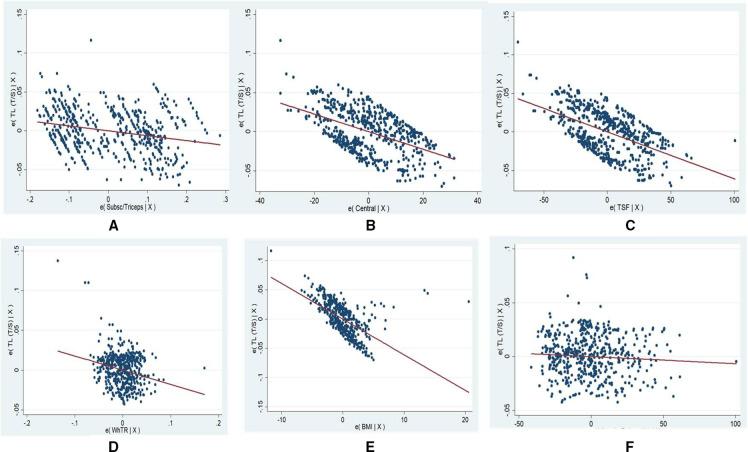
The average LTL was significantly decreased with increasing age. The average LTL was significantly shorter in obese women with abnormal fasting glycemia (p<0.05). R-squared (R) statistic for multivariable linear model after adjusted for age, family income, education and hypertension showed that LTL was inversely correlated with body mass index (BMI), waist and hip circumference, waist-hip and waist-to-height ratio, truncal skinfolds (subscapular, and subscapular/triceps ratio, central and total skinfolds), fat mass (kg) and % body fat. The relationship between obesity measures and LTL (using the LTL quartile 1 as reference) identified central skinfolds (R=0.92, p<0.0001), Σ4SF (R=0.90, p<0.0001), BMI (R=0.93, p<0.0001) and % body fat (R=0.91, p<0.0001) as independent predictors of LTL.
CONCLUSIONS
Besides age, obesity and subcutaneous adiposity (predominantly truncal) are major contributors to telomere shortening in Asian Indian women with abnormal fasting glycemia (impaired fasting glucose).
简介
白细胞端粒长度(LTL)与加速衰老和过早死亡有关。在这项研究中,我们旨在探索生物化学和人体测量标志物与亚洲印度空腹血糖异常(空腹血糖受损)女性的 LTL 之间的关系。
研究设计和方法
本研究纳入了 797 例糖尿病前期女性(肥胖 492 例,非肥胖 305 例)。评估了人口统计学和临床特征、人体测量和空腹血糖。通过定量 PCR 定量 LTL。LTL 表示为相对端粒长度或端粒重复:单拷贝基因(T:S)比值。根据 LTL 将受试者分为四组。
结果
平均 LTL 随年龄增长而显著降低。肥胖且空腹血糖异常的女性平均 LTL 明显较短(p<0.05)。经过年龄、家庭收入、教育和高血压调整后的多变量线性模型的 R 平方(R)统计显示,LTL 与体重指数(BMI)、腰围和臀围、腰围-臀围和腰围-身高比、躯干皮褶(肩胛下和肩胛下/三头肌比、中央和总皮褶)、脂肪量(kg)和体脂百分比呈负相关。肥胖测量与 LTL 之间的关系(以 LTL 四分位 1 为参考)确定了中央皮褶(R=0.92,p<0.0001)、Σ4SF(R=0.90,p<0.0001)、BMI(R=0.93,p<0.0001)和体脂百分比(R=0.91,p<0.0001)是 LTL 的独立预测因子。
结论
除了年龄之外,肥胖和皮下脂肪(主要是躯干)是亚洲印度空腹血糖异常(空腹血糖受损)女性端粒缩短的主要原因。

 Zotero 插件