
基于网络药理学和分子对接的麻黄草治疗肾病综合征的潜在分子机制。
Potential Molecular Mechanisms of Ephedra Herb in the Treatment of Nephrotic Syndrome Based on Network Pharmacology and Molecular Docking.
机构信息
Department of Nephrology, Yueyang Hospital of Integrated Traditional Chinese and Western Medicine, Shanghai University of Traditional Chinese Medicine, Shanghai 200437, China.
Department of Emergency, Yueyang Hospital of Integrated Traditional Chinese and Western Medicine, Shanghai University of Traditional Chinese Medicine, Shanghai 200437, China.
出版信息
Biomed Res Int. 2022 Jul 5;2022:9214589. doi: 10.1155/2022/9214589. eCollection 2022.
OBJECTIVE
To explore the possible mechanisms of Ephedra herb (EH) in the treatment of nephrotic syndrome (NS) by using network pharmacology and molecular docking in this study.
METHODS
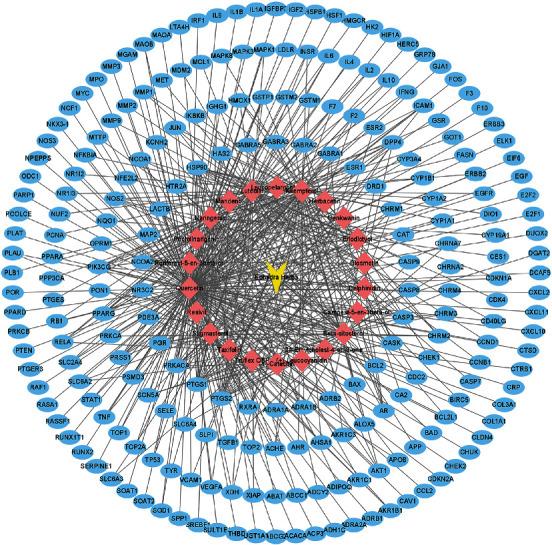
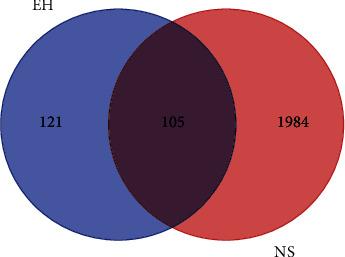
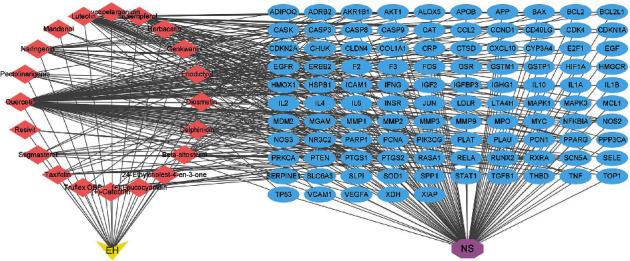
Active ingredients and related targets of EH were obtained from the Traditional Chinese Medicine Systems Pharmacology (TCMSP) database, and the gene names corresponding to the proteins were found through the UniProt database. Then, target genes related to NS were screened out from GeneCards, PharmGKB, and OMIM databases. Next, the intersection targets were obtained successfully through Venn diagram, which were also seen as key target genes of EH and NS. Cytoscape 3.9.0 software was used to construct the effective "active ingredient-target" network diagram, and "drug-ingredient-target-disease (D-I-T-D)" network diagram. After that, the STRING database was used to construct a protein-protein interaction (PPI) network. Furthermore, Gene Ontology (GO) and Kyoto Encyclopedia of Genes and Genomes (KEGG) pathway enrichment involved in the targets were performed by the DAVID database and ClueGO plugin in Cytoscape. Finally, AutoDockTools software was used for molecular docking to verify the binding strength between main active ingredients and key target proteins.
RESULTS
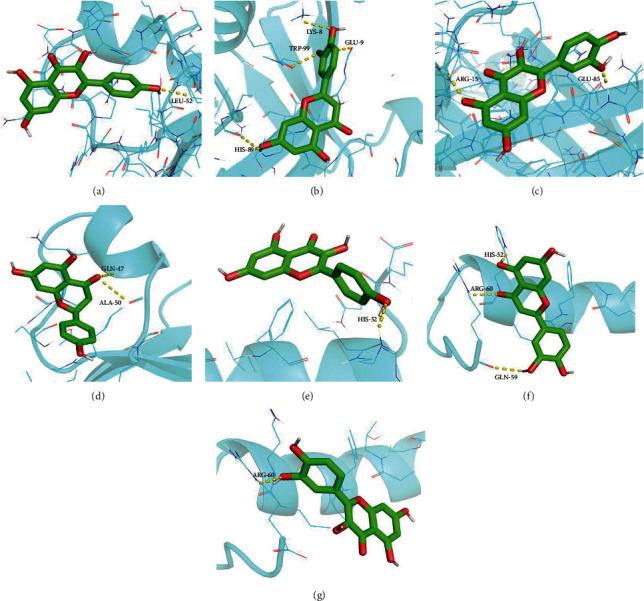
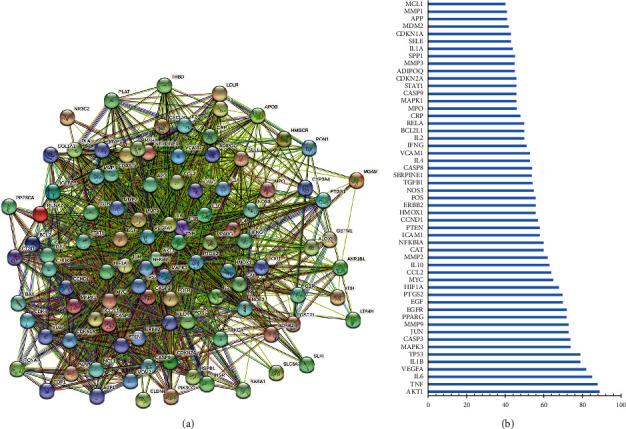
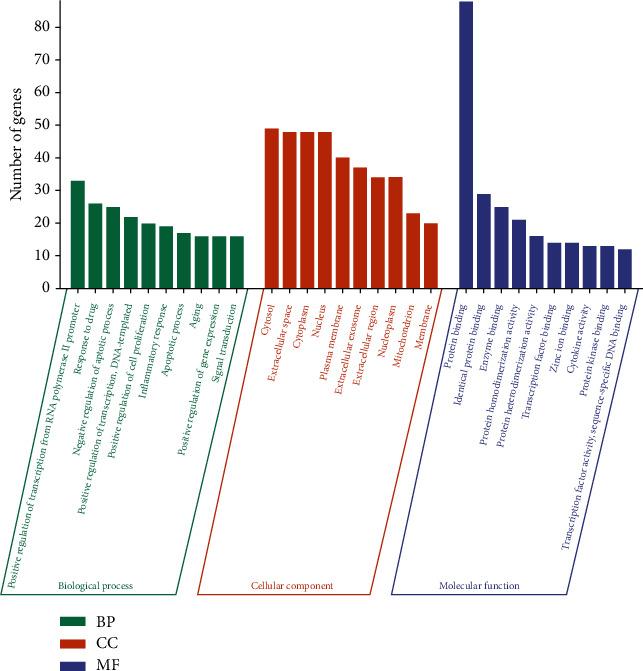
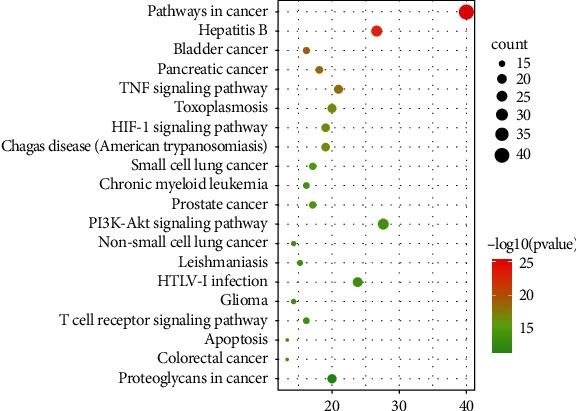
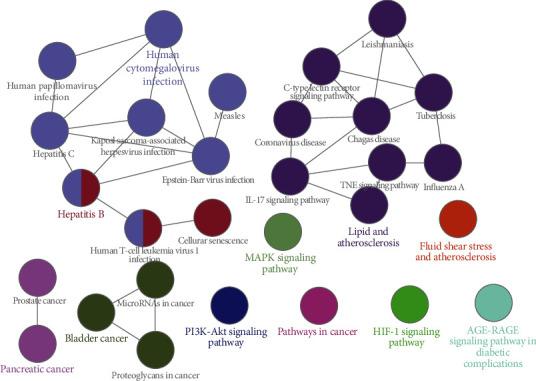
A total of 22 main active ingredients such as quercetin, kaempferol, luteolin, and naringenin were obtained, which could act on 105 targets related to NS. Through PPI network, 53 core targets such as AKT1, TNF, IL6, VEGFA, and IL1B were found, which might play a crucial role in the treatment of NS. Meanwhile, these targets were significantly involved in PI3K-Akt signaling pathway, TNF signaling pathway, AGE-RAGE signaling pathway, hepatitis B, and pathways in cancer through GO and KEGG enrichment analysis. The docking results indicated that active ingredients such as kaempferol, luteolin, quercetin, and naringenin all had good binding to the target protein AKT1 or TNF. Among them, luteolin and naringenin binding with AKT1 showed the best binding energy (-6.2 kcal/mol).
CONCLUSION
This study indicated that the potential mechanism of EH in treating NS may be related to PI3K-Akt signaling pathway, TNF signaling pathway, and AGE-RAGE signaling pathway, which provided better approaches for exploring the mechanism in treating NS and new ideas for further in vivo and in vitro experimental verifications.
目的
本研究采用网络药理学和分子对接方法探讨麻黄(EH)治疗肾病综合征(NS)的可能机制。
方法
从中药系统药理学(TCMSP)数据库中获取麻黄的活性成分和相关靶点,并通过 UniProt 数据库找到相应蛋白的基因名称。然后,从 GeneCards、PharmGKB 和 OMIM 数据库中筛选出与 NS 相关的基因靶点。接下来,通过 Venn 图获得交集靶点,这些靶点也被视为 EH 和 NS 的关键靶点。使用 Cytoscape 3.9.0 软件构建有效的“活性成分-靶点”网络图和“药物-成分-靶点-疾病(D-I-T-D)”网络图。然后,使用 STRING 数据库构建蛋白质-蛋白质相互作用(PPI)网络。此外,通过 DAVID 数据库和 Cytoscape 中的 ClueGO 插件对靶点进行基因本体(GO)和京都基因与基因组百科全书(KEGG)通路富集分析。最后,使用 AutoDockTools 软件进行分子对接,验证主要活性成分与关键靶蛋白的结合强度。
结果
共获得 22 种主要活性成分,如槲皮素、山奈酚、木樨草素和柚皮苷等,可作用于 105 个与 NS 相关的靶点。通过 PPI 网络,发现了 53 个核心靶点,如 AKT1、TNF、IL6、VEGFA 和 IL1B 等,这些靶点可能在治疗 NS 中发挥关键作用。同时,通过 GO 和 KEGG 富集分析,这些靶点还显著参与了 PI3K-Akt 信号通路、TNF 信号通路、AGE-RAGE 信号通路、乙型肝炎和癌症通路。对接结果表明,活性成分如山奈酚、木樨草素、槲皮素和柚皮苷均与靶蛋白 AKT1 或 TNF 具有良好的结合能力。其中,木樨草素和柚皮苷与 AKT1 的结合具有最佳的结合能(-6.2kcal/mol)。
结论
本研究表明,EH 治疗 NS 的潜在机制可能与 PI3K-Akt 信号通路、TNF 信号通路和 AGE-RAGE 信号通路有关,为探讨其治疗 NS 的机制提供了更好的方法,也为进一步的体内、体外实验验证提供了新的思路。

 Zotero 插件