
基于网络药理学研究丹参酮Ⅱ A 抗阿霉素致心肌毒性的心肌保护作用及活性成分。
Cardioprotective Mechanism and Active Compounds of on Adriamycin-Induced Cardiotoxicity: A Network Pharmacology Study.
机构信息
Department of Oncology, Renmin Hospital, Hubei University of Medicine, 39# Chaoyang Road, Shiyan, Hubei 442000, China.
Institute of Cancer, Renmin Hospital of Hubei University of Medicine, Shiyan 442000, China.
出版信息
Comput Math Methods Med. 2022 Sep 28;2022:4338260. doi: 10.1155/2022/4338260. eCollection 2022.
OBJECTIVE
To investigate the mechanism of (FG) against adriamycin-induced cardiotoxicity (AIC) through a network pharmacology approach.
METHODS
Active ingredients of FG were screened by TCMSP, and the targets of active ingredient were collected by Genclip3 and HERB databases. AIC-related target genes were predicted by Genecards, OMIM, and CTD databases. Protein-protein interaction (PPI) network was constructed by STRING platform and imported into Cytoscape software to construct the FG-active ingredients-targets-AIC network, and CytoNCA plug-in was used to analyze and identify the core target genes. The Metascape platform was used for transcription factor, GO and signaling pathway enrichment analysis.
RESULTS
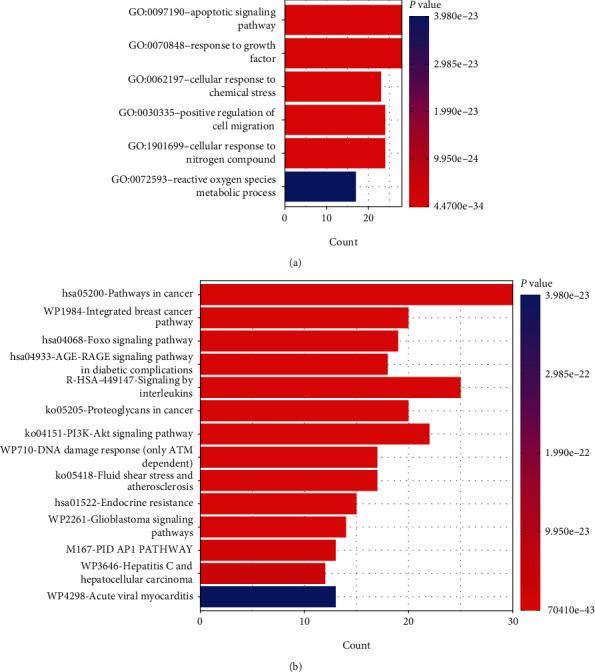
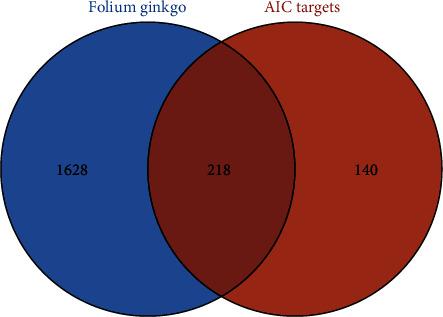
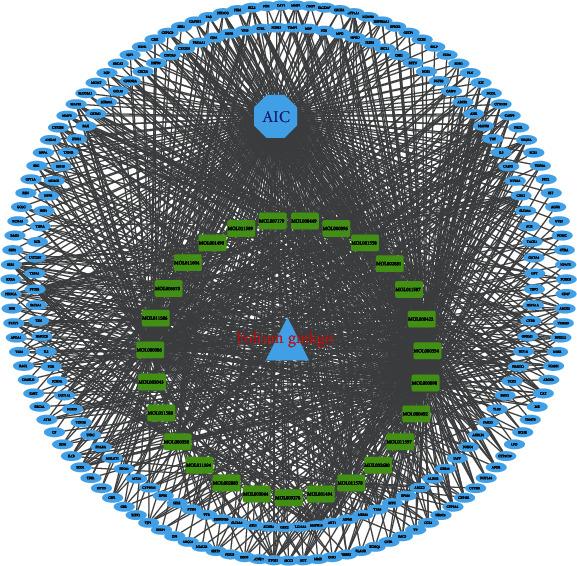
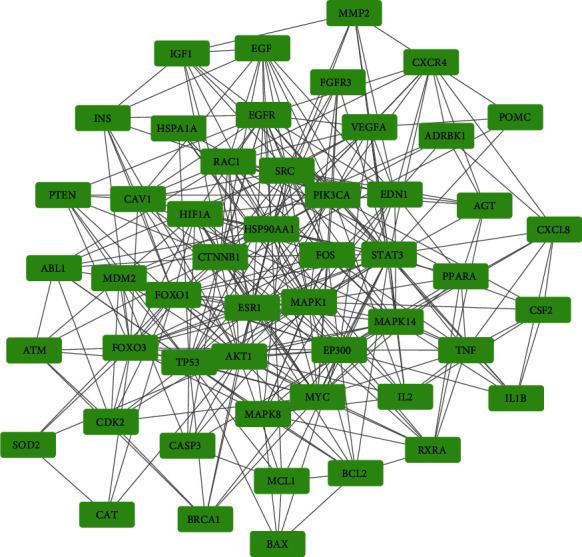
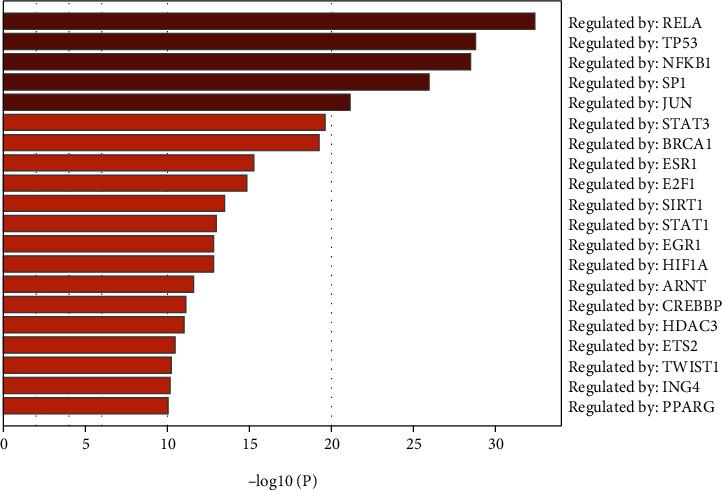
27 active ingredients of FG and 1846 potential targets were obtained and 358 AIC target genes were retrieved. The intersection of FG and AIC targets resulted in 218 target genes involved in FG action. The top 5 active ingredients with most targets were quercetin, luteolin, kaempferol, isorhamnetin, and sesamin. After constructing the FG-active ingredients-targets-AIC network, CytoNCA analysis yielded 51 core targets, of which the top ranked target was STAT3. Ninety important transcription factors were enriched by transcription factor enrichment analysis, including RELA, TP53, NFKB1, SP1, JUN, STAT3, etc. The results of GO enrichment analysis showed that the effective active ingredient targets of FG were involved in apoptotic signaling, response to growth factor, cellular response to chemical stress, reactive oxygen species metabolic process, etc. The signaling pathway enrichment analysis showed that there were many signaling pathways involved in AIC, mainly including pathways in cancer, FOXO signaling pathway, AGE-RAGE signaling pathway in diabetic complications, signaling by interleukins, and PI3K-AKT signaling pathway,.
CONCLUSIONS
The study based on a network pharmacology approach demonstrates that the possible mechanisms of FG against AIC are the involvement of multicomponents, multitargets, and multipathways, and STAT3 may be a key target. Further experiments are needed to verify the results.
目的
通过网络药理学方法研究(FG)对阿霉素诱导的心肌毒性(AIC)的作用机制。
方法
通过 TCMSP 筛选 FG 的活性成分,通过 Genclip3 和 HERB 数据库收集活性成分的靶点。通过 Genecards、OMIM 和 CTD 数据库预测 AIC 相关靶点。通过 STRING 平台构建蛋白质-蛋白质相互作用(PPI)网络,并将其导入 Cytoscape 软件中构建 FG-活性成分-靶点-AIC 网络,使用 CytoNCA 插件对核心靶点进行分析和鉴定。使用 Metascape 平台进行转录因子、GO 和信号通路富集分析。
结果
得到 27 个 FG 的活性成分和 1846 个潜在靶点,检索到 358 个 AIC 靶点。FG 和 AIC 靶点的交集得到 218 个参与 FG 作用的靶点。具有最多靶点的前 5 个活性成分是槲皮素、木樨草素、山奈酚、异鼠李素和芝麻素。构建 FG-活性成分-靶点-AIC 网络后,CytoNCA 分析得到 51 个核心靶点,其中排名最高的靶点是 STAT3。转录因子富集分析得到 90 个重要转录因子,包括 RELA、TP53、NFKB1、SP1、JUN、STAT3 等。GO 富集分析结果表明,FG 的有效活性成分靶点参与凋亡信号、生长因子反应、细胞对化学应激的反应、活性氧物质代谢过程等。信号通路富集分析表明,AIC 涉及许多信号通路,主要包括癌症途径、FOXO 信号通路、糖尿病并发症的 AGE-RAGE 信号通路、白细胞介素信号通路和 PI3K-AKT 信号通路等。
结论
本研究基于网络药理学方法表明,FG 防治 AIC 的可能机制是多成分、多靶点、多途径,STAT3 可能是关键靶点。需要进一步的实验来验证结果。
 Zotero 插件