
一种基于ALBI和腹水的模型,用于预测BCLC B期肝细胞癌的生存率。
An ALBI- and Ascites-Based Model to Predict Survival for BCLC Stage B Hepatocellular Carcinoma.
作者信息
He Cheng, Yang Jing, Jin Zheng, Zhu Ying, Hu Wei, Zeng Lingfeng, Li Xiaocheng
机构信息
Department of Hepatobiliary Surgery, Affiliated Hospital of Xiangnan University, Chenzhou, Hunan, China.
Department of Intensive Care Unit, Affiliated Hangzhou First People's Hospital, Zhejiang University School of Medicine, Hangzhou, Zhejiang, China.
出版信息
Evid Based Complement Alternat Med. 2022 Jul 7;2022:1801230. doi: 10.1155/2022/1801230. eCollection 2022.
BACKGROUND
We aimed to develop a predictive model constituted with the ALBI grade, the ascites, and tumor burden related parameters in patients with BCLC stage B HCC.
METHODS
Patients diagnosed as the BCLC stage B HCC were collected from a retrospective database. Construction and validation of the predictive model were performed based on multivariate Cox regression analysis. Predictive accuracy, discrimination (c-index), and fitness performance (calibration curve) of the model were compared with the other eight models. The decision curve analysis (DCA) was used to evaluate the clinical utility.
RESULTS
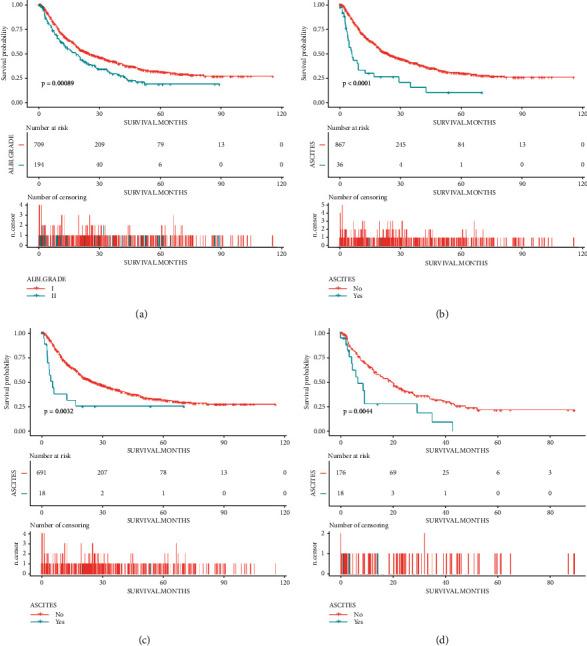
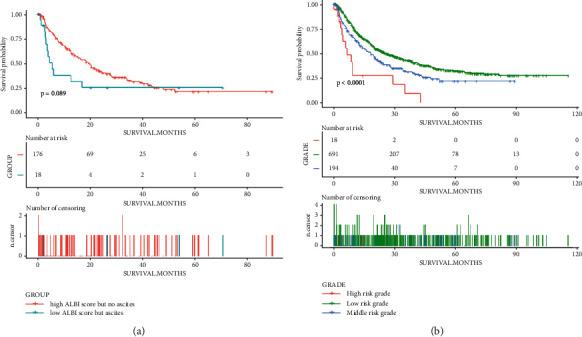
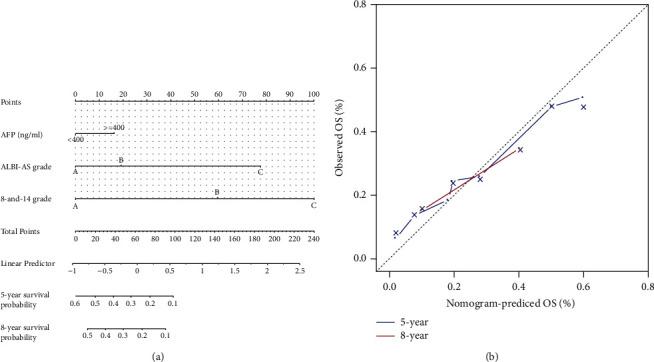
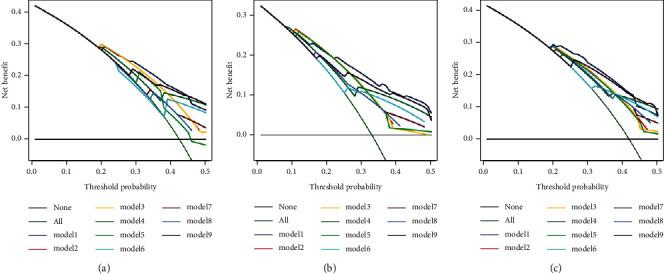
A total of 1773 patients diagnosed as BCLC stage B HCC between 2007 and 2016 were included in the present study. The ALBI-AS grade, the AFP level, and the 8-and-14 grade were used for the development of a prognostic prediction model after multivariate analysis. The area under the receiver operator characteristic curve (AUROC) for overall survival at 1, 2, and 3 years predicted by the present model were 0.73, 0.69, and 0.67 in the training cohort. The concordance index (c-index) and the Aiken information criterion (AIC) were 0.68 and 6216.3, respectively. In the internal and external validation cohorts, the present model still revealed excellent predictive accuracy, discrimination, and fitness performance. Then the ALBI-AS based model was evaluated to be superior to other prognostic models with the highest AUROC, c-index, and lowest AIC values. Moreover, DCA also demonstrated that the present model was clinically beneficial.
CONCLUSION
The ALBI-AS grade is a novel predictor of survival for patients with BCLC stage B HCC.
背景
我们旨在构建一个由ALBI分级、腹水及肿瘤负荷相关参数组成的预测模型,用于预测BCLC B期肝细胞癌(HCC)患者的预后。
方法
从一个回顾性数据库中收集诊断为BCLC B期HCC的患者。基于多因素Cox回归分析构建并验证预测模型。将该模型的预测准确性、区分度(c指数)和拟合性能(校准曲线)与其他八个模型进行比较。采用决策曲线分析(DCA)评估其临床实用性。
结果
本研究纳入了2007年至2016年间共1773例诊断为BCLC B期HCC的患者。多因素分析后,采用ALBI-AS分级、甲胎蛋白(AFP)水平及8和14分级构建预后预测模型。在训练队列中,该模型预测的1年、2年和3年总生存的受试者工作特征曲线下面积(AUROC)分别为0.73、0.69和0.67。一致性指数(c指数)和艾肯信息准则(AIC)分别为0.68和6216.3。在内部和外部验证队列中,该模型仍显示出优异的预测准确性、区分度和拟合性能。基于ALBI-AS的模型被评估为优于其他预后模型,具有最高的AUROC、c指数和最低的AIC值。此外,DCA也表明该模型具有临床实用性。
结论
ALBI-AS分级是BCLC B期HCC患者生存的一个新的预测指标。



 Zotero 插件