
印度小麦基因组计划:挖掘小麦种质资源潜力,培育抗病、营养丰富且适应气候变化的品种
Indian Wheat Genomics Initiative for Harnessing the Potential of Wheat Germplasm Resources for Breeding Disease-Resistant, Nutrient-Dense, and Climate-Resilient Cultivars.
作者信息
Kumar Sundeep, Jacob Sherry R, Mir Reyazul Rouf, Vikas V K, Kulwal Pawan, Chandra Tilak, Kaur Satinder, Kumar Uttam, Kumar Suneel, Sharma Shailendra, Singh Ravinder, Prasad Sai, Singh Anju Mahendru, Singh Amit Kumar, Kumari Jyoti, Saharan M S, Bhardwaj Subhash Chander, Prasad Manoj, Kalia Sanjay, Singh Kuldeep
机构信息
Indian Council of Agricultural Research-National Bureau of Plant Genetic Resources, New Delhi, India.
Division of Genetics and Plant Breeding, Sher-e-Kashmir University of Agricultural Sciences and Technology of Kashmir (SKUAST-Kashmir), Jammu and Kashmir, India.
出版信息
Front Genet. 2022 Jun 29;13:834366. doi: 10.3389/fgene.2022.834366. eCollection 2022.
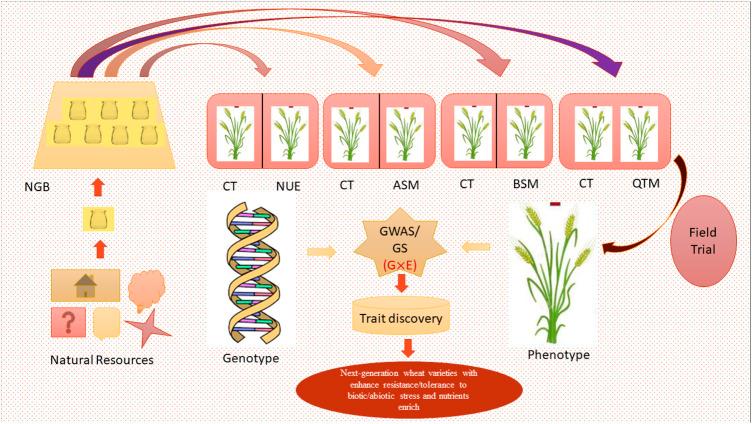
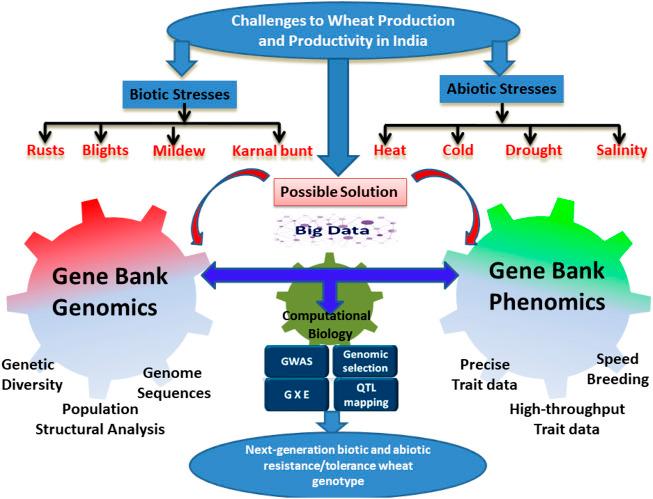
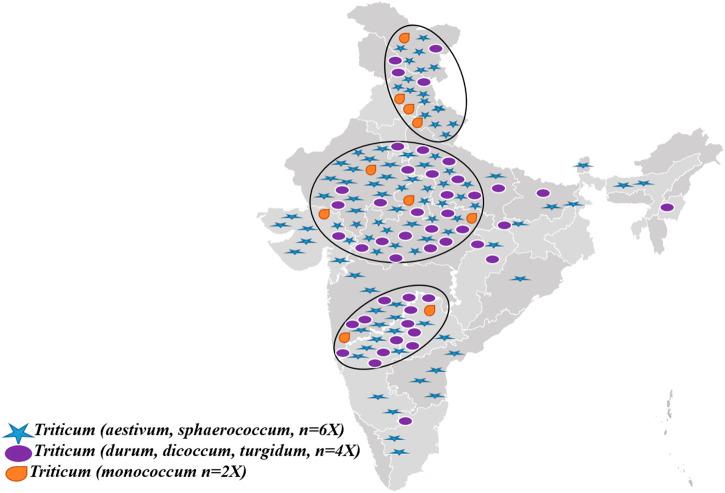
Wheat is one of the major staple cereal food crops in India. However, most of the wheat-growing areas experience several biotic and abiotic stresses, resulting in poor quality grains and reduced yield. To ensure food security for the growing population in India, there is a compelling need to explore the untapped genetic diversity available in gene banks for the development of stress-resistant/tolerant cultivars. The improvement of any crop lies in exploring and harnessing the genetic diversity available in its genetic resources in the form of cultivated varieties, landraces, wild relatives, and related genera. A huge collection of wheat genetic resources is conserved in various gene banks across the globe. Molecular and phenotypic characterization followed by documentation of conserved genetic resources is a prerequisite for germplasm utilization in crop improvement. The National Genebank of India has an extensive and diverse collection of wheat germplasm, comprising Indian wheat landraces, primitive cultivars, breeding lines, and collection from other countries. The conserved germplasm can contribute immensely to the development of wheat cultivars with high levels of biotic and abiotic stress tolerance. Breeding wheat varieties that can give high yields under different stress environments has not made much headway due to high genotypes and environmental interaction, non-availability of truly resistant/tolerant germplasm, and non-availability of reliable markers linked with the QTL having a significant impact on resistance/tolerance. The development of new breeding technologies like genomic selection (GS), which takes into account the G × E interaction, will facilitate crop improvement through enhanced climate resilience, by combining biotic and abiotic stress resistance/tolerance and maximizing yield potential. In this review article, we have summarized different constraints being faced by Indian wheat-breeding programs, challenges in addressing biotic and abiotic stresses, and improving quality and nutrition. Efforts have been made to highlight the wealth of Indian wheat genetic resources available in our National Genebank and their evaluation for the identification of trait-specific germplasm. Promising genotypes to develop varieties of important targeted traits and the development of different genomics resources have also been highlighted.
小麦是印度主要的谷类主食作物之一。然而,大多数小麦种植区面临多种生物和非生物胁迫,导致籽粒品质不佳和产量降低。为确保印度不断增长的人口的粮食安全,迫切需要探索基因库中尚未开发的遗传多样性,以培育抗逆/耐逆品种。任何作物的改良都在于探索和利用其遗传资源中以栽培品种、地方品种、野生近缘种和相关属形式存在的遗传多样性。全球各地的各种基因库中保存着大量的小麦遗传资源。对保存的遗传资源进行分子和表型特征分析并记录下来,是在作物改良中利用种质的先决条件。印度国家基因库拥有广泛且多样的小麦种质收集品,包括印度小麦地方品种、原始品种、育种系以及从其他国家收集的材料。保存的种质可为培育具有高水平生物和非生物胁迫耐受性的小麦品种做出巨大贡献。由于基因型与环境互作程度高、缺乏真正抗逆/耐逆的种质以及与对抗性/耐受性有重大影响的QTL相关的可靠标记,培育能在不同胁迫环境下高产的小麦品种进展不大。像基因组选择(GS)这样考虑到G×E互作的新育种技术的发展,将通过增强气候适应力,结合生物和非生物胁迫抗性/耐受性并最大化产量潜力,促进作物改良。在这篇综述文章中,我们总结了印度小麦育种计划面临的不同限制、应对生物和非生物胁迫以及提高品质和营养方面的挑战。我们努力突出了我国国家基因库中丰富的印度小麦遗传资源,以及对其进行评估以鉴定特定性状种质的情况。还强调了用于培育具有重要目标性状品种的有前景的基因型以及不同基因组学资源的开发。
 Zotero 插件