
钙决定种内竞争适应性。
Calcium Determines Intraspecies Competitive Fitness.
机构信息
Department of Food Science & Technology, University of California, Davisgrid.27860.3b, California, USA.
出版信息
Appl Environ Microbiol. 2022 Aug 9;88(15):e0066622. doi: 10.1128/aem.00666-22. Epub 2022 Jul 19.
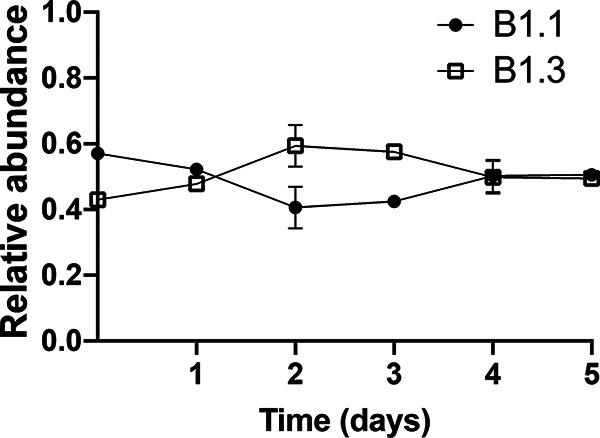
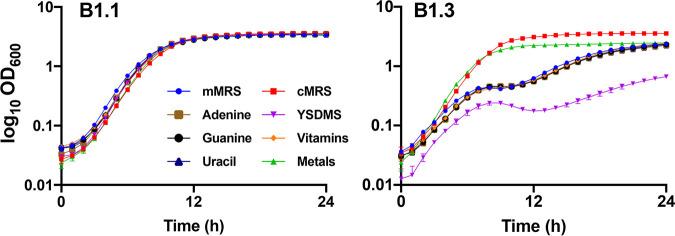
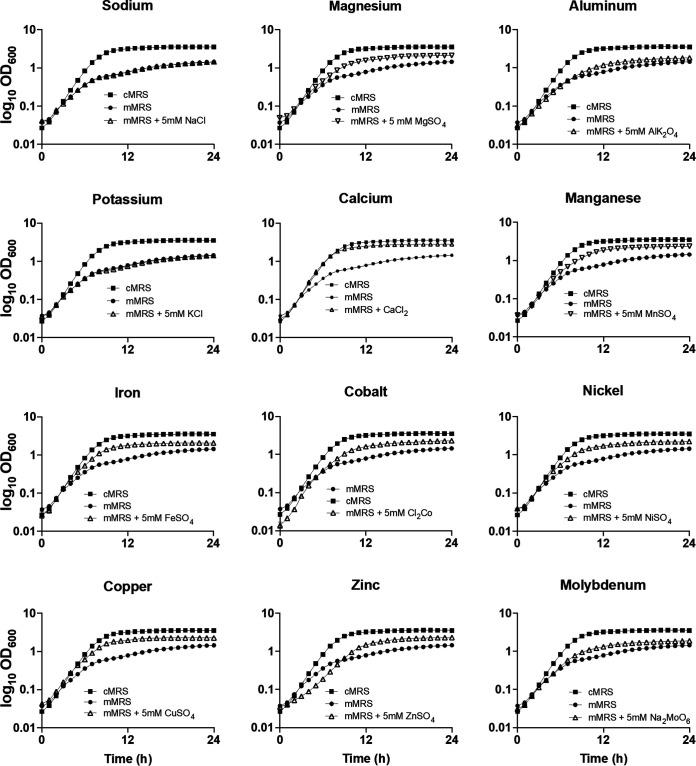
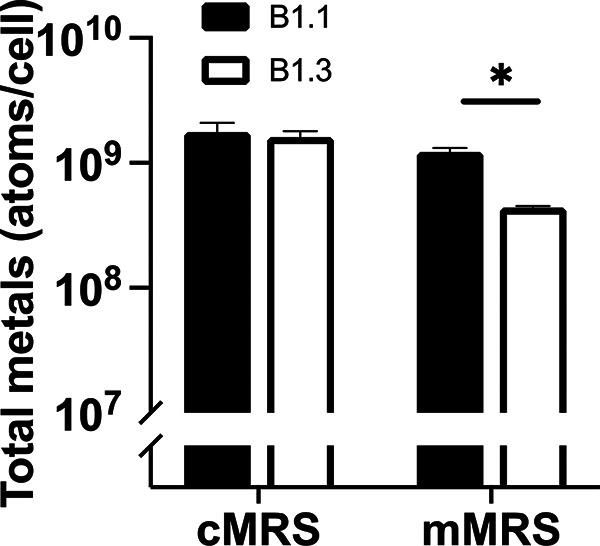
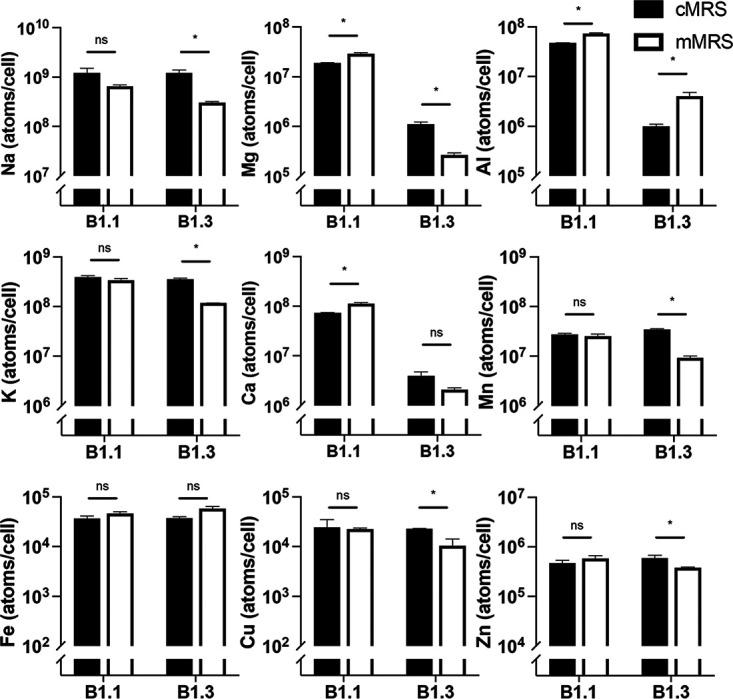
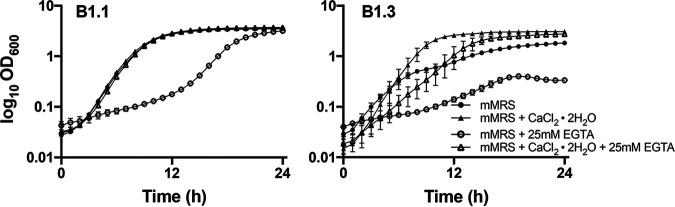
The importance of individual nutrients for microbial strain robustness and coexistence in habitats containing different members of the same species is not well understood. To address this for Lactiplantibacillus plantarum in food fermentations, we performed comparative genomics and examined the nutritive requirements and competitive fitness for strains B1.1 and B1.3 isolated from a single sample of teff injera fermentation batter. Compared to B1.1 and other strains, B1.3 has a smaller genome, limited biosynthetic capacities, and large mobilome. Despite these differences, B1.3 was equally competitive with B1.1 in a suspension of teff flour. In commercially sourced, nutrient-replete MRS (cMRS) medium, strain B1.3 reached 3-fold-higher numbers than B1.1 within 2 days of passage. Because B1.3 growth and competitive fitness were poor in mMRS medium (here called mMRS), a modified MRS medium lacking beef extract, we used mMRS to identify nutrients needed for robust B1.3 growth. No improvement was observed when mMRS was supplemented with nucleotides, amino acids, vitamins, or monovalent metals. Remarkably, the addition of divalent metal salts increased the growth rate and cell yields of B1.3 in mMRS. Metal requirements were confirmed by inductively coupled plasma mass spectrometry, showing that total B1.3 intracellular metal concentrations were significantly (up to 2.7-fold) reduced compared to B1.1. Supplemental CaCl conferred the greatest effect, resulting in equal growth between B1.1 and B1.3 over five successive passages in mMRS. Moreover, calcium supplementation reversed a B1.3 strain-specific, stationary-phase, flocculation phenotype. These findings show how calcium requirements affect competitive fitness at the strain level. Ecological theory states that the struggle for existence is stronger between closely related species. Contrary to this assertion, fermented foods frequently sustain conspecific individuals, in spite of their high levels of phylogenetic relatedness. Therefore, we investigated two isolates of , B1.1 and B1.3, randomly selected from a single batch of teff injera batter. These strains spanned the known genomic and phenotypic range of the species, and in laboratory culture medium used for strain screening, B1.3 exhibited poor growth and was outcompeted by the more robust strain B1.1. Nonetheless, B1.1 and B1.3 were equally competitive in teff flour. This result shows how has adapted for coexistence in that environment. The capacity for the single macronutrient calcium to restore B1.3 competitive fitness in laboratory culture medium suggests that intraspecies diversity found in food systems is fine-tuned to nutrient requirements at the strain level.
对于在含有同一物种不同成员的栖息地中微生物菌株健壮性和共存的个体营养的重要性,我们了解甚少。为了研究植物乳杆菌在食品发酵中的情况,我们进行了比较基因组学研究,并检查了从埃塞俄比亚提非 injera 发酵面糊的单个样本中分离出的菌株 B1.1 和 B1.3 的营养需求和竞争适应性。与 B1.1 和其他菌株相比,B1.3 的基因组较小,生物合成能力有限,移动元件较大。尽管存在这些差异,但 B1.3 在埃塞俄比亚画眉草面粉悬液中的竞争力与 B1.1 相当。在商业来源、营养丰富的 MRS(cMRS)培养基中,菌株 B1.3 在传代 2 天内的数量比 B1.1 高出 3 倍。由于 B1.3 在 mMRS 培养基(这里称为 mMRS)中的生长和竞争适应性较差(缺乏牛肉提取物的改良 MRS 培养基),我们使用 mMRS 来鉴定 B1.3 健壮生长所需的营养物质。当 mMRS 中添加核苷酸、氨基酸、维生素或单价金属时,没有观察到任何改善。值得注意的是,添加二价金属盐可提高 B1.3 在 mMRS 中的生长速度和细胞产率。通过电感耦合等离子体质谱法确认了金属需求,结果表明,与 B1.1 相比,B1.3 的总细胞内金属浓度显著降低(高达 2.7 倍)。补充氯化钙的效果最大,导致 B1.1 和 B1.3 在 mMRS 中连续传代 5 次后的生长速度相等。此外,钙补充剂逆转了 B1.3 菌株特有的静止期絮凝表型。这些发现表明钙需求如何影响菌株水平的竞争适应性。生态理论指出,亲缘关系密切的物种之间的生存斗争更为激烈。与这一断言相反,发酵食品经常维持同种个体,尽管它们具有很高的系统发育相关性。因此,我们从埃塞俄比亚画眉草 injera 面糊的单个批次中随机选择了两个植物乳杆菌的分离株,B1.1 和 B1.3。这些菌株涵盖了已知的 种的基因组和表型范围,在用于菌株筛选的实验室培养基中,B1.3 的生长较差,被更健壮的菌株 B1.1 所竞争。尽管如此,B1.1 和 B1.3 在埃塞俄比亚画眉草面粉中的竞争力相当。该结果表明,在这种环境中,植物乳杆菌已经适应了共存。在实验室培养基中,单一宏量营养素钙的能力可以恢复 B1.3 的竞争适应性,这表明在食品系统中发现的种内多样性是根据菌株水平的营养需求进行微调的。


 Zotero 插件