
俄罗斯新冠疫情期间情感障碍或焦虑症患者压力水平及行为反应的决定因素
Determinants of Stress Levels and Behavioral Reactions in Individuals With Affective or Anxiety Disorders During the COVID-19 Pandemic in Russia.
作者信息
Sorokin Mikhail Yu, Kasyanov Evgeny D, Rukavishnikov Grigory V, Khobeysh Maria A, Makarevich Olga V, Neznanov Nikolay G, Maximova Tatyana G, Verzilin Dmitry N, Lutova Natalia B, Mazo Galina E
机构信息
Department of Integrative Pharmaco-Psychotherapy of Patients With Mental Disorders, V.M. Bekhterev National Medical Research Center for Psychiatry and Neurology, Saint Petersburg, Russia.
Department of Translational Psychiatry, V.M. Bekhterev National Medical Research Center for Psychiatry and Neurology, Saint Petersburg, Russia.
出版信息
Front Sociol. 2022 Jul 5;7:870421. doi: 10.3389/fsoc.2022.870421. eCollection 2022.
INTRODUCTION
Individuals with affective and anxiety disorders are among those most vulnerable to the negative effects of the COVID-19 pandemic.
AIM
This study aims to analyze the determinants of stress levels and protective behavioral strategies associated with the COVID-19 pandemic in Russian-speaking people with affective or anxiety disorders (AADs).
MATERIALS AND METHODS
In this cross-sectional online survey, the psychological distress and behavioral patterns of respondents with self-reported AAD ( = 1,375) and without disorders ( = 4,278) were evaluated during three periods of restrictive measures in Russia (March-May 2020). Distress levels were verified using the Psychological Stress Measure (PSM-25).
RESULTS
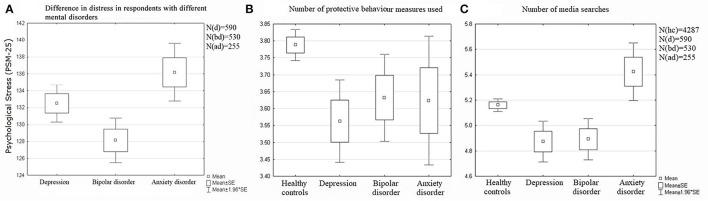
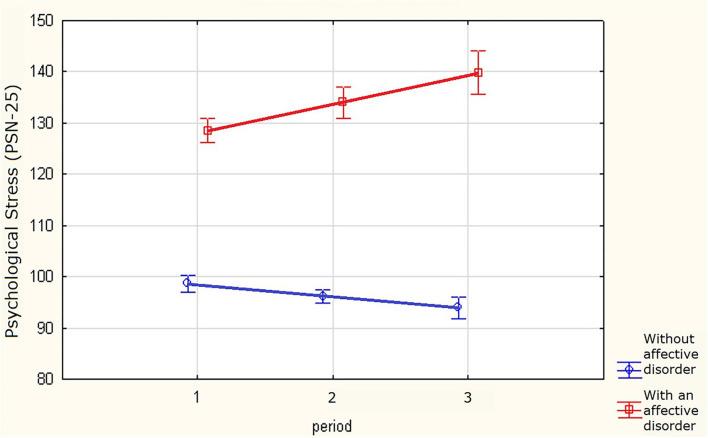
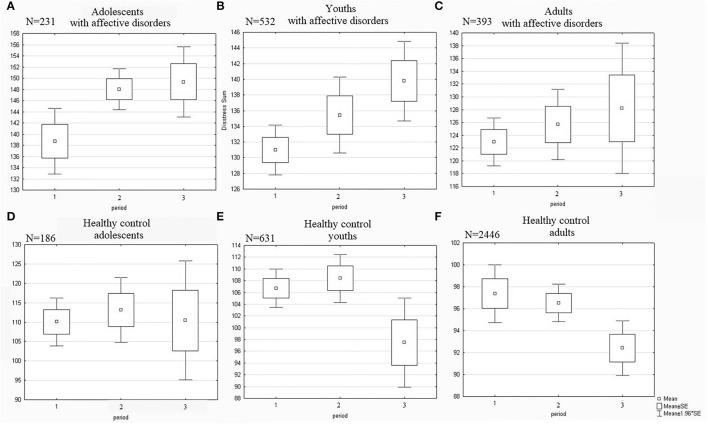
Stress levels among respondents with AAD were higher at all study periods than for those with no mental disorder (Cohen's 0.8-1.6). The stress level increased (Cohen's = 0.4) in adolescents (16-18 years) with AAD and remained the same in those without disorders; in youths (19-24 years) with and without disorders, an increase (Cohen's = 0.3) and a decrease (Cohen's = 0.3) in the stress were observed, correspondingly; the stress in adults (25-44 years) with disorders did not change and decreased in those without disorders (Cohen's = 0.4). Individuals with bipolar disorders demonstrated lower stress than individuals with depressive (Cohen's = 0.15) and anxiety disorders (Cohen's = 0.27). Respondents with depressive and bipolar disorders employed fewer protective measures simultaneously and were less likely to search for information about COVID-19.
CONCLUSION
The presence of affective or anxiety disorders is associated with a more acute response to the COVID-19 pandemic. Apparently, the type of mental disorder influenced stress levels and protective behavior patterns.
引言
患有情感障碍和焦虑症的个体是最易受到新冠疫情负面影响的人群之一。
目的
本研究旨在分析患有情感或焦虑症(AADs)的俄语使用者在新冠疫情期间压力水平的决定因素以及相关的保护行为策略。
材料与方法
在这项横断面在线调查中,对自我报告患有AAD(n = 1375)和未患疾病(n = 4278)的受访者在俄罗斯实施限制措施的三个时期(2020年3月至5月)的心理困扰和行为模式进行了评估。使用心理压力量表(PSM - 25)验证压力水平。
结果
在所有研究时期,患有AAD的受访者的压力水平均高于无精神障碍者(科恩d值为0.8 - 1.6)。患有AAD的青少年(16 - 18岁)压力水平增加(科恩d值 = 0.4),而无精神障碍的青少年压力水平保持不变;在有和无精神障碍 的青年(19 - 24岁)中,压力分别出现增加(科恩d值 = 0.3)和下降(科恩d值 = 0.3);患有精神障碍的成年人(25 - 44岁)压力未变化,无精神障碍的成年人压力下降(科恩d值 = 0.4)。双相情感障碍患者的压力低于抑郁症患者(科恩d值 = 0.15)和焦虑症患者(科恩d值 = 0.27)。患有抑郁症和双相情感障碍的受访者同时采取的保护措施较少,且不太可能搜索有关新冠疫情的信息。
结论
情感或焦虑症的存在与对新冠疫情更强烈的反应相关。显然,精神障碍的类型影响了压力水平和保护行为模式。

 Zotero 插件