
蜜蜂早期蜂王发育:社会环境和蜂王饲养源影响肠道微生物组及其相关代谢。
Early Queen Development in Honey Bees: Social Context and Queen Breeder Source Affect Gut Microbiota and Associated Metabolism.
机构信息
USDA-ARS Carl Hayden Bee Research Center, Tucson, Arizona, USA.
Department of Microbiology, School of Animal and Comparative Biomedical Sciences, University of Arizonagrid.134563.6, Tucson, Arizona, USA.
出版信息
Microbiol Spectr. 2022 Aug 31;10(4):e0038322. doi: 10.1128/spectrum.00383-22. Epub 2022 Jul 18.
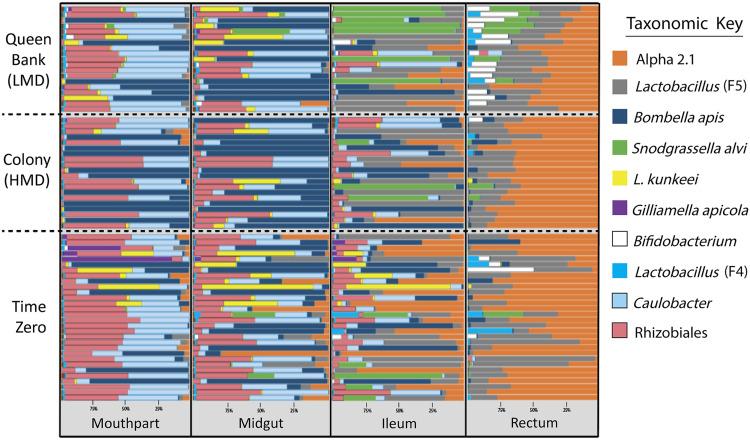
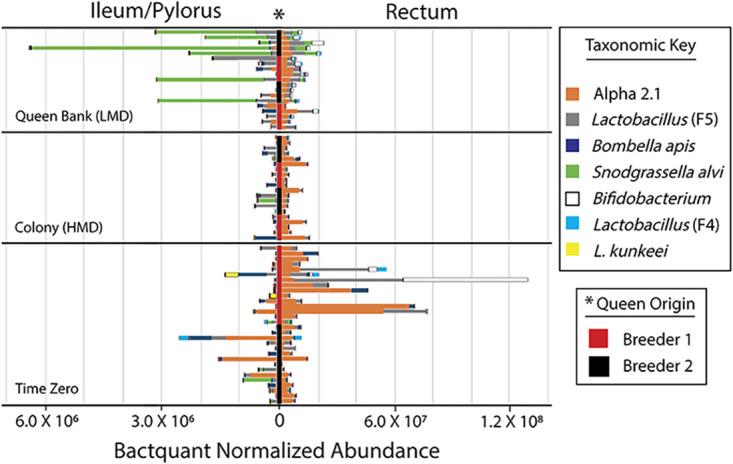
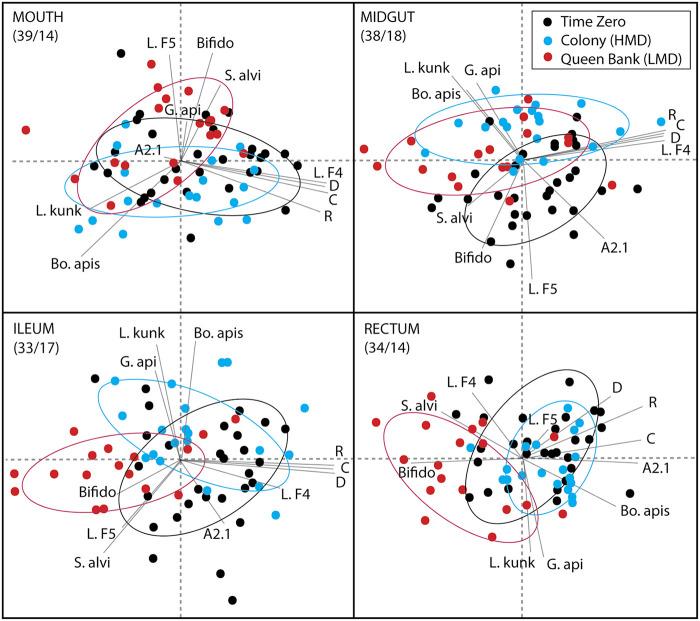
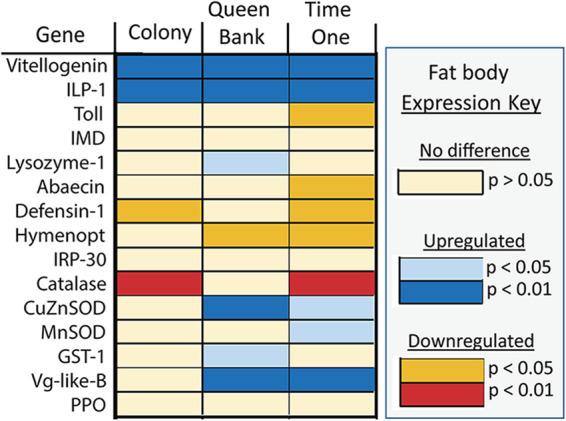
The highly social honey bee has dense populations but a significantly reduced repertoire of immune genes relative to solitary species, suggesting a greater reliance on social immunity. Here we investigate immune gene expression and gut microbial succession in queens during colony introduction. Recently mated queens were placed into an active colony or a storage hive for multiple queens: a queen-bank. Feeding intensity, social context, and metabolic demand differ greatly between the two environments. After 3 weeks, we examined gene expression associated with oxidative stress and immunity and performed high-throughput sequencing of the queen gut microbiome across four alimentary tract niches. Microbiota and gene expression in the queen hindgut differed by time, queen breeder source, and metabolic environment. In the ileum, upregulation of most immune and oxidative stress genes occurred regardless of treatment conditions, suggesting postmating effects on gut gene expression. Counterintuitively, queens exposed to the more social colony environment contained significantly less bacterial diversity indicative of social immune factors shaping the queens microbiome. Queen bank queens resembled much older queens with decreased Alpha 2.1, greater abundance of and in the hindgut, and significantly larger ileum microbiotas, dominated by blooms of Snodgrassella alvi. Combined with earlier findings, we conclude that the queen gut microbiota experiences an extended period of microbial succession associated with queen breeder source, postmating development, and colony assimilation. In modern agriculture, honey bee queen failure is repeatedly cited as one of the major reasons for yearly colony loss. Here we discovered that the honey bee queen gut microbiota alters according to early social environment and is strongly tied to the identity of the queen breeder. Like human examples, this early life variation appears to set the trajectory for ecological succession associated with social assimilation and queen productivity. The high metabolic demand of natural colony assimilation is associated with less bacterial diversity, a smaller hindgut microbiome, and a downregulation of genes that control pathogens and oxidative stress. Queens placed in less social environments with low metabolic demand (queen banks) developed a gut microbiota that resembled much older queens that produce fewer eggs. The queens key reproductive role in the colony may rely in part on a gut microbiome shaped by social immunity and the early queen rearing environment.
高度社会化的蜜蜂种群密度大,但与独居物种相比,其免疫基因谱显著减少,这表明它们更依赖于社会免疫。在这里,我们研究了引入群体时蜂王的免疫基因表达和肠道微生物演替。最近交配的蜂王被放置在一个活跃的群体或一个用于多只蜂王的储存蜂箱中:蜂王银行。两种环境的喂养强度、社会背景和代谢需求差异很大。3 周后,我们检查了与氧化应激和免疫相关的基因表达,并对蜂王肠道微生物组的四个营养道生态位进行了高通量测序。蜂王后肠的微生物群和基因表达随时间、蜂王饲养源和代谢环境而不同。在回肠中,无论处理条件如何,大多数免疫和氧化应激基因的上调都发生了,这表明交配后对肠道基因表达有影响。与预期相反的是,暴露于更社会化的群体环境中的蜂王肠道中细菌多样性明显较少,这表明社会免疫因素塑造了蜂王的微生物组。蜂王银行的蜂王与更年长的蜂王相似,后肠中的 Alpha 2.1 减少, 和 增加,回肠微生物群显著增大,主要由 Snodgrassella alvi 的大量繁殖组成。结合早期的研究结果,我们得出结论,蜂王肠道微生物群经历了一个与蜂王饲养源、交配后发育和群体同化相关的延长的微生物演替期。在现代农业中,蜜蜂蜂王失败被反复引用为每年蜂群损失的主要原因之一。在这里,我们发现蜜蜂蜂王肠道微生物群根据早期的社会环境而改变,并且与蜂王饲养源密切相关。与人类的例子一样,这种早期的生活变化似乎为与社会同化和蜂王生产力相关的生态演替设定了轨迹。自然群体同化的高代谢需求与较少的细菌多样性、较小的后肠微生物群以及控制病原体和氧化应激的基因下调有关。被放置在代谢需求较低(蜂王银行)、社会环境不那么社会化的环境中的蜂王发展出的肠道微生物群类似于产生较少卵子的更年长的蜂王。蜂王在群体中的关键生殖作用部分可能依赖于由社会免疫和早期蜂王饲养环境塑造的肠道微生物群。

 Zotero 插件