
一种细菌共生体保护蜜蜂免受真菌感染。
A Bacterial Symbiont Protects Honey Bees from Fungal Disease.
机构信息
Department of Biology, Indiana University, Bloomington, Indiana, USA.
出版信息
mBio. 2021 Jun 29;12(3):e0050321. doi: 10.1128/mBio.00503-21. Epub 2021 Jun 8.
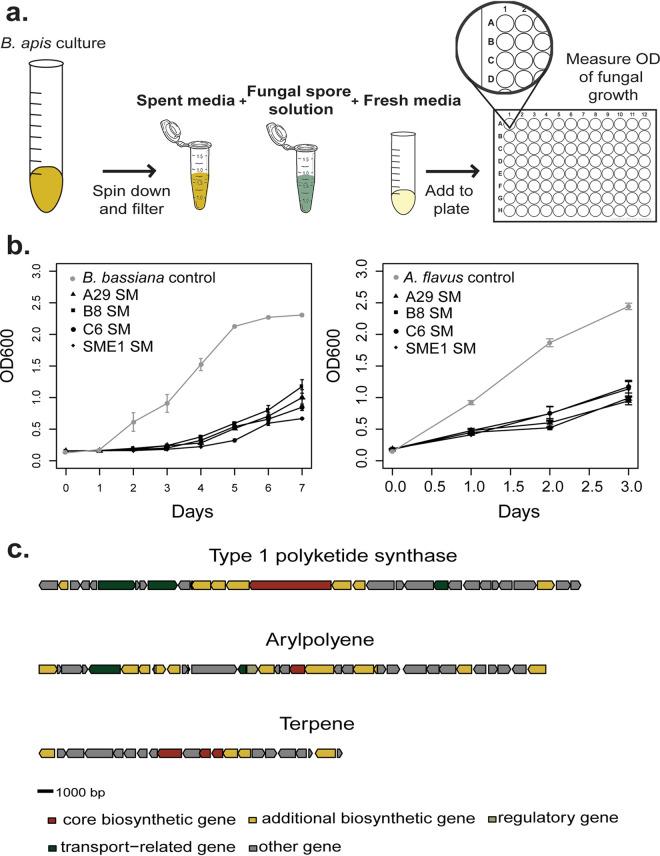
Fungal pathogens, among other stressors, negatively impact the productivity and population size of honey bees, one of our most important pollinators (1, 2), in particular their brood (larvae and pupae) (3, 4). Understanding the factors that influence disease incidence and prevalence in brood may help us improve colony health and productivity. Here, we examined the capacity of a honey bee-associated bacterium, Bombella apis, to suppress the growth of fungal pathogens and ultimately protect bee brood from infection. Our results showed that strains of inhibit the growth of two insect fungal pathogens, Beauveria bassiana and Aspergillus flavus, . This phenotype was recapitulated ; bee broods supplemented with were significantly less likely to be infected by A. flavus. Additionally, the presence of reduced sporulation of A. flavus in the few bees that were infected. Analyses of biosynthetic gene clusters across strains suggest antifungal candidates, including a type 1 polyketide, terpene, and aryl polyene. Secreted metabolites from alone were sufficient to suppress fungal growth, supporting the hypothesis that fungal inhibition is mediated by an antifungal metabolite. Together, these data suggest that can suppress fungal infections in bee brood via secretion of an antifungal metabolite. Fungi can play critical roles in host microbiomes (5-7), yet bacterial-fungal interactions are understudied. For insects, fungi are the leading cause of disease (5, 8). In particular, populations of the European honey bee (Apis mellifera), an agriculturally and economically critical species, have declined in part due to fungal pathogens. The presence and prevalence of fungal pathogens in honey bees have far-reaching consequences, endangering other species and threatening food security (1, 2, 9). Our research highlights how a bacterial symbiont protects bee brood from fungal infection. Further mechanistic work could lead to the development of new antifungal treatments.
真菌病原体等应激源会降低蜜蜂的生产力和种群数量,而蜜蜂是我们最重要的传粉媒介之一(1, 2),特别是它们的幼虫和蛹(3, 4)。了解影响幼虫疾病发病率和流行率的因素,可能有助于我们改善蜂群的健康和生产力。在这里,我们研究了一种与蜜蜂相关的细菌—— Bombella apis,它抑制真菌病原体生长并保护蜜蜂幼虫免受感染的能力。我们的研究结果表明, 抑制了两种昆虫真菌病原体——球孢白僵菌和黄曲霉的生长。这一表型在基因敲除实验中得到了重现;补充了 的蜜蜂幼虫感染黄曲霉的可能性显著降低。此外, 的存在降低了少数被感染蜜蜂中的黄曲霉孢子形成。对 菌株中生物合成基因簇的分析表明了候选的抗真菌物质,包括一种 1 型聚酮化合物、萜烯和芳基多烯。 单独分泌的代谢物足以抑制真菌生长,这支持了真菌抑制是由一种抗真菌代谢物介导的假说。综上所述,这些数据表明 可以通过分泌一种抗真菌代谢物来抑制蜜蜂幼虫的真菌感染。真菌在宿主微生物组中起着至关重要的作用(5-7),但细菌-真菌相互作用的研究还很缺乏。对于昆虫来说,真菌是疾病的主要原因(5, 8)。特别是,欧洲蜜蜂( Apis mellifera )的种群数量下降,部分原因是真菌病原体的存在和流行。真菌病原体在蜜蜂中的存在和流行,对其他物种造成了深远的影响,威胁到了粮食安全(1, 2, 9)。我们的研究强调了一种细菌共生体如何保护蜜蜂幼虫免受真菌感染。进一步的机制研究可能会导致新的抗真菌治疗方法的开发。


 Zotero 插件