
限时进食 3 周可改善 2 型糖尿病成人的血糖稳态,但不能改善胰岛素敏感性:一项随机交叉试验。
Three weeks of time-restricted eating improves glucose homeostasis in adults with type 2 diabetes but does not improve insulin sensitivity: a randomised crossover trial.
机构信息
Department of Nutrition and Movement Sciences, NUTRIM School of Nutrition and Translational Research in Metabolism, Maastricht University Medical Center, Maastricht, the Netherlands.
Department of Radiology and Nuclear Medicine, NUTRIM School of Nutrition and Translational Research in Metabolism, Maastricht University Medical Center, Maastricht, the Netherlands.
出版信息
Diabetologia. 2022 Oct;65(10):1710-1720. doi: 10.1007/s00125-022-05752-z. Epub 2022 Jul 25.
AIMS/HYPOTHESIS: Time-restricted eating (TRE) is suggested to improve metabolic health by limiting food intake to a defined time window, thereby prolonging the overnight fast. This prolonged fast is expected to lead to a more pronounced depletion of hepatic glycogen stores overnight and might improve insulin sensitivity due to an increased need to replenish nutrient storage. Previous studies showed beneficial metabolic effects of 6-8 h TRE regimens in healthy, overweight adults under controlled conditions. However, the effects of TRE on glucose homeostasis in individuals with type 2 diabetes are unclear. Here, we extensively investigated the effects of TRE on hepatic glycogen levels and insulin sensitivity in individuals with type 2 diabetes.
METHODS
Fourteen adults with type 2 diabetes (BMI 30.5±4.2 kg/m, HbA 46.1±7.2 mmol/mol [6.4±0.7%]) participated in a 3 week TRE (daily food intake within 10 h) vs control (spreading food intake over ≥14 h) regimen in a randomised, crossover trial design. The study was performed at Maastricht University, the Netherlands. Eligibility criteria included diagnosis of type 2 diabetes, intermediate chronotype and absence of medical conditions that could interfere with the study execution and/or outcome. Randomisation was performed by a study-independent investigator, ensuring that an equal amount of participants started with TRE and CON. Due to the nature of the study, neither volunteers nor investigators were blinded to the study interventions. The quality of the data was checked without knowledge on intervention allocation. Hepatic glycogen levels were assessed with C-MRS and insulin sensitivity was assessed using a hyperinsulinaemic-euglycaemic two-step clamp. Furthermore, glucose homeostasis was assessed with 24 h continuous glucose monitoring devices. Secondary outcomes included 24 h energy expenditure and substrate oxidation, hepatic lipid content and skeletal muscle mitochondrial capacity.
RESULTS
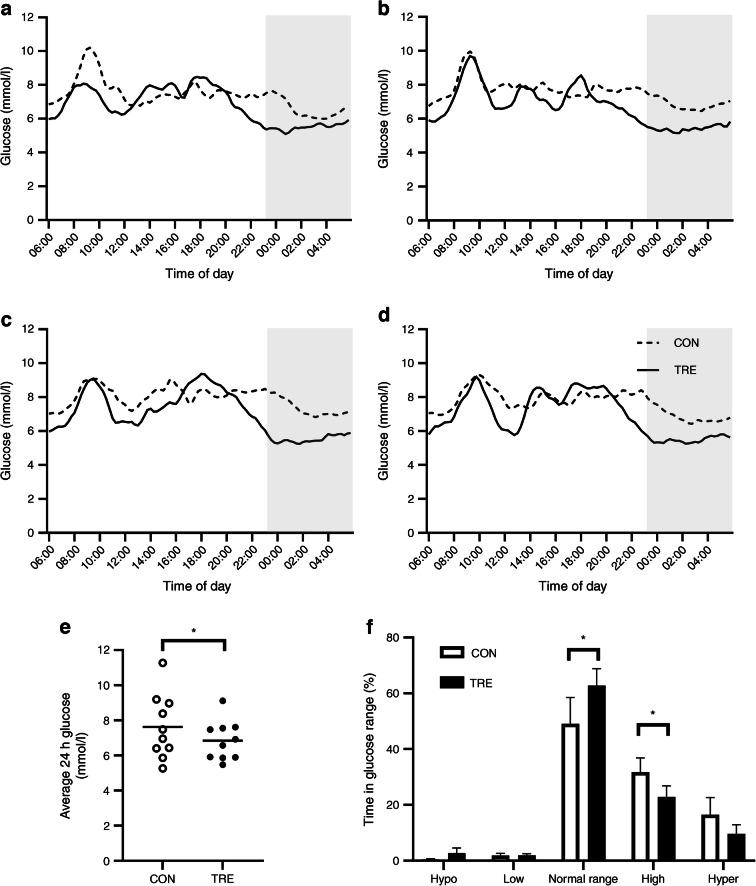
Results are depicted as mean ± SEM. Hepatic glycogen content was similar between TRE and control condition (0.15±0.01 vs 0.15±0.01 AU, p=0.88). M value was not significantly affected by TRE (19.6±1.8 vs 17.7±1.8 μmol kg min in TRE vs control, respectively, p=0.10). Hepatic and peripheral insulin sensitivity also remained unaffected by TRE (p=0.67 and p=0.25, respectively). Yet, insulin-induced non-oxidative glucose disposal was increased with TRE (non-oxidative glucose disposal 4.3±1.1 vs 1.5±1.7 μmol kg min, p=0.04). TRE increased the time spent in the normoglycaemic range (15.1±0.8 vs 12.2±1.1 h per day, p=0.01), and decreased fasting glucose (7.6±0.4 vs 8.6±0.4 mmol/l, p=0.03) and 24 h glucose levels (6.8±0.2 vs 7.6±0.3 mmol/l, p<0.01). Energy expenditure over 24 h was unaffected; nevertheless, TRE decreased 24 h glucose oxidation (260.2±7.6 vs 277.8±10.7 g/day, p=0.04). No adverse events were reported that were related to the interventions.
CONCLUSIONS/INTERPRETATION: We show that a 10 h TRE regimen is a feasible, safe and effective means to improve 24 h glucose homeostasis in free-living adults with type 2 diabetes. However, these changes were not accompanied by changes in insulin sensitivity or hepatic glycogen.
TRIAL REGISTRATION
ClinicalTrials.gov NCT03992248 FUNDING: ZonMW, 459001013.
目的/假设:限时进食(TRE)通过将食物摄入量限制在一个定义的时间窗口内,从而延长夜间禁食时间,被认为可以改善代谢健康。这种长时间禁食预计会导致夜间肝糖原储存更明显地消耗,并可能由于需要补充营养储存而提高胰岛素敏感性。先前的研究表明,在受控条件下,健康超重成年人的 6-8 小时 TRE 方案具有有益的代谢作用。然而,TRE 对 2 型糖尿病患者血糖稳态的影响尚不清楚。在这里,我们广泛研究了 TRE 对 2 型糖尿病患者肝糖原水平和胰岛素敏感性的影响。
方法
14 名 2 型糖尿病患者(BMI 30.5±4.2 kg/m,HbA 46.1±7.2 mmol/mol [6.4±0.7%])参与了一项为期 3 周的 TRE(每天 10 小时内进食)与对照(至少 14 小时内进食)方案的随机交叉试验设计。该研究在荷兰马斯特里赫特大学进行。入选标准包括 2 型糖尿病的诊断、中间生物钟型和不存在可能干扰研究执行和/或结果的医疗条件。随机分组由一个独立的研究人员进行,以确保有相等数量的参与者开始 TRE 和 CON。由于研究的性质,志愿者和研究人员都不知道研究干预措施。数据质量的检查是在不知道干预分配的情况下进行的。肝糖原水平通过 C-MRS 评估,胰岛素敏感性通过高胰岛素-正常血糖钳夹进行评估。此外,还使用 24 小时连续血糖监测设备评估血糖稳态。次要结局包括 24 小时能量消耗和底物氧化、肝脂质含量和骨骼肌线粒体容量。
结果
结果表示为平均值±SEM。TRE 和对照条件下肝糖原含量相似(0.15±0.01 与 0.15±0.01 AU,p=0.88)。M 值不受 TRE 影响(TRE 与对照相比,分别为 19.6±1.8 与 17.7±1.8 μmol kg min,p=0.10)。肝和外周胰岛素敏感性也不受 TRE 影响(p=0.67 和 p=0.25)。然而,胰岛素诱导的非氧化葡萄糖处置增加(非氧化葡萄糖处置 4.3±1.1 与 1.5±1.7 μmol kg min,p=0.04)。TRE 增加了血糖正常范围的时间(15.1±0.8 与 12.2±1.1 小时/天,p=0.01),并降低了空腹血糖(7.6±0.4 与 8.6±0.4 mmol/l,p=0.03)和 24 小时血糖水平(6.8±0.2 与 7.6±0.3 mmol/l,p<0.01)。24 小时能量消耗不受影响;然而,TRE 降低了 24 小时葡萄糖氧化(260.2±7.6 与 277.8±10.7 g/天,p=0.04)。没有报告与干预措施相关的不良事件。
结论/解释:我们表明,10 小时 TRE 方案是改善 2 型糖尿病患者 24 小时血糖稳态的可行、安全和有效的方法。然而,这些变化并没有伴随着胰岛素敏感性或肝糖原的变化。
试验注册
ClinicalTrials.gov NCT03992248 资金来源:ZonMW,459001013。


 Zotero 插件