
口服补充镁对接受胰岛素治疗的 2 型糖尿病且血清镁低的患者的胰岛素敏感性没有影响:一项随机对照试验。
Oral magnesium supplementation does not affect insulin sensitivity in people with insulin-treated type 2 diabetes and a low serum magnesium: a randomised controlled trial.
机构信息
Department of Internal Medicine, Radboudumc, Nijmegen, the Netherlands.
Department of Medical Biosciences, Radboudumc, Nijmegen, the Netherlands.
出版信息
Diabetologia. 2024 Jan;67(1):52-61. doi: 10.1007/s00125-023-06029-9. Epub 2023 Nov 3.
AIMS/HYPOTHESIS: Hypomagnesaemia has been associated with insulin resistance and an increased risk of type 2 diabetes. Whether magnesium supplementation improves insulin sensitivity in people with type 2 diabetes and a low serum magnesium level is unknown.
METHODS
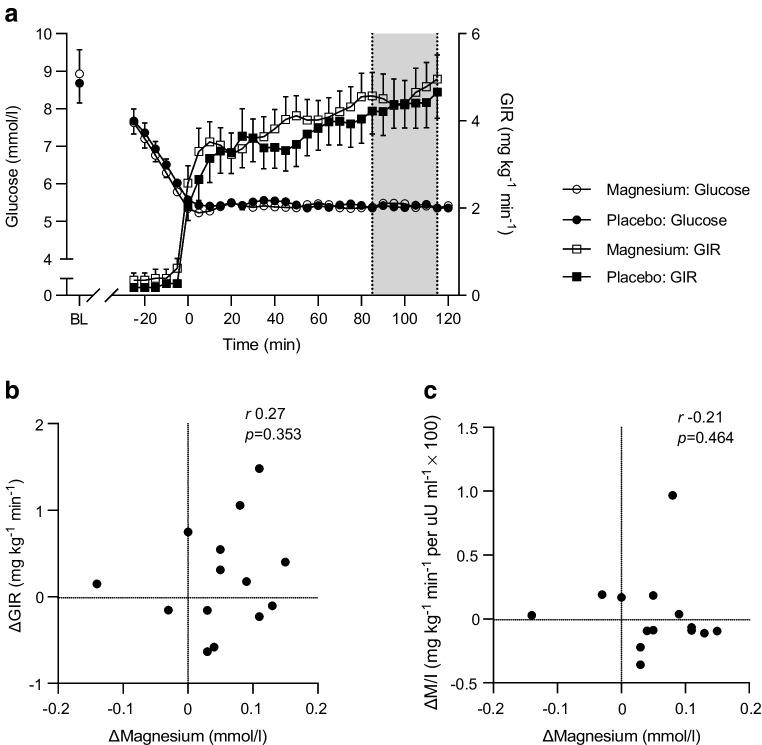
Using a randomised, double-blind (both participants and investigators were blinded to the participants' treatment sequences), placebo-controlled, crossover study design, we compared the effect of oral magnesium supplementation (15 mmol/day) for 6 weeks with that of matched placebo in individuals with insulin-treated type 2 diabetes (age ≥18 years, BMI 18-40 kg/m, HbA <100 mmol/mol [11.3%], serum magnesium ≤0.79 mmol/l). Participants were recruited from the outpatient clinic and through advertisements. Randomisation to a treatment sequence order was done using a randomisation list. We used block randomisation and the two possible treatment sequences were evenly distributed among the trial population. The primary outcome was the mean glucose infusion rate during the final 30 min of a hyperinsulinaemic-euglycaemic clamp (i.e. M value). Secondary outcomes included variables of glucose control, insulin need, BP, lipid profile and hypomagnesaemia-related symptoms during follow-up.
RESULTS
We recruited 14 participants (50% women, 100% White, mean ± SD age 67±6 years, BMI 31±5 kg/m, HbA 58±9 mmol/mol [7.4±0.9%]) with insulin-treated type 2 diabetes. Magnesium supplementation increased both mean ± SEM serum magnesium level (0.75±0.02 vs 0.70±0.02 mmol/l, p=0.016) and urinary magnesium excretion (magnesium/creatinine ratio, 0.23±0.02 vs 0.15±0.02, p=0.005), as compared with placebo. The M value of the glucose clamp did not differ between the magnesium and placebo study arms (4.6±0.5 vs 4.4±0.6 mg kg min, p=0.108). During the 6 weeks of treatment, continuous glucose monitoring outcomes, HbA, insulin dose, lipid profile and BP also did not differ, except for a lower HDL-cholesterol concentration after magnesium compared with placebo (1.14±0.08 vs 1.20±0.09 mmol/l, p=0.026). Symptoms potentially related to hypomagnesaemia were similar for both treatment arms.
CONCLUSIONS/INTERPRETATION: Despite an albeit modest increase in serum magnesium concentration, oral magnesium supplementation does not improve insulin sensitivity in people with insulin-treated type 2 diabetes and low magnesium levels.
TRIAL REGISTRATION
EudraCT number 2021-001243-27.
FUNDING
This study was supported by a grant from the Dutch Diabetes Research Foundation (2017-81-014).
目的/假设:低镁血症与胰岛素抵抗和 2 型糖尿病风险增加有关。镁补充剂是否能改善 2 型糖尿病和低血清镁水平患者的胰岛素敏感性尚不清楚。
方法
采用随机、双盲(参与者和研究者均对参与者的治疗顺序设盲)、安慰剂对照、交叉研究设计,我们比较了口服镁补充剂(15 mmol/天)治疗 6 周与匹配安慰剂对接受胰岛素治疗的 2 型糖尿病患者(年龄≥18 岁,BMI 18-40 kg/m²,HbA<100 mmol/mol [11.3%],血清镁≤0.79 mmol/l)的影响。参与者从门诊和广告中招募。使用随机列表对治疗顺序进行随机分组。我们使用区组随机化,两种可能的治疗顺序在试验人群中均匀分布。主要结局是在高胰岛素-正常血糖钳夹的最后 30 分钟内的平均葡萄糖输注率(即 M 值)。次要结局包括随访期间血糖控制、胰岛素需求、血压、血脂谱和低镁血症相关症状的变量。
结果
我们招募了 14 名参与者(50%为女性,100%为白人,平均±SD 年龄 67±6 岁,BMI 31±5 kg/m²,HbA 58±9 mmol/mol [7.4±0.9%]),他们患有接受胰岛素治疗的 2 型糖尿病。与安慰剂相比,镁补充剂增加了平均血清镁水平(0.75±0.02 与 0.70±0.02 mmol/l,p=0.016)和尿镁排泄(镁/肌酐比值,0.23±0.02 与 0.15±0.02,p=0.005)。葡萄糖钳夹的 M 值在镁和安慰剂研究臂之间没有差异(4.6±0.5 与 4.4±0.6 mg/kg/min,p=0.108)。在 6 周的治疗期间,连续血糖监测结果、HbA、胰岛素剂量、血脂谱和血压也没有差异,除了镁治疗后 HDL-胆固醇浓度较低(1.14±0.08 与 1.20±0.09 mmol/l,p=0.026)。两种治疗臂的低镁血症相关症状相似。
结论/解释:尽管血清镁浓度略有升高,但口服镁补充剂并不能改善接受胰岛素治疗的 2 型糖尿病和低镁水平患者的胰岛素敏感性。
试验注册
EudraCT 编号 2021-001243-27。
资金
本研究由荷兰糖尿病研究基金会(2017-81-014)资助。

 Zotero 插件