
结直肠癌浸润调节性 T 细胞:功能异质性、代谢适应及治疗靶点。
Colorectal Cancer-Infiltrating Regulatory T Cells: Functional Heterogeneity, Metabolic Adaptation, and Therapeutic Targeting.
机构信息
Center Molecular Medicine, University Medical Center Utrecht, Utrecht, Netherlands.
Regenerative Medicine Center, University Medical Center Utrecht, Utrecht, Netherlands.
出版信息
Front Immunol. 2022 Jul 8;13:903564. doi: 10.3389/fimmu.2022.903564. eCollection 2022.
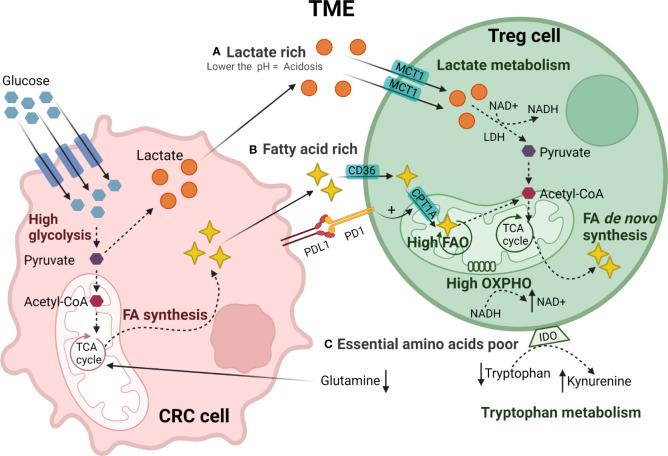
Colorectal cancer (CRC) is a heterogeneous disease with one of the highest rates of incidence and mortality among cancers worldwide. Understanding the CRC tumor microenvironment (TME) is essential to improve diagnosis and treatment. Within the CRC TME, tumor-infiltrating lymphocytes (TILs) consist of a heterogeneous mixture of adaptive immune cells composed of mainly anti-tumor effector T cells (CD4+ and CD8+ subpopulations), and suppressive regulatory CD4+ T (Treg) cells. The balance between these two populations is critical in anti-tumor immunity. In general, while tumor antigen-specific T cell responses are observed, tumor clearance frequently does not occur. Treg cells are considered to play an important role in tumor immune escape by hampering effective anti-tumor immune responses. Therefore, CRC-tumors with increased numbers of Treg cells have been associated with promoting tumor development, immunotherapy failure, and a poorer prognosis. Enrichment of Treg cells in CRC can have multiple causes including their differentiation, recruitment, and preferential transcriptional and metabolic adaptation to the TME. Targeting tumor-associated Treg cell may be an effective addition to current immunotherapy approaches. Strategies for depleting Treg cells, such as low-dose cyclophosphamide treatment, or targeting one or more checkpoint receptors such as CTLA-4 with PD-1 with monoclonal antibodies, have been explored. These have resulted in activation of anti-tumor immune responses in CRC-patients. Overall, it seems likely that CRC-associated Treg cells play an important role in determining the success of such therapeutic approaches. Here, we review our understanding of the role of Treg cells in CRC, the possible mechanisms that support their homeostasis in the tumor microenvironment, and current approaches for manipulating Treg cells function in cancer.
结直肠癌(CRC)是一种异质性疾病,是全球癌症发病率和死亡率最高的癌症之一。了解 CRC 肿瘤微环境(TME)对于改善诊断和治疗至关重要。在 CRC TME 中,肿瘤浸润淋巴细胞(TIL)由主要抗肿瘤效应 T 细胞(CD4+和 CD8+亚群)组成的适应性免疫细胞的异质混合物组成,以及抑制性调节性 CD4+T(Treg)细胞。这两种细胞群体之间的平衡对于抗肿瘤免疫至关重要。一般来说,虽然观察到肿瘤抗原特异性 T 细胞反应,但肿瘤清除通常不会发生。Treg 细胞被认为通过阻碍有效的抗肿瘤免疫反应在肿瘤免疫逃逸中发挥重要作用。因此,CRC 肿瘤中 Treg 细胞数量增加与促进肿瘤发展、免疫治疗失败和预后较差有关。Treg 细胞在 CRC 中的富集可能有多种原因,包括其分化、募集以及对 TME 的优先转录和代谢适应。针对肿瘤相关 Treg 细胞可能是对当前免疫治疗方法的有效补充。已经探索了耗尽 Treg 细胞的策略,例如低剂量环磷酰胺治疗,或使用 PD-1 单克隆抗体靶向 CTLA-4 等一个或多个检查点受体。这些方法已导致 CRC 患者的抗肿瘤免疫反应被激活。总体而言,CRC 相关的 Treg 细胞似乎在决定这些治疗方法的成功方面发挥着重要作用。在这里,我们回顾了我们对 Treg 细胞在 CRC 中的作用的理解,支持它们在肿瘤微环境中维持平衡的可能机制,以及目前用于操纵 Treg 细胞在癌症中功能的方法。

 Zotero 插件