
比较转录组分析为西瓜耐盐性研究提供见解()。
Comparative Transcriptome Profiling Provides Insights into Plant Salt Tolerance in Watermelon ().
作者信息
Zhu Yingchun, Yuan Gaopeng, Gao Bowen, An Guolin, Li Weihua, Si Wenjing, Sun Dexi, Liu Junpu
机构信息
Zhengzhou Fruit Research Institute, The Chinese Academy of Agricultural Sciences, Zhengzhou 450009, China.
出版信息
Life (Basel). 2022 Jul 12;12(7):1033. doi: 10.3390/life12071033.
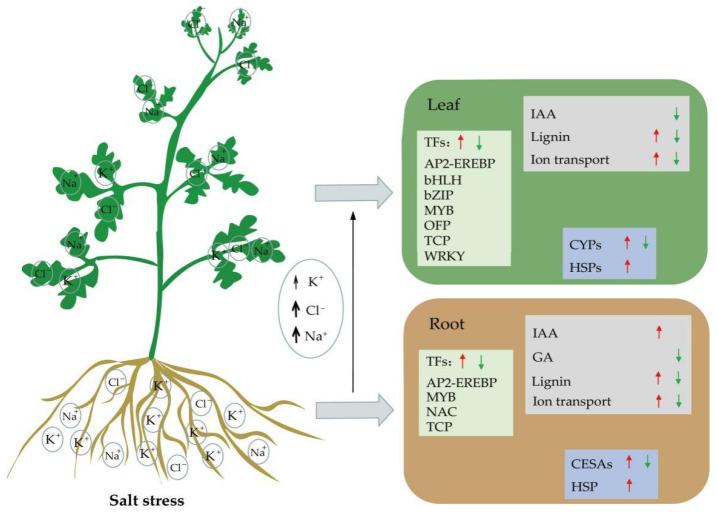
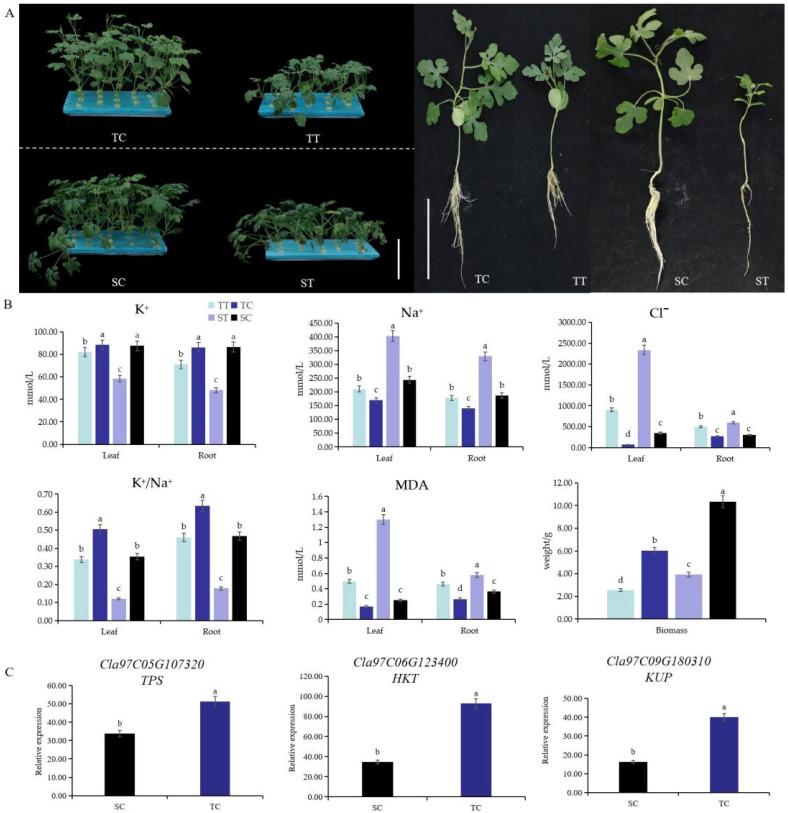
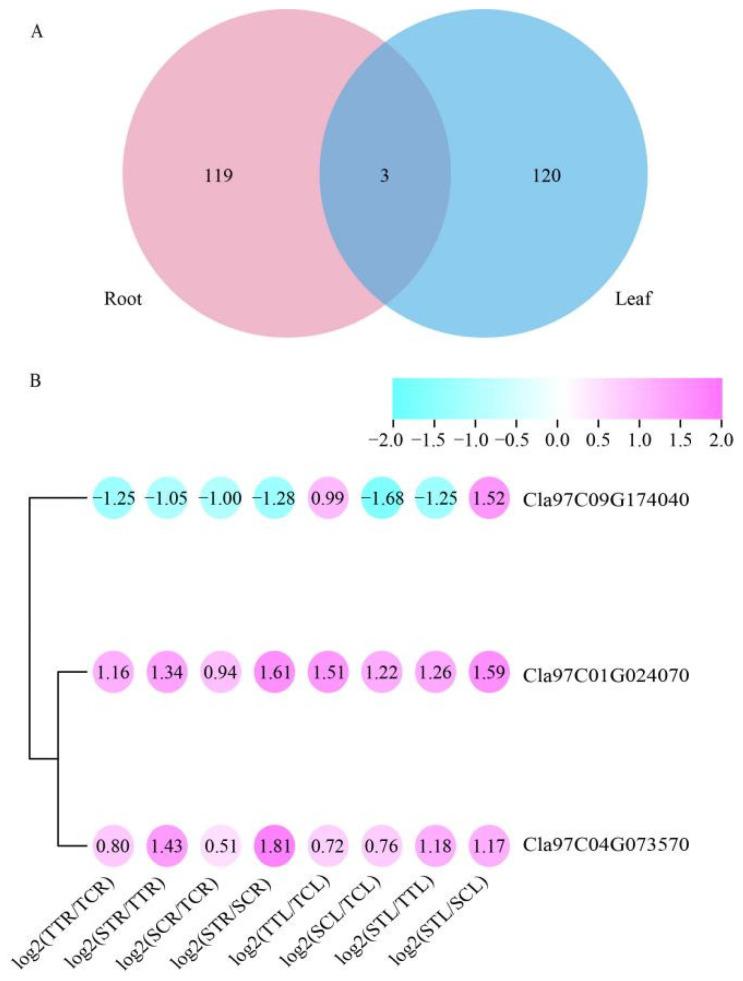
Salt stress seriously reduced the yield and quality of watermelon and restricted the sustainable development of the watermelon industry. However, the molecular mechanism of watermelon in response to salt stress is still unclear. In this study, 150 mmol·L NaCl was used to deal with the seedlings of salt-tolerant and salt-sensitive watermelon varieties. Physiological characteristics showed that salt stress significantly reduced the biomass of watermelon seedlings and the accumulation of K in roots and leaves and significantly increased the content of Na, Cl, and malondialdehyde (MDA). Compared with the salt-sensitive variety, the salt-tolerant variety had higher K accumulation, lower Cl, Cl accumulation, and MDA content in roots and leaves. Then, RNA-seq was performed on roots and leaves in normal culture and under 150 mmol·L NaCl treatment. A total of 21,069 genes were identified by RNA-seq analysis, of which 1412 were genes encoding transcription factors (TFs). In the comparison groups of roots and leaves, 122 and 123 shared differentially expressed genes (DEGs) were obtained, respectively. Gene ontology (GO) annotation and KEGG enrichment results showed that there were many identical GO terms and KEGG pathways in roots and leaves, especially the pathways that related to sugar or energy (ATP or NADP/NADPH). In addition, some DEGs related to salt tolerance were identified, such as plant hormone indole-3-acetic acid (IAA) and gibberellin (GA) signal transduction pathway-related genes, K/Na/Ca-related genes, lignin biosynthesis-related genes, etc. At the same time, we also identified some TFs related to salt tolerance, such as AP2-EREBP, bZIP, bHLH, MYB, NAC, OFP, TCP, and WRKY and found that these TFs had high correlation coefficients with salt tolerance-related genes, indicating that they might have a potential regulatory relationship. Interestingly, one TCP TF (Cla97C09G174040) co-exists both in roots and leaves, and it is speculated that it may be regulated by to improve the salt tolerance of watermelon.
盐胁迫严重降低了西瓜的产量和品质,制约了西瓜产业的可持续发展。然而,西瓜响应盐胁迫的分子机制仍不清楚。在本研究中,用150 mmol·L NaCl处理耐盐和盐敏感西瓜品种的幼苗。生理特性表明,盐胁迫显著降低了西瓜幼苗的生物量以及根和叶中钾的积累,并显著增加了钠、氯和丙二醛(MDA)的含量。与盐敏感品种相比,耐盐品种在根和叶中具有更高的钾积累、更低的氯、氯积累和MDA含量。然后,对正常培养和150 mmol·L NaCl处理下的根和叶进行RNA测序。通过RNA测序分析共鉴定出21069个基因,其中1412个是编码转录因子(TFs)的基因。在根和叶的比较组中,分别获得了122个和123个共有差异表达基因(DEGs)。基因本体(GO)注释和KEGG富集结果表明,根和叶中有许多相同的GO术语和KEGG途径,特别是与糖或能量(ATP或NADP/NADPH)相关的途径。此外,还鉴定了一些与耐盐性相关的DEGs,如植物激素吲哚-3-乙酸(IAA)和赤霉素(GA)信号转导途径相关基因、K/Na/Ca相关基因、木质素生物合成相关基因等。同时,我们还鉴定了一些与耐盐性相关的TFs,如AP2-EREBP、bZIP、bHLH、MYB、NAC、OFP、TCP和WRKY,并发现这些TFs与耐盐性相关基因具有较高的相关系数,表明它们可能具有潜在的调控关系。有趣的是,一个TCP TF(Cla97C09G174040)在根和叶中都存在,推测它可能受 调控以提高西瓜的耐盐性。


 Zotero 插件