
基于质谱的靶向蛋白质组学在人类肠道和肝脏中核受体的基因表达和蛋白丰度研究中的新应用。
Gene Expression and Protein Abundance of Nuclear Receptors in Human Intestine and Liver: A New Application for Mass Spectrometry-Based Targeted Proteomics.
机构信息
Department of Pharmacology, Center of Drug Absorption and Transport, University Medicine Greifswald, 17475 Greifswald, Germany.
Department of Experimental and Clinical Pharmacology, Pomeranian Medical University, 70-204 Szczecin, Poland.
出版信息
Molecules. 2022 Jul 20;27(14):4629. doi: 10.3390/molecules27144629.
BACKGROUND
Unwanted drug-drug interactions (DDIs), as caused by the upregulation of clinically relevant drug metabolizing enzymes and transporter proteins in intestine and liver, have the potential to threaten the therapeutic efficacy and safety of drugs. The molecular mechanism of this undesired but frequently occurring scenario of polypharmacy is based on the activation of nuclear receptors such as the pregnane X receptor (PXR) or the constitutive androstane receptor (CAR) by perpetrator agents such as rifampin, phenytoin or St. John's wort. However, the expression pattern of nuclear receptors in human intestine and liver remains uncertain, which makes it difficult to predict the extent of potential DDIs. Thus, it was the aim of this study to characterize the gene expression and protein abundance of clinically relevant nuclear receptors, i.e., the aryl hydrocarbon receptor (AhR), CAR, farnesoid X receptor (FXR), glucocorticoid receptor (GR), hepatocyte nuclear factor 4 alpha (HNF4α), PXR and small heterodimer partner (SHP), in the aforementioned organs.
METHODS
Gene expression analysis was performed by quantitative real-time PCR of jejunal, ileal, colonic and liver samples from eight human subjects. In parallel, a targeted proteomic method was developed and validated in order to determine the respective protein amounts of nuclear receptors in human intestinal and liver samples. The LC-MS/MS method was validated according to the current bioanalytical guidelines and met the criteria regarding linearity (0.1-50 nmol/L), within-day and between-day accuracy and precision, as well as the stability criteria.
RESULTS
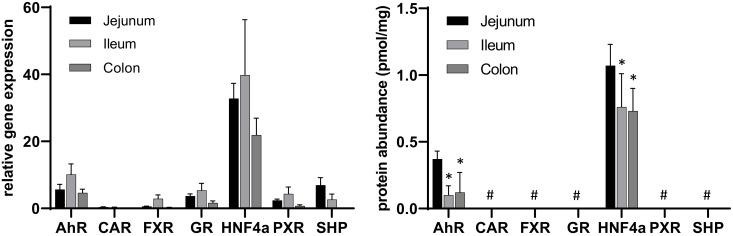
The developed method was successfully validated and applied to determine the abundance of nuclear receptors in human intestinal and liver samples. Gene expression and protein abundance data demonstrated marked differences in human intestine and liver. On the protein level, only AhR and HNF4α could be detected in gut and liver, which corresponds to their highest gene expression. In transfected cell lines, PXR and CAR could be quantified.
CONCLUSIONS
The substantially different expression pattern of nuclear receptors in human intestinal and liver tissue may explain the different extent of unwanted DDIs in the dependence on the administration route of drugs.
背景
由于临床上相关的药物代谢酶和转运蛋白在肠道和肝脏中的上调,导致药物相互作用(DDIs)不受欢迎,这有可能威胁到药物的治疗效果和安全性。这种多药治疗中经常发生的不良情况的分子机制基于配体激活核受体,如孕烷 X 受体(PXR)或组成型雄烷受体(CAR),配体如利福平、苯妥英或圣约翰草。然而,核受体在人肠道和肝脏中的表达模式尚不确定,这使得预测潜在 DDIs 的程度变得困难。因此,本研究的目的是描述临床相关核受体,即芳香烃受体(AhR)、CAR、法尼醇 X 受体(FXR)、糖皮质激素受体(GR)、肝细胞核因子 4α(HNF4α)、PXR 和小异二聚体伴侣(SHP)的基因表达和蛋白丰度,在上述器官中。
方法
通过对 8 个人类受试者的空肠、回肠、结肠和肝样本进行定量实时 PCR 进行基因表达分析。同时,开发并验证了一种靶向蛋白质组学方法,以确定人肠道和肝脏样本中核受体的相应蛋白含量。LC-MS/MS 方法根据当前的生物分析指南进行了验证,符合线性(0.1-50nmol/L)、日内和日间精密度和准确度以及稳定性标准。
结果
该方法成功验证并应用于测定人肠道和肝脏样本中核受体的丰度。基因表达和蛋白丰度数据表明,人肠道和肝脏存在显著差异。在蛋白水平上,仅在肠道和肝脏中可以检测到 AhR 和 HNF4α,这与它们的最高基因表达相对应。在转染细胞系中,可以定量测定 PXR 和 CAR。
结论
核受体在人肠道和肝脏组织中的表达模式存在显著差异,这可能解释了药物给药途径不同导致的不受欢迎的 DDIs 程度不同。


 Zotero 插件