
慢性伤口生物膜背景下的细菌相互作用:综述
Bacterial Interactions in the Context of Chronic Wound Biofilm: A Review.
作者信息
Durand Benjamin A R N, Pouget Cassandra, Magnan Chloé, Molle Virginie, Lavigne Jean-Philippe, Dunyach-Remy Catherine
机构信息
Bacterial Virulence and Chronic Infections, UMR 1047, Université Montpellier, INSERM, Service de Microbiologie et Hygiène Hospitalière, CHU Nîmes, 30908 Nîmes, France.
Laboratory of Pathogen Host Interactions, Université de Montpellier, CNRS, UMR 5235, 34000 Montpellier, France.
出版信息
Microorganisms. 2022 Jul 25;10(8):1500. doi: 10.3390/microorganisms10081500.
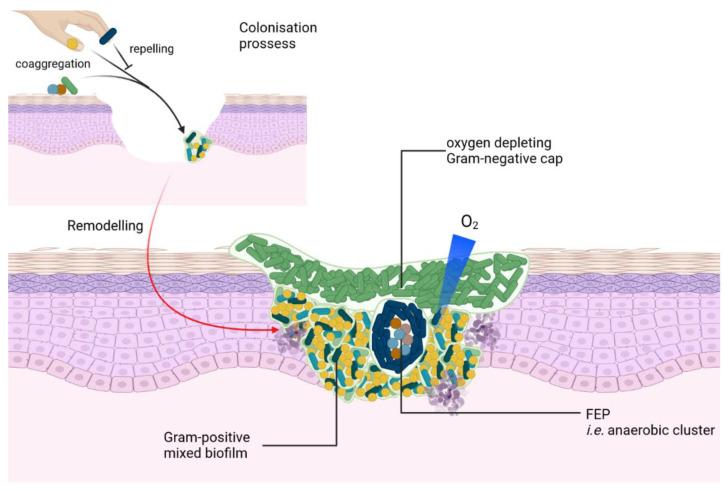
Chronic wounds, defined by their resistance to care after four weeks, are a major concern, affecting millions of patients every year. They can be divided into three types of lesions: diabetic foot ulcers (DFU), pressure ulcers (PU), and venous/arterial ulcers. Once established, the classical treatment for chronic wounds includes tissue debridement at regular intervals to decrease biofilm mass constituted by microorganisms physiologically colonizing the wound. This particular niche hosts a dynamic bacterial population constituting the bed of interaction between the various microorganisms. The temporal reshuffle of biofilm relies on an organized architecture. Microbial community turnover is mainly associated with debridement (allowing transitioning from one major representant to another), but also with microbial competition and/or collaboration within wounds. This complex network of species and interactions has the potential, through diversity in antagonist and/or synergistic crosstalk, to accelerate, delay, or worsen wound healing. Understanding these interactions between microorganisms encountered in this clinical situation is essential to improve the management of chronic wounds.
慢性伤口是一个主要问题,其定义为四周后仍难以愈合,每年影响数百万患者。慢性伤口可分为三种类型的损伤:糖尿病足溃疡(DFU)、压疮(PU)以及静脉/动脉溃疡。一旦形成,慢性伤口的传统治疗方法包括定期进行组织清创,以减少由生理性定植于伤口的微生物构成的生物膜量。这个特殊的生态位容纳了一个动态的细菌群体,构成了各种微生物之间相互作用的基础。生物膜的时间性重组依赖于一种有组织的结构。微生物群落的更替主要与清创有关(使从一种主要代表菌转变为另一种),但也与伤口内的微生物竞争和/或协作有关。这种复杂的物种和相互作用网络有可能通过拮抗和/或协同相互作用的多样性来加速、延迟或恶化伤口愈合。了解在这种临床情况下遇到的微生物之间的这些相互作用对于改善慢性伤口的管理至关重要。

 Zotero 插件