
单细胞基因组学助力揭示非小细胞肺癌患者循环肿瘤细胞亚群。
Powering single-cell genomics to unravel circulating tumour cell subpopulations in non-small cell lung cancer patients.
机构信息
School of Medical and Health Sciences, Edith Cowan University, Perth, Joondalup, WA, 6027, Australia.
Centre for Precision Health, Edith Cowan University, Joondalup, WA, 6027, Australia.
出版信息
J Cancer Res Clin Oncol. 2023 May;149(5):1941-1950. doi: 10.1007/s00432-022-04202-y. Epub 2022 Jul 28.
BACKGROUND
Circulating tumour cells (CTCs) are attractive "liquid biopsy" candidates that could provide insights into the different phenotypes of tumours present within a patient. The epithelial-to-mesenchymal transition (EMT) of CTCs is considered a critical step in tumour metastasis; however, it may confound traditional epithelial feature-based CTC isolation and detection. We applied single-cell copy number alteration (CNA) analysis for the identification of genomic alterations to confirm the neoplastic nature of circulating cells with only mesenchymal phenotypes.
METHODS
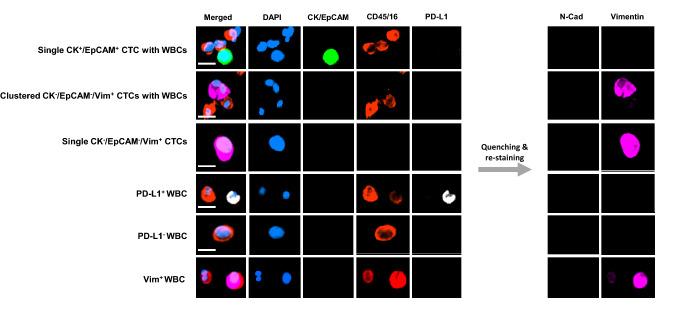
We isolated CTCs from blood samples collected from 46 NSCLC patients using the Parsortix system. Enriched cells were subjected to immunofluorescent staining for CTC identification using a multi-marker panel comprising both epithelial and mesenchymal markers. A subset of isolated CTCs was subjected to whole genome amplification (WGA) and low-pass whole-genome sequencing (LP-WGS) for the analysis of copy number alterations (CNAs).
RESULTS
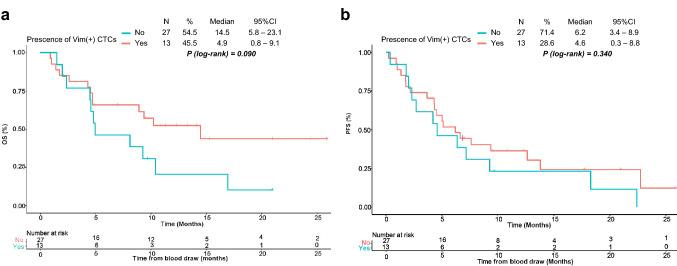
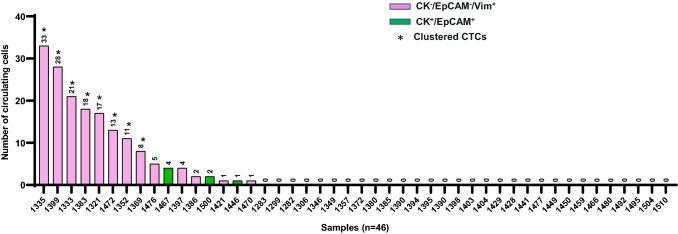
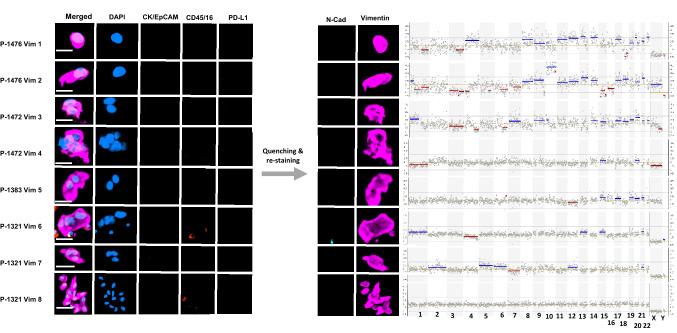
CTCs were detected in 16/46 (34.8%) patients, inclusive of CK/EpCAM CTCs (3/46, 6.5%) and Vim CTCs (13/46, 28.3%). Clusters of Vim cells were detected in 8 samples, which constitutes 50% of the total number of NSCLC patients with CTCs. No patients had detectable hybrid CK/EpCAM/Vim cells. All of the tested CK/EpCAM CTCs and 7/8 Vim CTCs or CTC clusters carried CNAs confirming their neoplastic nature. Notably, the Vim cluster with no CNAs was characterised by spindle morphology and, therefore, defined as normal mesenchymal circulating cells.
CONCLUSION
Our results revealed that CK-negative, vimentin-expressing cells represent a large proportion of CTCs detected in NSCLC patients, which are likely missed by standard epithelial-marker-dependent CTC categorisation.
背景
循环肿瘤细胞(CTCs)是一种有吸引力的“液体活检”候选物,可以提供有关患者体内不同肿瘤表型的见解。CTCs 的上皮-间充质转化(EMT)被认为是肿瘤转移的关键步骤;然而,它可能会混淆基于传统上皮特征的 CTC 分离和检测。我们应用单细胞拷贝数改变(CNA)分析来鉴定基因组改变,以确认仅有间充质表型的循环细胞的肿瘤性质。
方法
我们使用 Parsortix 系统从 46 名 NSCLC 患者的血液样本中分离 CTCs。富集的细胞用包含上皮和间充质标志物的多标志物组合进行免疫荧光染色,以鉴定 CTC。从分离的 CTC 中选择一部分进行全基因组扩增(WGA)和低深度全基因组测序(LP-WGS),以分析拷贝数改变(CNAs)。
结果
在 16/46(34.8%)名患者中检测到 CTCs,包括 CK/EpCAM CTCs(3/46,6.5%)和 Vim CTCs(13/46,28.3%)。在 8 个样本中检测到 Vim 细胞簇,占总 NSCLC 患者 CTCs 的 50%。没有患者检测到可检测的混合 CK/EpCAM/Vim 细胞。所有测试的 CK/EpCAM CTCs 和 7/8 的 Vim CTCs 或 CTC 簇都携带 CNA,证实了它们的肿瘤性质。值得注意的是,没有 CNA 的 Vim 簇表现为梭形形态,因此被定义为正常的间充质循环细胞。
结论
我们的结果表明,CK 阴性、波形蛋白表达的细胞代表 NSCLC 患者中检测到的 CTCs 的很大一部分,这可能会被基于标准上皮标志物的 CTC 分类所忽略。

 Zotero 插件