
冠状病毒 IBV 感染应激下地塞米松对鸡肾脏的非靶向代谢组学分析。
Non-Targeted Metabolomic Analysis of Chicken Kidneys in Response to Coronavirus IBV Infection Under Stress Induced by Dexamethasone.
机构信息
Laboratory of Veterinary Microbiology and Animal Infectious Diseases, College of Animal Sciences and Veterinary Medicine, Guangxi University, Nanning, China.
Shanghai Veterinary Research Institute, Chinese Academy of Agricultural Sciences, Shanghai, China.
出版信息
Front Cell Infect Microbiol. 2022 Jul 15;12:945865. doi: 10.3389/fcimb.2022.945865. eCollection 2022.
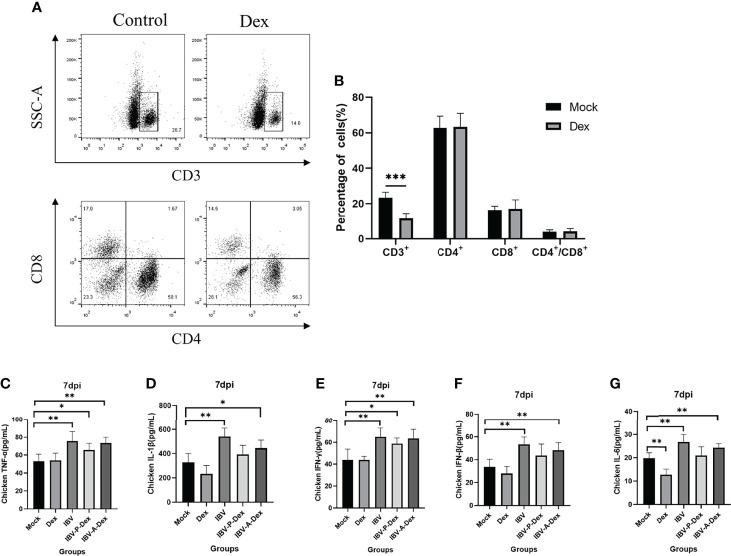
Stress in poultry can lead to changes in body metabolism and immunity, which can increase susceptibility to infectious diseases. However, knowledge regarding chicken responses to viral infection under stress is limited. Dexamethasone (Dex) is a synthetic glucocorticoid similar to that secreted by animals under stress conditions, and has been widely used to induce stress in chickens. Herein, we established a stress model in 7-day-old chickens injected with Dex to elucidate the effects of stress on IBV replication in the kidneys. The metabolic changes, immune status and growth of the chickens under stress conditions were comprehensively evaluated. Furthermore, the metabolic profile, weight gain, viral load, serum cholesterol levels, cytokines and peripheral blood lymphocyte ratio were compared in chickens treated with Dex and infected with IBV. An LC-MS/MS-based metabolomics method was used to examine differentially enriched metabolites in the kidneys. A total of 113 metabolites whose abundance was altered after Dex treatment were identified, most of which were lipids and lipid-like molecules. The principal metabolic alterations in chicken kidneys caused by IBV infection included fatty acid, valine, leucine and isoleucine metabolism. Dex treatment before and after IBV infection mainly affected the host's tryptophan, phenylalanine, amino sugar and nucleotide sugar metabolism. In addition, Dex led to up-regulation of serum cholesterol levels and renal viral load in chickens, and to the inhibition of weight gain, peripheral blood lymphocytes and IL-6 production. We also confirmed that the exogenous cholesterol in DF-1 cells promoted the replication of IBV. However, whether the increase in viral load in kidney tissue is associated with the up-regulation of cholesterol levels induced by Dex must be demonstrated in future experiments. In conclusion, chick growth and immune function were significantly inhibited by Dex. Host cholesterol metabolism and the response to IBV infection are regulated by Dex. This study provides valuable insights into the molecular regulatory mechanisms in poultry stress, and should support further research on the intrinsic link between cholesterol metabolism and IBV replication under stress conditions.
禽类应激会导致机体代谢和免疫功能发生改变,从而增加对传染性疾病的易感性。然而,关于应激状态下鸡只对病毒感染的反应的知识有限。地塞米松(Dex)是一种合成的糖皮质激素,类似于动物在应激条件下分泌的激素,已被广泛用于诱导鸡只应激。在此,我们建立了 7 日龄鸡注射地塞米松的应激模型,以阐明应激对鸡肾脏中 IBV 复制的影响。综合评估了应激条件下鸡的代谢变化、免疫状态和生长情况。此外,比较了用 Dex 处理和感染 IBV 的鸡的代谢谱、体重增加、病毒载量、血清胆固醇水平、细胞因子和外周血淋巴细胞比例。采用基于 LC-MS/MS 的代谢组学方法检测肾脏中差异富集的代谢物。鉴定出 113 种丰度在 Dex 处理后发生改变的代谢物,其中大多数是脂质和类脂分子。IBV 感染引起的鸡肾脏主要代谢变化包括脂肪酸、缬氨酸、亮氨酸和异亮氨酸代谢。IBV 感染前后用 Dex 处理主要影响宿主色氨酸、苯丙氨酸、氨基糖和核苷酸糖代谢。此外,Dex 导致鸡血清胆固醇水平和肾脏病毒载量升高,体重增加、外周血淋巴细胞和 IL-6 产生受到抑制。我们还证实,DF-1 细胞中的外源性胆固醇促进了 IBV 的复制。然而,肾脏组织中病毒载量的增加是否与 Dex 诱导的胆固醇水平上调有关,还需要在未来的实验中证明。总之,Dex 显著抑制小鸡的生长和免疫功能。宿主胆固醇代谢和对 IBV 感染的反应受 Dex 调节。本研究为禽类应激的分子调控机制提供了有价值的见解,应支持进一步研究应激条件下胆固醇代谢与 IBV 复制之间的内在联系。




 Zotero 插件