
丝状真菌中生物合成基因簇的转录激活
Transcriptional Activation of Biosynthetic Gene Clusters in Filamentous Fungi.
作者信息
Mózsik László, Iacovelli Riccardo, Bovenberg Roel A L, Driessen Arnold J M
机构信息
Department of Molecular Microbiology, Groningen Biomolecular Sciences and Biotechnology Institute, University of Groningen, Groningen, Netherlands.
DSM Biotechnology Center, Delft, Netherlands.
出版信息
Front Bioeng Biotechnol. 2022 Jul 15;10:901037. doi: 10.3389/fbioe.2022.901037. eCollection 2022.
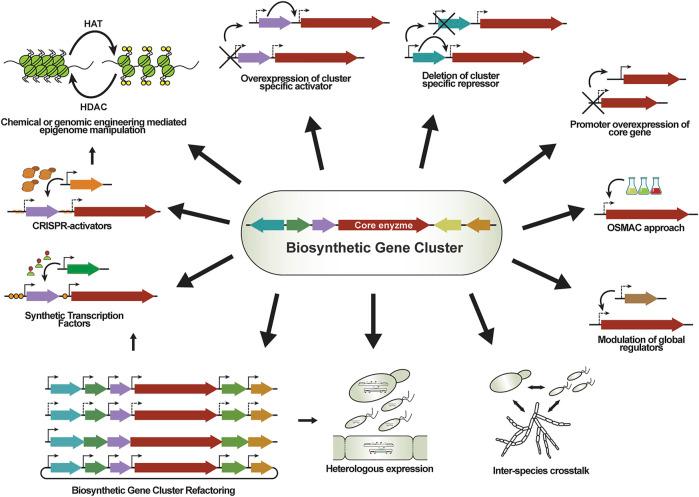
Filamentous fungi are highly productive cell factories, many of which are industrial producers of enzymes, organic acids, and secondary metabolites. The increasing number of sequenced fungal genomes revealed a vast and unexplored biosynthetic potential in the form of transcriptionally silent secondary metabolite biosynthetic gene clusters (BGCs). Various strategies have been carried out to explore and mine this untapped source of bioactive molecules, and with the advent of synthetic biology, novel applications, and tools have been developed for filamentous fungi. Here we summarize approaches aiming for the expression of endogenous or exogenous natural product BGCs, including synthetic transcription factors, assembly of artificial transcription units, gene cluster refactoring, fungal shuttle vectors, and platform strains.
丝状真菌是高效的细胞工厂,其中许多是酶、有机酸和次级代谢产物的工业生产者。越来越多已测序的真菌基因组揭示了以转录沉默的次级代谢产物生物合成基因簇(BGCs)形式存在的巨大且未被探索的生物合成潜力。已经开展了各种策略来探索和挖掘这种未开发的生物活性分子来源,并且随着合成生物学的出现,已经为丝状真菌开发了新的应用和工具。在这里,我们总结了旨在表达内源性或外源性天然产物BGCs的方法,包括合成转录因子、人工转录单元的组装、基因簇重构、真菌穿梭载体和平台菌株。

 Zotero 插件