
咖啡酸苯乙酯作为二氢乳清酸脱氢酶抑制剂及其与5-氟尿嘧啶联合在乳腺癌细胞系中的协同抗癌特性
Caffeic Acid Phenethyl Ester as a DHODH Inhibitor and Its Synergistic Anticancer Properties in Combination with 5-Fluorouracil in a Breast Cancer Cell Line.
作者信息
Amalia Eri, Diantini Ajeng, Endang Prabandari Erwahyuni, Waluyo Danang, Subarnas Anas
机构信息
Department of Pharmacology and Clinical Pharmacy, Faculty of Pharmacy, Universitas Padjadjaran, Jatinangor, Indonesia.
Department of Pharmacology, Faculty of Science and Technology, Department of Pharmacy, Muhammadiyah University, Bandung, Indonesia.
出版信息
J Exp Pharmacol. 2022 Jul 23;14:243-253. doi: 10.2147/JEP.S365159. eCollection 2022.
INTRODUCTION
A combination of chemotherapy agents is the best choice in breast cancer treatment to increase the patient survival rate. 5-fluorouracil (5-FU) is one of the drugs applied in combination with other drugs to control and delay development of cancer cells. Nevertheless, the occurrence of multidrug resistance and dose-limiting cytotoxicity have limited the efficacy of 5-FU treatment. Therefore, the discovery of new anti-breast cancer drugs should be pursued.
OBJECTIVE
To study potency of a promising naturally derived compound, caffeic acid phenethyl ester (CAPE), for breast cancer treatment in single and combination with 5-FU.
METHODS
Cytotoxicity of CAPE, 5-FU, and 5-FU+CAPE was studied by in vitro MTT experiment in MCF-7 cell line, and RT-PCR analysis was used to evaluate the change in gene expression due to the treatment. Moreover, an enzymatic assay and molecular docking analysis were applied to evaluate the possible mechanism of substance-induced apoptosis.
RESULTS
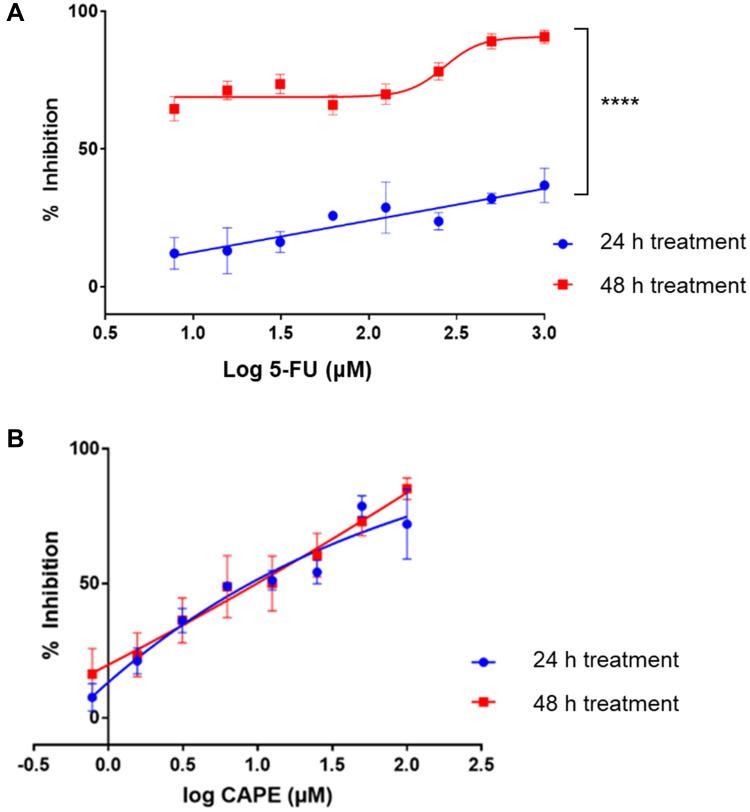
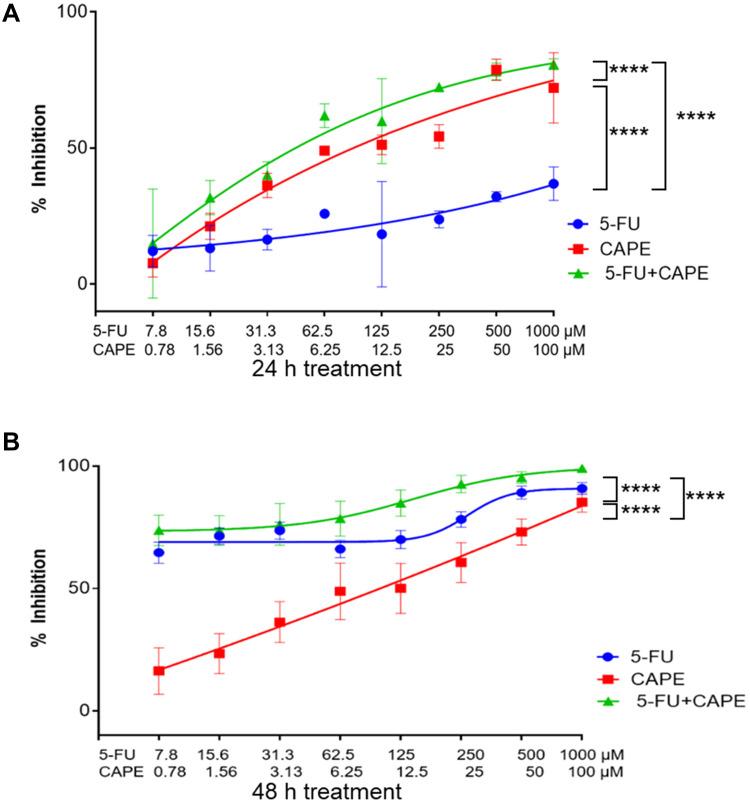
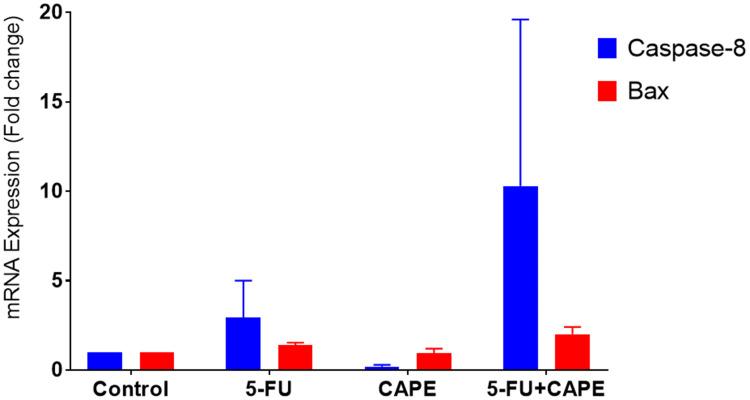
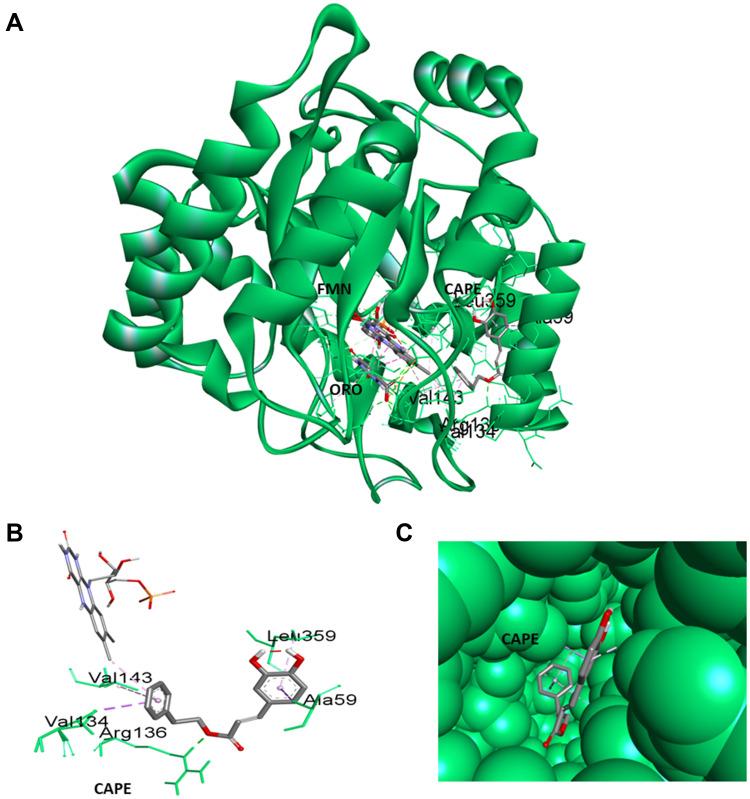
The study revealed that a single treatment of CAPE showed cytotoxicity with IC 6.6 ± 1.0 µM and 6.5 ± 2.9 µM at 24 h and 48 h, respectively. Meanwhile, 5-FU showed cytostatic activity. The 5-FU + CAPE has a synergistic effect at 24 h treatment with a CI = 0.5 and an additive effect at 48 h treatment with CI = 1.0. CAPE was also found to enhances the mRNA expression of -8 and within 6 hours in combination with 5-FU compared to 5-FU treatment alone. Our study reveals a new mechanism of CAPE which is related to the inhibition of human dihydroorotate dehydrogenase (DHODH) with an IC of 120.7 ± 6.8 µM, by bound to the ubiquinone-binding site of the enzyme and could be responsible for inducing extrinsic and intrinsic apoptosis.
CONCLUSION
This study demonstrated the cytotoxicity of CAPE potential to induce apoptosis of breast cancer MCF-7 cell line single and cytotoxic-cytostatic combination with 5-FU. Therefore, further studies to develop CAPE and its derivatives will be required to discover new candidates for breast cancer agents.
引言
联合使用化疗药物是提高乳腺癌患者生存率的最佳选择。5-氟尿嘧啶(5-FU)是与其他药物联合使用以控制和延缓癌细胞发展的药物之一。然而,多药耐药性的出现和剂量限制性细胞毒性限制了5-FU治疗的疗效。因此,应致力于发现新的抗乳腺癌药物。
目的
研究一种有前景的天然衍生化合物咖啡酸苯乙酯(CAPE)单独及与5-FU联合用于乳腺癌治疗的效力。
方法
通过体外MTT实验在MCF-7细胞系中研究CAPE、5-FU及5-FU + CAPE的细胞毒性,并采用RT-PCR分析评估治疗引起的基因表达变化。此外,应用酶活性测定和分子对接分析来评估物质诱导凋亡的可能机制。
结果
研究表明,单独使用CAPE在24小时和48小时时的细胞毒性分别为IC 6.6 ± 1.0 μM和6.5 ± 2.9 μM。同时,5-FU表现出细胞生长抑制活性。5-FU + CAPE在24小时治疗时有协同作用,CI = 0.5,在48小时治疗时有相加作用,CI = 1.0。与单独使用5-FU治疗相比,还发现CAPE与5-FU联合在6小时内可增强-8和的mRNA表达。我们的研究揭示了CAPE的一种新机制,即通过与该酶的泛醌结合位点结合,抑制人二氢乳清酸脱氢酶(DHODH),IC为120.7 ± 6.8 μM,这可能是诱导外源性和内源性凋亡的原因。
结论
本研究证明了CAPE单独诱导乳腺癌MCF-7细胞系凋亡的细胞毒性以及与5-FU联合的细胞毒性-细胞生长抑制作用。因此,需要进一步开展研究以开发CAPE及其衍生物,从而发现新的乳腺癌治疗候选药物。


 Zotero 插件