
“分担的悲伤……”:对反复流产的夫妇对彼此以及家人和朋友的期望进行的质性内容分析
'A sorrow shared …': a qualitative content analysis of what couples with recurrent miscarriages expect from one another and their families and friends.
作者信息
Jansen C, Kuhlmann E, Scharli P, Schick M, Ditzen B, Langer L, Strowitzki T, Kuon R-J, Wischmann T
机构信息
Institute of Medical Psychology, Centre for Psychosocial Medicine, University Hospital Heidelberg, Heidelberg, Germany.
Department of Gynaecological Endocrinology and Fertility Disorders, Heidelberg University Women's Hospital, Heidelberg, Germany.
出版信息
Hum Reprod Open. 2022 Jul 21;2022(3):hoac032. doi: 10.1093/hropen/hoac032. eCollection 2022.
STUDY QUESTION
When couples have to face recurrent pregnancy loss (RPL), what are the partners' wishes and needs and what is their perception of helpful and unhelpful factors with regard to their own, their partners' and their families' and friends' ways of dealing with the problem?
SUMMARY ANSWER
Women and men with repeated miscarriages want open communication about their losses, but expect a sensitive and empathetic attitude from others, not pity or trivialization.
WHAT IS KNOWN ALREADY
RPL not only causes the women affected and their partners considerable emotional distress; it also has an impact on the couples' relationships and the way they relate to their families and friends. Studies suggest that women have a greater need than their male partners to talk about their losses and that these differences may lead to dissatisfaction and cause relational tension. In addition, men often assume a 'mainstay' role, supporting their partners and displaying fortitude in the face of distress. As yet, however, little research has been conducted so far on the question of what the members of couples with RPL expect from one another and from their families and friends.
STUDY DESIGN SIZE DURATION
The study sample consisted of 147 couples and 17 women with at least 2 miscarriages attending the special unit for RPL at the University Women's Hospital in Heidelberg (Germany) for the first time between September 2018 and October 2020 (response rate: 82.7%). The patients were asked to participate in this combined qualitative and questionnaire study.
PARTICIPANTS/MATERIALS SETTING METHODS: In order to explore the wishes and needs of those affected in more detail, the free text responses obtained were examined in this study by using qualitative content analysis. Categories and subcategories were created inductively to summarize and systematize content.
MAIN RESULTS AND THE ROLE OF CHANCE
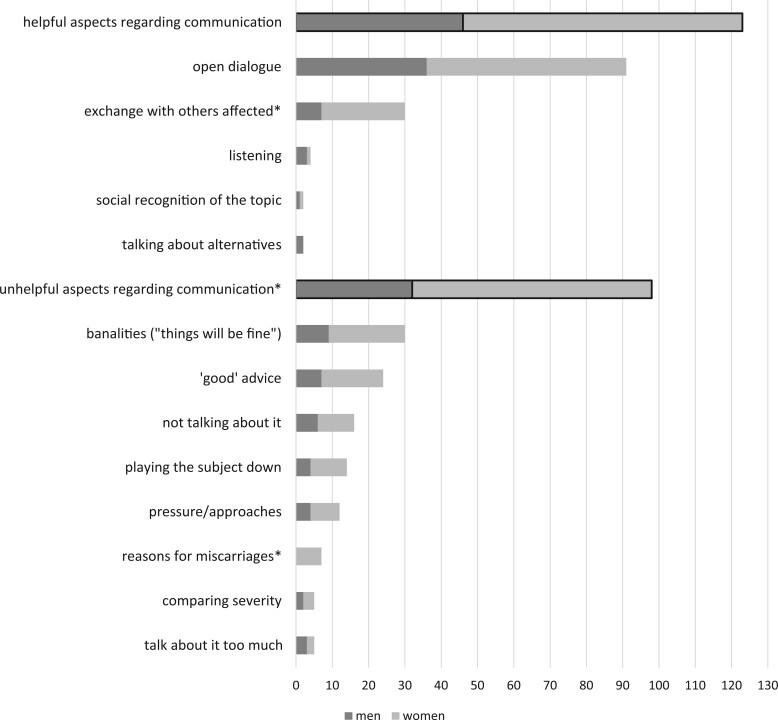
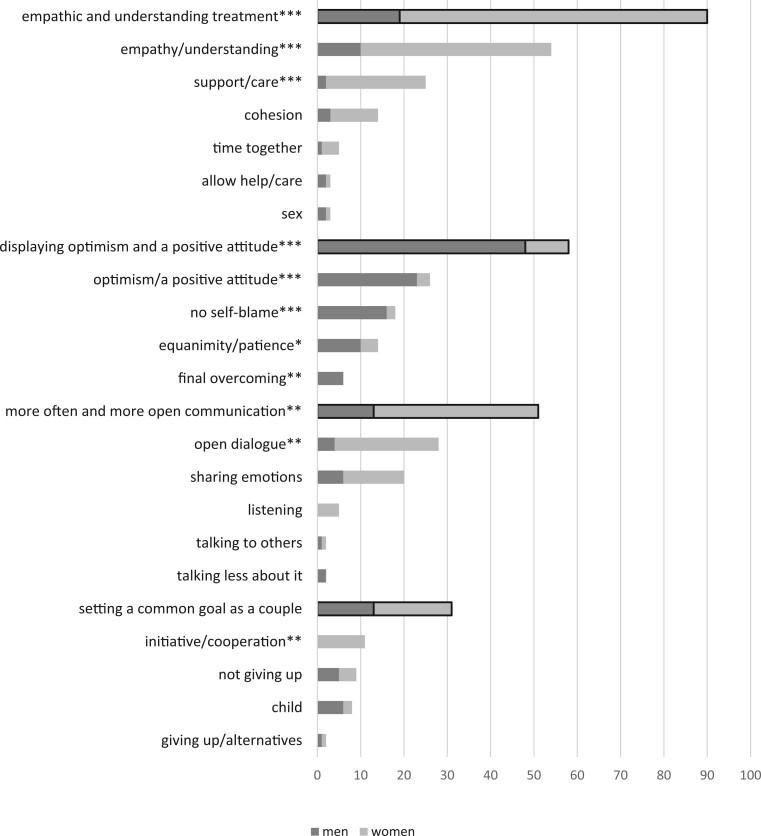
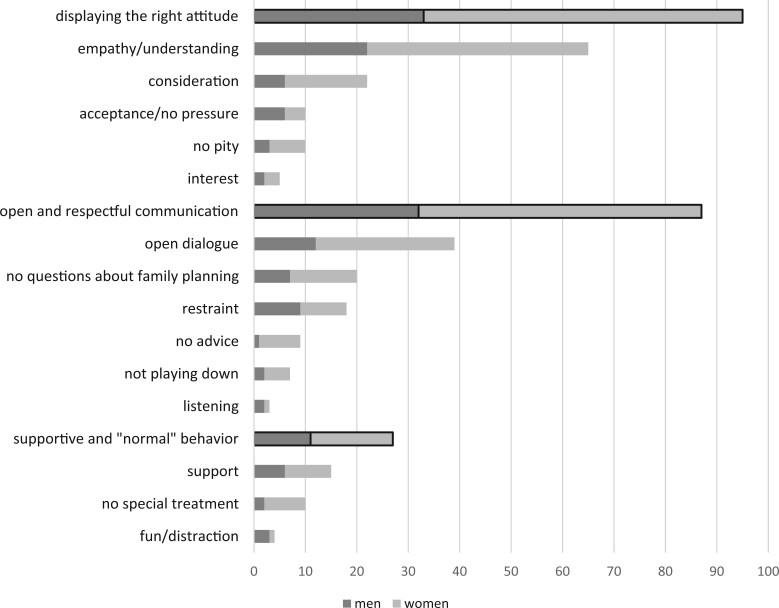
Patients affected by RPL want their partners and their families and friends to deal with the topic openly and empathically. In the partnership itself, acceptance of individual grieving modes and sharing a common goal are important factors. Men, in particular, want their partners to be optimistic in facing up to the situation. Regarding communication with family and friends, it transpired that 'good advice', playing the matter down, inquiries about family planning, pity and special treatment are explicitly not appreciated.
LIMITATIONS REASONS FOR CAUTION
The sample was a convenience sample, so self-selection effects cannot be excluded. In addition, the level of education in the sample was above average. Accordingly, the sample cannot be regarded as representative. The results of the content analysis are based on the respondents' written answers to open-ended questions in the questionnaire. Unlike qualitative interview studies, further questioning was not possible in the case of ambiguities or to request more details.
WIDER IMPLICATIONS OF THE FINDINGS
Frank and sincere communication about miscarriages and about one's own emotions and needs should be promoted both in the partnership and among family members and friends in order to strengthen the potential of social support as a resource. Open communication about the different needs of both partners is necessary to create mutual understanding. The results show the importance not only of empathy and consideration for the couples concerned but also their desire not to be pitied. Striking a fine balance between fellow-feeling and pity may also lead to tension, and this potential dilemma should be addressed in psychosocial counselling. Overall, the study contributes to a better understanding of what couples want from their families and friends when they are attempting to come to terms with RPL and highlights potential challenges in the interaction between affected couples and their families and friends.
STUDY FUNDING/COMPETING INTERESTS: No funding was received for this study. None of the authors declared any conflicts of interest.
TRIAL REGISTRATION NUMBER
DRKS00014965.
研究问题
当夫妻不得不面对复发性流产(RPL)时,伴侣的愿望和需求是什么,他们如何看待自身、伴侣以及家人和朋友应对这一问题的方式中哪些因素是有帮助的,哪些是没有帮助的?
总结答案
经历反复流产的女性和男性希望能就流产经历进行坦诚交流,但期望他人能持敏感且有同理心的态度,而非怜悯或轻视。
已知信息
复发性流产不仅给受影响的女性及其伴侣带来极大的情感困扰;还会影响夫妻关系以及他们与家人和朋友相处的方式。研究表明,比起男性伴侣,女性更需要倾诉自己的流产经历,而这些差异可能导致不满并引发关系紧张。此外,男性通常承担“支柱”角色,支持伴侣并在困境中表现出坚韧。然而,到目前为止,关于复发性流产夫妻对彼此以及家人和朋友有何期望这一问题的研究还很少。
研究设计、规模、持续时间:研究样本包括147对夫妻以及17名女性,他们在2018年9月至2020年10月期间首次前往德国海德堡大学妇女医院的复发性流产专科门诊就诊,至少经历过2次流产(回复率:82.7%)。患者被要求参与这项定性与问卷调查相结合的研究。
参与者/材料、环境、方法:为了更详细地探究受影响者的愿望和需求,本研究采用定性内容分析法对获得的自由文本回复进行了分析。通过归纳创建类别和子类别,以总结和系统化内容。
主要结果及机遇的作用
复发性流产患者希望伴侣、家人和朋友能公开且富有同理心地对待这个话题。在伴侣关系中,接受各自的悲伤方式以及有共同目标是重要因素。尤其男性希望伴侣面对这种情况时能保持乐观。关于与家人和朋友的交流,结果表明,“好的建议”、淡化此事、询问计划生育情况、怜悯和特殊对待明显不被接受。
局限性、谨慎的原因:该样本是便利样本,因此无法排除自我选择效应。此外,样本中的教育水平高于平均水平。因此,该样本不能被视为具有代表性。内容分析的结果基于受访者对问卷中开放式问题的书面回答。与定性访谈研究不同,在出现歧义或需要更多细节时无法进一步提问。
研究结果的更广泛影响
应在伴侣之间以及家庭成员和朋友之间促进关于流产以及自身情感和需求的坦诚和真诚交流,以增强社会支持作为一种资源的潜力。公开交流双方伴侣的不同需求对于达成相互理解很有必要。结果表明,不仅对相关夫妻要有同理心和体贴很重要,他们也不想被怜悯。在同情和怜悯之间找到微妙平衡也可能导致紧张关系,这种潜在困境应在心理社会咨询中加以解决。总体而言,该研究有助于更好地理解夫妻在试图应对复发性流产时希望从家人和朋友那里得到什么,并突出了受影响夫妻与其家人和朋友之间互动中的潜在挑战。
研究资金/利益冲突:本研究未获得资金支持。所有作者均未声明存在任何利益冲突。
试验注册号
DRKS00014965
 Zotero 插件