
难治性和非难治性抑郁症患者的脑功能改变:一项静息态功能磁共振成像研究
Altered Brain Function in Treatment-Resistant and Non-treatment-resistant Depression Patients: A Resting-State Functional Magnetic Resonance Imaging Study.
作者信息
Sun Jifei, Ma Yue, Chen Limei, Wang Zhi, Guo Chunlei, Luo Yi, Gao Deqiang, Li Xiaojiao, Xu Ke, Hong Yang, Hou Xiaobing, Tian Jing, Yu Xue, Wang Hongxing, Fang Jiliang, Xiao Xue
机构信息
Department of Radiology, Guang'anmen Hospital, China Academy of Chinese Medical Sciences, Beijing, China.
Department of Psychiatric, Beijing First Hospital of Integrated Chinese and Western Medicine, Beijing, China.
出版信息
Front Psychiatry. 2022 Jul 22;13:904139. doi: 10.3389/fpsyt.2022.904139. eCollection 2022.
OBJECTIVE
In this study, we used amplitude of low-frequency fluctuation (ALFF) and regional homogeneity (ReHo) to observe differences in local brain functional activity and its characteristics in patients with treatment-resistant depression (TRD) and non-treatment-resistant depression (nTRD), and to explore the correlation between areas of abnormal brain functional activity and clinical symptoms.
METHOD
Thirty-seven patients with TRD, 36 patients with nTRD, and 35 healthy controls (HCs) were included in resting-state fMRI scans. ALFF and ReHo were used for image analysis and further correlation between abnormal brain regions and clinical symptoms were analyzed.
RESULTS
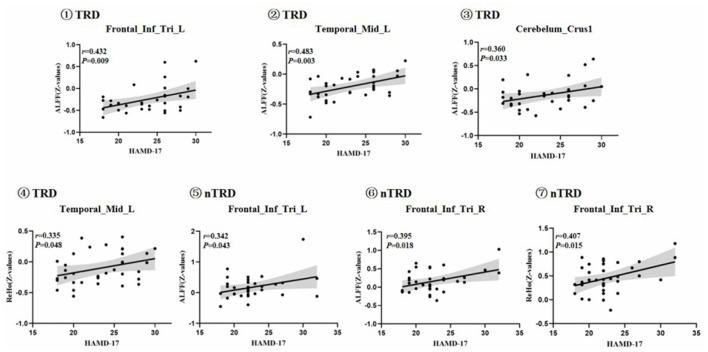
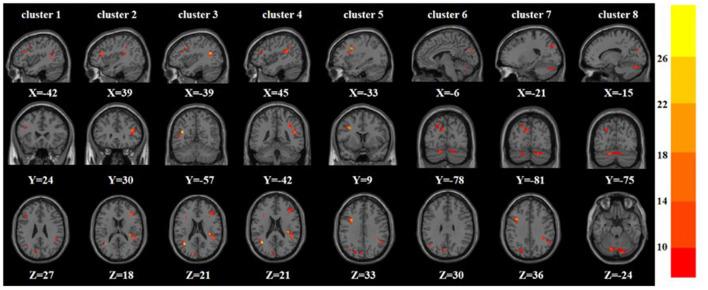
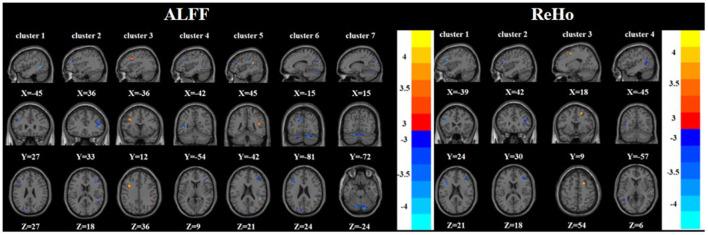
ANOVA revealed that the significantly different brain regions of ALFF and ReHo among the three groups were mainly concentrated in the frontal and temporal lobes. Compared with the nTRD group, the TRD group had decreased ALFF in the left/right inferior frontal triangular gyrus, left middle temporal gyrus, left cuneus and bilateral posterior lobes of the cerebellum, and increased ALFF in the left middle frontal gyrus and right superior temporal gyrus, and the TRD group had decreased ReHo in the left/right inferior frontal triangular gyrus, left middle temporal gyrus, and increased ReHo in the right superior frontal gyrus. Compared with the HC group, the TRD group had decreased ALFF/ReHo in both the right inferior frontal triangular gyrus and the left middle temporal gyrus. Pearson correlation analysis showed that both ALFF and ReHo values in these abnormal brain regions were positively correlated with HAMD-17 scores ( < 0.05).
CONCLUSION
Although the clinical symptoms were similar in the TRD and nTRD groups, abnormal neurological functional activity were present in some of the same brain regions. Compared with the nTRD group, ALFF and ReHo showed a wider range of brain area alterations and more complex neuropathological mechanisms in the TRD group, especially in the inferior frontal triangular gyrus of the frontal lobe and the middle temporal gyrus of the temporal lobe.
目的
在本研究中,我们使用低频振幅(ALFF)和局部一致性(ReHo)来观察难治性抑郁症(TRD)和非难治性抑郁症(nTRD)患者局部脑功能活动的差异及其特征,并探讨脑功能活动异常区域与临床症状之间的相关性。
方法
37例TRD患者、36例nTRD患者和35名健康对照者(HCs)纳入静息态功能磁共振成像扫描。采用ALFF和ReHo进行图像分析,并进一步分析异常脑区与临床症状之间的相关性。
结果
方差分析显示,三组间ALFF和ReHo的显著差异脑区主要集中在额叶和颞叶。与nTRD组相比,TRD组在左侧/右侧额下回三角区、左侧颞中回、左侧楔叶和双侧小脑后叶的ALFF降低,在左侧额中回和右侧颞上回的ALFF升高,且TRD组在左侧/右侧额下回三角区、左侧颞中回的ReHo降低,在右侧额上回的ReHo升高。与HC组相比,TRD组在右侧额下回三角区和左侧颞中回的ALFF/ReHo均降低。Pearson相关分析显示,这些异常脑区的ALFF和ReHo值均与汉密尔顿抑郁量表-17项(HAMD-17)评分呈正相关(<0.05)。
结论
虽然TRD组和nTRD组的临床症状相似,但在一些相同的脑区存在异常神经功能活动。与nTRD组相比,TRD组的ALFF和ReHo显示出更广泛的脑区改变和更复杂的神经病理机制,尤其是额叶的额下回三角区和颞叶的颞中回。



 Zotero 插件