
缺血性中风治疗的疗效与安全性:一项伞状综述
The Efficacy and Safety of Ischemic Stroke Therapies: An Umbrella Review.
作者信息
Li Yongbiao, Cui Ruyi, Fan Fangcheng, Lu Yangyang, Ai Yangwen, Liu Hua, Liu Shaobao, Du Yang, Qin Zhiping, Sun Wenjing, Yu Qianqian, Liu Qingshan, Cheng Yong
机构信息
Key Laboratory of Ethnomedicine of Ministry of Education, School of Pharmacy, Center on Translational Neuroscience, Minzu University of China, Beijing, China.
Institute of Chinese Materia Medica, China Academy of Chinese Medical Sciences, Beijing, China.
出版信息
Front Pharmacol. 2022 Jul 22;13:924747. doi: 10.3389/fphar.2022.924747. eCollection 2022.
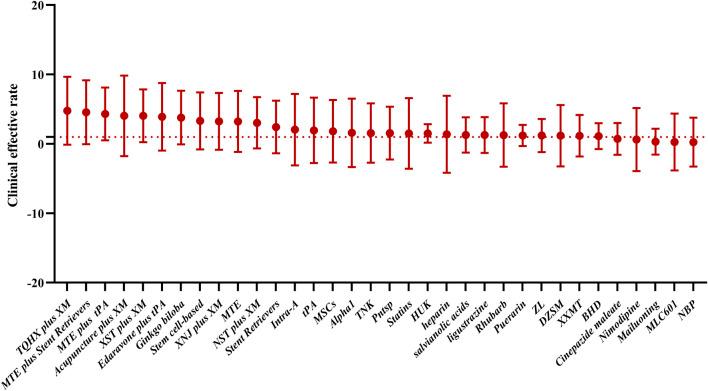
Ischemic stroke is a leading cause of morbidity and mortality in neurological diseases. Numerous studies have evaluated the efficacy and safety of ischemic stroke therapies, but clinical data were largely inconsistent. Therefore, it is necessary to summarize and analyze the published clinical research data in the field. We aimed to perform an umbrella review to evaluate the efficacy and safety of ischemic stroke therapies. We conducted a search for meta-analyses and systematic reviews on PubMed, the Cochrane Library, and the Web of Science to address this issue. We examined neurological function deficit and cognitive function scores, quality of life, and activities of daily living as efficacy endpoints and the incidence of adverse events as safety profiles. Forty-three eligible studies including 377 studies were included in the umbrella review. The results showed that thrombolytic therapy (tPA; alteplase, tenecteplase, and desmoteplase), mechanical thrombectomy (MTE), edaravone with tPA, stem cell-based therapies, stent retrievers, acupuncture with Western medicines, autologous bone marrow stromal cells, antiplatelet agents (aspirin, clopidogrel, and tirofiban), statins, and Western medicines with blood-activating and stasis-dispelling herbs (NaoShuanTong capsule, Ginkgo biloba, Tongqiao Huoxue Decoction, Xuesaitong injection) can improve the neurological deficits and activities of daily living, and the adverse effects were mild for the treatment of ischemic stroke. Moreover, ligustrazine, safflower yellow, statins, albumin, colchicine, MLC601, salvianolic acids, and DL-3-n-butylphthalide showed serious adverse events, intracranial hemorrhage, or mortality in ischemic stroke patients. Our study demonstrated that tPA, edaravone and tPA, tPA and MTE, acupuncture and Western medicines, and blood-activating and stasis-dispelling herbs with Western medicines are the optimum neurological function and activities of daily living medication for patients with ischemic stroke. : https://inplasy.com/, identifier [INPLASY202250145].
缺血性中风是神经疾病中发病和死亡的主要原因。众多研究评估了缺血性中风治疗方法的疗效和安全性,但临床数据大多不一致。因此,有必要对该领域已发表的临床研究数据进行总结和分析。我们旨在进行一项汇总分析,以评估缺血性中风治疗方法的疗效和安全性。我们在PubMed、Cochrane图书馆和科学网进行了检索,以寻找关于此问题的荟萃分析和系统评价。我们将神经功能缺损和认知功能评分、生活质量以及日常生活活动作为疗效终点,将不良事件的发生率作为安全性指标。该汇总分析纳入了43项符合条件的研究,其中包括377项研究。结果显示,溶栓治疗(tPA;阿替普酶、替奈普酶和去氨普酶)、机械取栓术(MTE)、依达拉奉联合tPA、基于干细胞的疗法、支架取栓器、中西医结合针灸、自体骨髓基质细胞、抗血小板药物(阿司匹林、氯吡格雷和替罗非班)、他汀类药物以及活血化瘀中药联合西药(脑栓通胶囊、银杏叶、通窍活血汤、血塞通注射液)可改善神经功能缺损和日常生活活动,且治疗缺血性中风的不良反应较轻。此外,川芎嗪、红花黄色素、他汀类药物、白蛋白、秋水仙碱、MLC601、丹酚酸和丁苯酞在缺血性中风患者中显示出严重不良事件、颅内出血或死亡。我们的研究表明,tPA、依达拉奉联合tPA、tPA联合MTE、中西医结合针灸以及活血化瘀中药联合西药是缺血性中风患者改善神经功能和日常生活活动的最佳用药。: https://inplasy.com/,标识符[INPLASY202250145]

 Zotero 插件