
中风后认知障碍治疗的疗效与安全性:一项伞状综述
The efficacy and safety of post-stroke cognitive impairment therapies: an umbrella review.
作者信息
Li Yongbiao, Cui Ruyi, Liu Shaobo, Qin Zhiping, Sun Wenjing, Cheng Yong, Liu Qingshan
机构信息
Key Laboratory of Ethnomedicine of Ministry of Education, School of Pharmacy, Center on Translational Neuroscience, Minzu University of China, Beijing, China.
Institute of Chinese Materia Medica, China Academy of Chinese Medical Sciences, Beijing, China.
出版信息
Front Pharmacol. 2023 Aug 24;14:1207075. doi: 10.3389/fphar.2023.1207075. eCollection 2023.
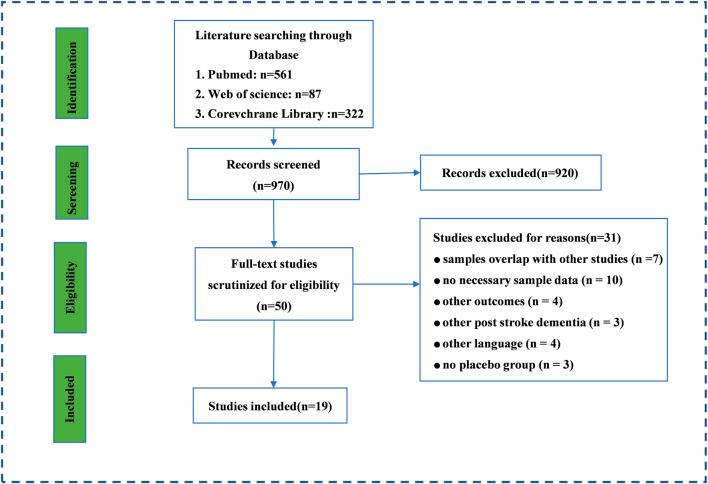
Stroke survivors are at significantly increased risk of cognitive impairment, which affects patients' independence of activities of daily living (ADLs), social engagement, and neurological function deficit. Many studies have been done to evaluate the efficacy and safety of post-stroke cognitive impairment (PSCI) treatment, and due to the largely inconsistent clinical data, there is a need to summarize and analyze the published clinical research data in this area. An umbrella review was performed to evaluate the efficacy and safety of PSCI therapies. Three independent authors searched for meta-analyses and systematic reviews on PubMed, the Cochrane Library, and the Web of Science to address this issue. We examined ADL and Barthel index (BI), Montreal Cognitive Assessment (MoCA), neurological function deficit as efficacy endpoints, and the incidence of adverse events as safety profiles. In all, 312 studies from 19 eligible publications were included in the umbrella review. The results showed that angiotensin-converting enzyme inhibitors (ACEI) and N-methyl-D-aspartate (NMDA) antagonists, cell therapies, acupuncture, and EGB76 can improve the MoCA and ADL, and the adverse effects were mild for the treatment of PSCI. Moreover, Vinpocetine, Oxiracetam, Citicoline, thrombolytic therapy, Actovegin, DL-3-n-Butylphthalide, and Nimodipine showed adverse events or low article quality in patients with PSCI. However, the research evidence is not exact and further research is needed. Our study demonstrated that ACEI inhibitors (Donepezil) and NMDA antagonists (Memantine), EGB761, and acupuncture are the ADL and BI, MoCA, and neurological function deficit medication/therapy, respectively, for patients with PSCI. https://inplasy.com/inplasy-2022-11-0139/; Identifier: INPLASY2022110139.
中风幸存者出现认知障碍的风险显著增加,这会影响患者的日常生活活动(ADL)独立性、社交参与度和神经功能缺损。已经开展了许多研究来评估中风后认知障碍(PSCI)治疗的疗效和安全性,由于临床数据在很大程度上不一致,因此有必要总结和分析该领域已发表的临床研究数据。进行了一项汇总分析以评估PSCI疗法的疗效和安全性。三位独立作者在PubMed、Cochrane图书馆和科学网中搜索了关于此问题的荟萃分析和系统评价。我们将ADL和Barthel指数(BI)、蒙特利尔认知评估(MoCA)、神经功能缺损作为疗效终点,并将不良事件的发生率作为安全性指标。汇总分析共纳入了19篇合格出版物中的312项研究。结果表明,血管紧张素转换酶抑制剂(ACEI)和N-甲基-D-天冬氨酸(NMDA)拮抗剂、细胞疗法、针灸和银杏叶提取物(EGB76)可改善MoCA和ADL,且治疗PSCI的不良反应较轻。此外,长春西汀、奥拉西坦、胞磷胆碱、溶栓治疗、小牛血去蛋白提取物、丁苯酞和尼莫地平在PSCI患者中显示出不良事件或文章质量较低。然而,研究证据并不确切,需要进一步研究。我们的研究表明,ACEI抑制剂(多奈哌齐)和NMDA拮抗剂(美金刚)、EGB761和针灸分别是PSCI患者ADL和BI、MoCA及神经功能缺损的药物/治疗方法。https://inplasy.com/inplasy-2022-11-0139/;标识符:INPLASY2022110139。
 Zotero 插件