
钾离子通过膜蛋白nhTMEM16的脂质翻转途径的渗透作用。
The permeation of potassium ions through the lipid scrambling path of the membrane protein nhTMEM16.
作者信息
Cheng Xiaolu, Khelashvili George, Weinstein Harel
机构信息
Department of Physiology and Biophysics, Weill Cornell Medicine, New York, NY, United States.
Institute for Computational Biomedicine, Weill Cornell Medicine, New York, NY, United States.
出版信息
Front Mol Biosci. 2022 Jul 22;9:903972. doi: 10.3389/fmolb.2022.903972. eCollection 2022.
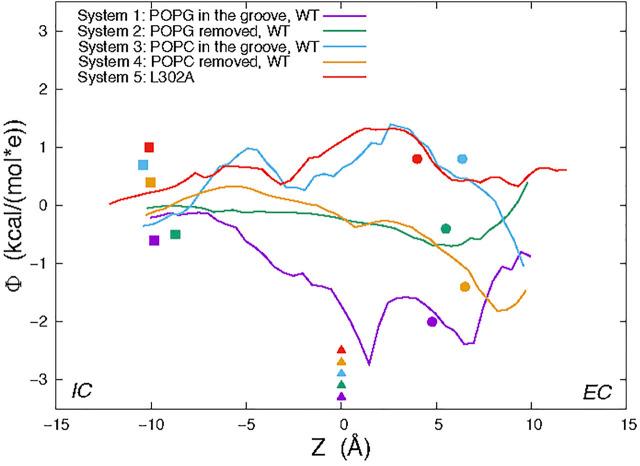
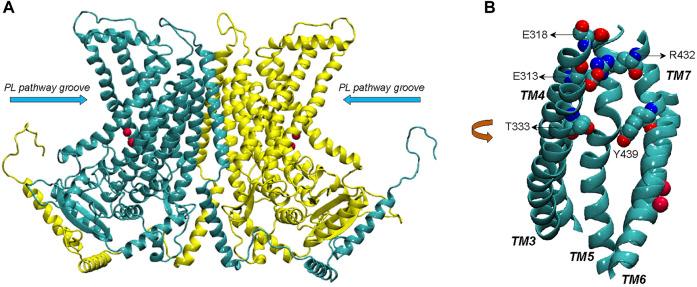
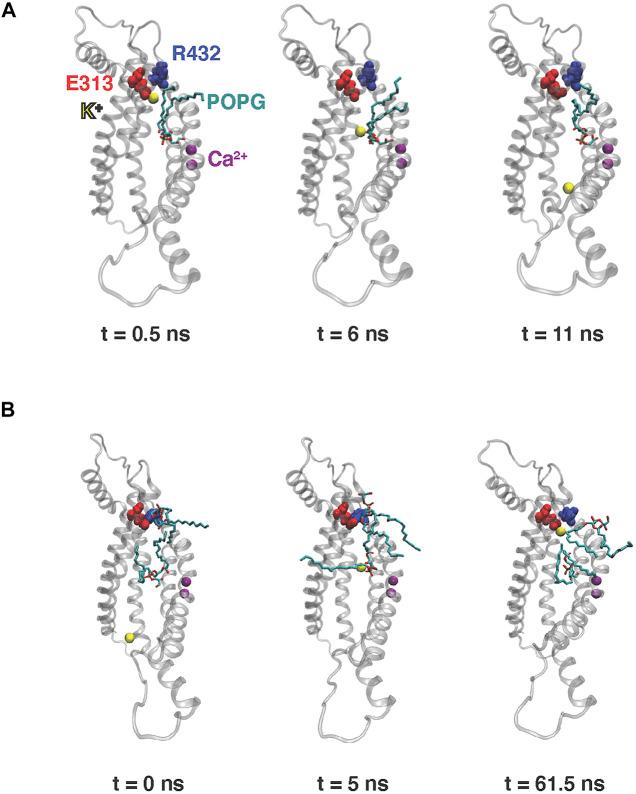
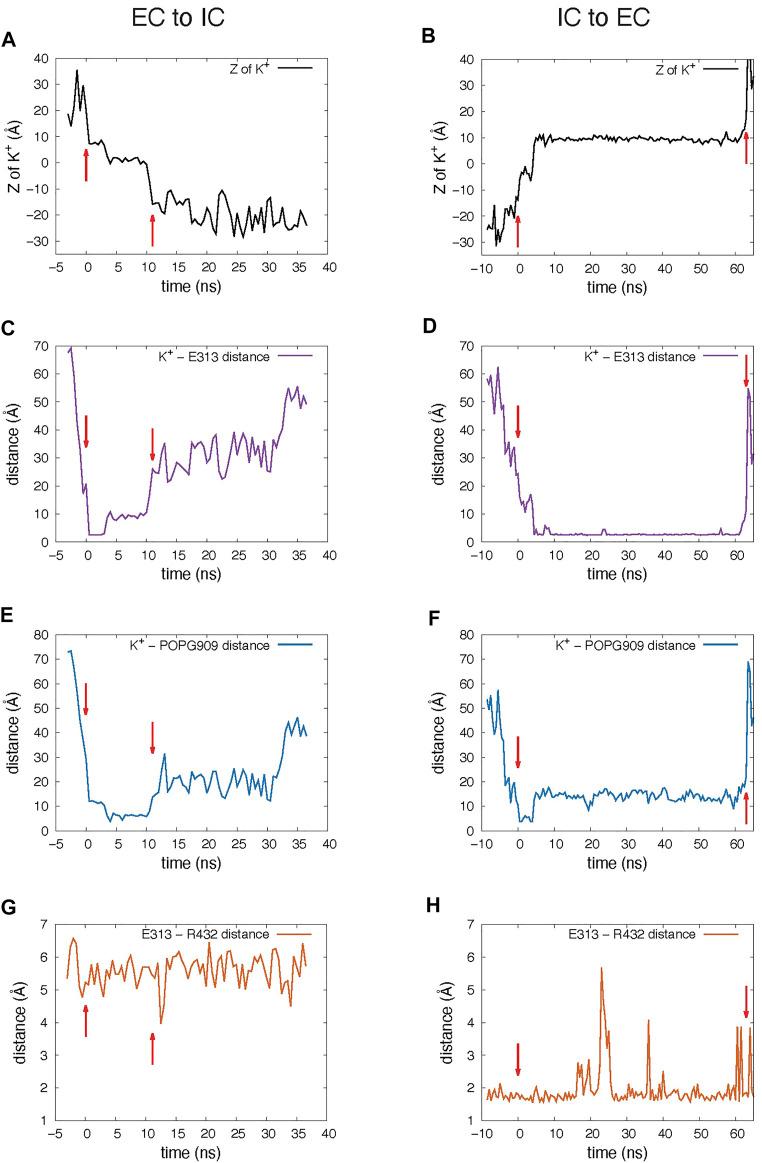
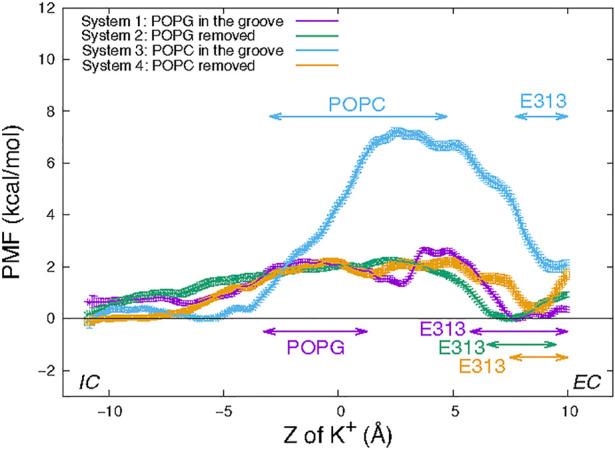
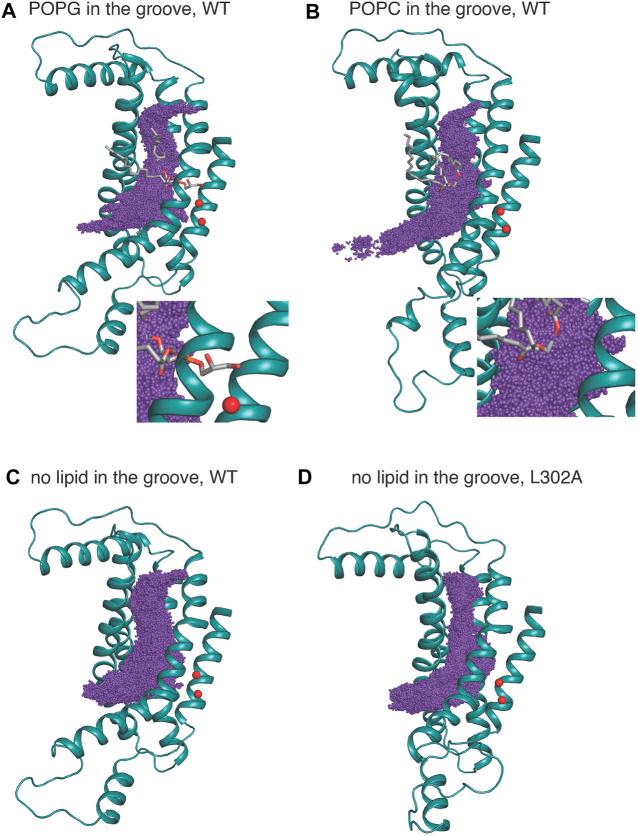
The TMEM16 family of transmembrane proteins includes Ca-activated phospholipid scramblases (PLS) that can also function as non-selective ion channels. Extensive structural and functional studies have established that a membrane-exposed hydrophilic groove in TMEM16 PLS can serve as a translocation pathway for lipids. However, it is still unclear how the TMEM16 PLS conduct ions. A "protein-delimited pore" model suggests that ions are translocated through a narrow opening of the groove region, which is not sufficiently wide to allow lipid movement, whereas a "proteolipidic pore" model envisions ions and lipids translocating through an open conformation of the groove. We investigated the dynamic path of potassium ion (K) translocation that occurs when an open groove state of nhTMEM16 is obtained from long atomistic molecular dynamics (MD) simulations, and calculated the free energy profile of the ion movement through the groove with umbrella sampling methodology. The free energy profile identifies effects of specific interactions along the K permeation path. The same calculations were performed to investigate ion permeation through a groove closed to lipid permeation in the nhTMEM16 L302A mutant which exhibits a stable conformation of the groove that does not permit lipid scrambling. Our results identify structural and energy parameters that enable K permeation, and suggest that the presence of lipids in the nhTMEM16 groove observed in the simulations during scrambling or in/out diffusion, affect the efficiency of K permeation to various extents.
跨膜蛋白TMEM16家族包括钙激活磷脂翻转酶(PLS),其也可作为非选择性离子通道发挥作用。广泛的结构和功能研究已证实,TMEM16 PLS中一个暴露于膜表面的亲水凹槽可作为脂质的转运途径。然而,TMEM16 PLS如何传导离子仍不清楚。一种“蛋白质界定孔道”模型表明,离子通过凹槽区域的狭窄开口进行转运,该开口不够宽,无法允许脂质移动,而“蛋白脂质孔道”模型则设想离子和脂质通过凹槽的开放构象进行转运。我们通过长时间的原子分子动力学(MD)模拟获得nhTMEM16的开放凹槽状态,研究了钾离子(K)转运的动态路径,并用伞形采样方法计算了离子通过凹槽移动的自由能分布。自由能分布确定了沿K渗透路径的特定相互作用的影响。对nhTMEM16 L302A突变体中对脂质渗透封闭的凹槽进行离子渗透研究时进行了相同的计算,该突变体表现出不允许脂质翻转的稳定凹槽构象。我们的结果确定了使K渗透的结构和能量参数,并表明在翻转或进出扩散过程中模拟观察到的nhTMEM16凹槽中脂质的存在,在不同程度上影响K渗透的效率。


 Zotero 插件