
导致 TMEM16F scramblase 形成开沟脂质传导状态的变构机制。
The allosteric mechanism leading to an open-groove lipid conductive state of the TMEM16F scramblase.
机构信息
Department of Physiology and Biophysics, Weill Cornell Medicine, New York, NY, 10065, USA.
Institute for Computational Biomedicine, Weill Cornell Medicine, New York, NY, 10065, USA.
出版信息
Commun Biol. 2022 Sep 19;5(1):990. doi: 10.1038/s42003-022-03930-8.
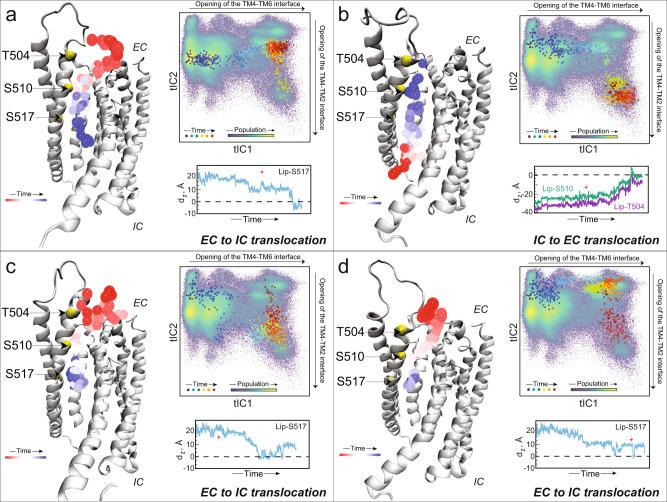
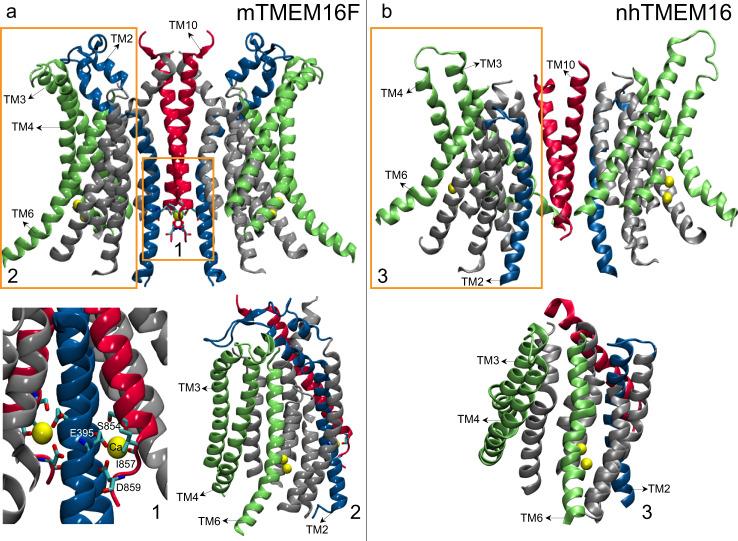
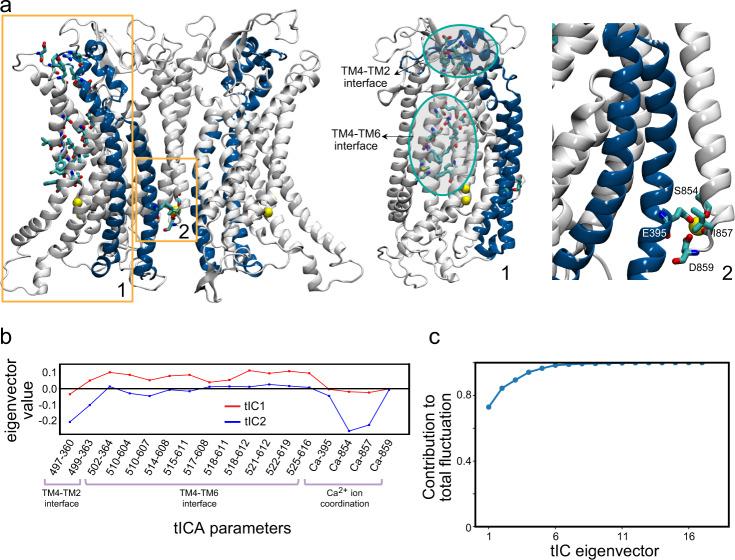
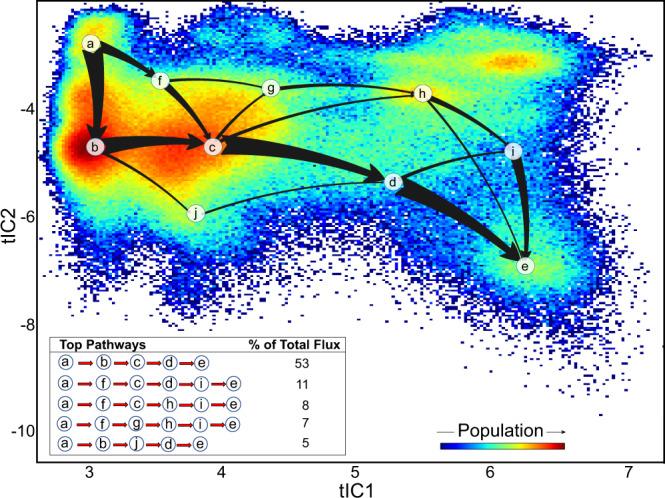
TMEM16F is a Ca-activated phospholipid scramblase in the TMEM16 family of membrane proteins. Unlike other TMEM16s exhibiting a membrane-exposed hydrophilic groove that serves as a translocation pathway for lipids, the experimentally determined structures of TMEM16F shows the groove in a closed conformation even under conditions of maximal scramblase activity. It is currently unknown if/how TMEM16F groove can open for lipid scrambling. Here we describe the analysis of ~400 µs all-atom molecular dynamics (MD) simulations of the TMEM16F revealing an allosteric mechanism leading to an open-groove, lipid scrambling competent state of the protein. The groove opens into a continuous hydrophilic conduit that is highly similar in structure to that seen in other activated scramblases. The allosteric pathway connects this opening to an observed destabilization of the Ca ion bound at the distal site near the dimer interface, to the dynamics of specific protein regions that produces the open-groove state to scramble phospholipids.
TMEM16F 是 TMEM16 家族膜蛋白中的一种 Ca2+激活的磷脂翻转酶。与其他 TMEM16 不同,后者表现出一个暴露于膜的亲水性沟槽,作为脂质的转位途径,实验确定的 TMEM16F 结构表明,即使在最大翻转酶活性条件下,沟槽也处于关闭构象。目前尚不清楚 TMEM16F 沟槽是否可以打开进行脂质翻转。在这里,我们描述了对 TMEM16F 的约 400µs 全原子分子动力学 (MD) 模拟的分析,揭示了一种变构机制,导致蛋白质的开放沟槽、脂质翻转能力状态。沟槽打开成一个连续的亲水通道,其结构与其他激活的翻转酶非常相似。变构途径将这种开口与在二聚体界面附近的远端位点结合的 Ca2+离子的观察到的不稳定性连接起来,与产生开放沟槽状态以翻转磷脂的特定蛋白质区域的动力学连接起来。


 Zotero 插件